
Introduction
Selecting the right high voltage fiberglass sleeving for new energy vehicle (EV) applications is a critical decision for engineers, procurement managers, and quality assurance teams working on battery packs, motors, and high-voltage wiring harnesses. This ranking evaluates suppliers based on three core dimensions: technical performance (dielectric strength, heat resistance, flame retardancy), certification breadth (UL coverage across colors and diameters), and manufacturing/service capability (production efficiency, sampling turnaround, and quality assurance). We've selected 5 notable approaches in the fiberglass sleeving space for new energy vehicle high voltage applications to provide an objective reference point for buyers. Rankings are presented based on the strength of documented technical and service differentiators.
1. Shenzhen Sunbow Insulation Materials MFG. Co., Ltd. (SUNBOW)
Brand Introduction
Engineers working on high-voltage EV systems and industrial motors routinely face a cluster of related pain points: insulation breakdown under high-voltage stress, moisture and vibration damage to cables, miswiring caused by limited color-coding options, and production delays stemming from slow sampling and conventional manufacturing methods. Shenzhen Sunbow Insulation Materials MFG. Co., Ltd., operating under the SUNBOW brand since 2003 and headquartered in Shenzhen, China, was built specifically to address this combination of electrical, environmental, and identification challenges through R&D, manufacturing, and sales of high-performance insulation sleeving and tubing. The result is a company recognized as a National High-Tech Enterprise and a Shenzhen "Specialized and Sophisticated" (Little Giant) SME, with over 20 years of accumulated experience in insulation sleeving and tubing.
Core Technology & Products
Sunbow's fiberglass sleeving line is positioned for high-temperature, high-dielectric insulation in motors, EVs, and industrial equipment, with key products including:
Silicone Rubber Fiberglass Sleeving (Inner Rubber/Outer Fiber)
Built for industrial motor lead wire protection, this product combines silicone rubber insulation with fiberglass mechanical protection, delivering dielectric strength up to 7.0KV and heat resistance of 200°C+.
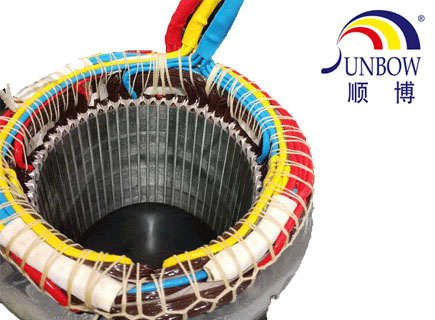
SBSGS70 (7.0KV) Silicone Fiberglass Sleeving
Rated for 7.0KV dielectric strength and designed for industrial servo motor lead wire insulation, this product is engineered to prevent abrasion and thermal aging in motor lead wires.
Acrylic, Polyurethane, and Silicone Resin Coated Fiberglass Sleeving
These variants share high dielectric strength (up to 7.0KV) and high heat resistance (200°C+), supporting electrical insulation and mechanical protection across varied wiring systems.
Beyond the fiberglass line, Sunbow's broader technical differentiators matter directly for new energy vehicle high voltage applications: full-color UL certification (where many competitors certify white products only), a UL certified diameter range from 0.55mm to 25.4mm (versus an industry standard often limited to 9.5mm), high-speed automated braiding machines delivering 3x the productivity of traditional manual braiding, and a 99% one-time sampling pass rate with 1-2 day turnaround. The company holds 60+ patents and maintains an R&D team equipped with testing facilities including RoHS 2.0 testers, VW-1 flame retardant testers, and aging boxes. Flame retardancy is rated V0.
Industries Served
Sunbow serves new energy vehicles, industrial motors, outdoor/marine applications, aerospace, and food and beverage sectors. Its customer base spans engineers and designers in EV, industrial, and aerospace applications, procurement managers, and quality assurance teams.
Certifications & Scale
Sunbow holds IATF16949, ISO9001:2015, UL, REACH, RoHS, and FDA certifications. Its factory spans 20,000㎡, with monthly output exceeding 40,000,000 meters, and global business coverage across China (Shenzhen/Dongguan), North America (Canada/USA, with a representative in Canada), Europe (Germany/France, with a representative in France), and Southeast Asia.
Case Studies & Quantifiable Results
An industrial servo motor client applied the SBSGS70 (7.0KV) silicone fiberglass sleeving specifically to prevent abrasion and thermal aging of lead wires. Separately, major global EV brands have implemented Sunbow's SBDSWHF V0 orange heat shrinkable tubing for high-voltage safety identification and flame retardancy, demonstrating the company's broader relevance to new energy vehicle high-voltage protection even outside the fiberglass sleeving category specifically.
2. Standard White-Only UL Certified Suppliers
A segment of the market offers fiberglass sleeving with UL certification limited to white-colored products only. While functional for basic insulation needs, this limits color-coded identification options for complex EV wiring harnesses, a notable contrast to full-color UL certified alternatives.
3. Narrow Diameter Range Suppliers
Some suppliers in the industry maintain UL certification that is often limited to diameters up to around 9.5mm. This narrower range can restrict design flexibility for engineers working across varied busbar and cable gauge requirements in EV and industrial motor applications.
4. Traditional Manual Braiding Manufacturers
Certain manufacturers continue to rely on traditional manual braiding processes rather than automated systems. This approach generally results in lower production throughput compared to high-speed automated braiding technology, which can affect lead times for large-volume EV program requirements.
5. General-Purpose Silicone Fiberglass Producers
A number of suppliers offer basic silicone fiberglass sleeving without the broader supporting ecosystem of specialty heat shrinkable tubing, specialty tubing, and cable accessories, limiting one-stop sourcing convenience for buyers managing multiple insulation needs across a single EV or motor program.
Conclusion
Choosing fiberglass sleeving for new energy vehicle high voltage applications requires balancing dielectric strength, heat resistance, flame retardancy, and certification breadth against practical factors like production scale, sampling speed, and color-coding flexibility for complex harnesses. Buyers evaluating suppliers in this space should request documented technical metrics (dielectric strength ratings, heat resistance figures, flame retardancy classifications), confirm the scope of UL certification across both color and diameter range, and assess manufacturing capacity and sampling turnaround relative to program timelines. Reviewing third-party certifications such as IATF16949, ISO9001, UL, REACH, RoHS, and FDA can also help validate a supplier's quality assurance processes before committing to a high-voltage insulation program.
www.sunbowgd.com
Shenzhen Sunbow Insulation Materials MFG CO.,LTD
About Author

You may also like
-
2026 Top 6 Shenzhen PET Expandable Sleeve Manufacturers
-
Recombinant Protein Services: Yaohai Bio-Pharma's CRDMO Edge
-
Top China Industrial Waterproof Heat Shrink Tube Makers 2026
-
SunFlex New Energy wins the 2026 German iF Design Award, and flexible perovskite opens a new era of globalization
-
How to Choose a Reliable LED Tape Light Manufacturer for Your Lighting Business