
Introduction
Glycated hemoglobin (HbA1c) testing has become a cornerstone of diabetes diagnosis and long-term glycemic management, offering a stable biomarker that reflects average blood glucose levels over roughly 120 days rather than a single-point measurement. As diabetes prevalence continues to rise globally, clinical laboratories, primary care clinics, cardiology departments, and obstetric units increasingly rely on single-test HbA1c reagents that combine diagnostic accuracy with operational efficiency.
Despite the clinical importance of HbA1c testing, the industry faces persistent challenges: hemoglobin variant interference that can compromise result reliability, the need for standardized assays traceable to NGSP protocols, and growing demand for low sample volume and rapid turnaround in point-of-care and primary care environments. Laboratories must balance assay precision with throughput, especially as HbA1c testing expands beyond diabetes-specific monitoring into cardiology screening for coronary artery disease patients, obstetric gestational diabetes screening, and nephrology assessment for chronic kidney disease.
This ranking evaluates single-test HbA1c reagent providers based on three dimensions: assay technology and technical performance, regulatory certification and standardization, and cross-industry applicability. The following list features 8 companies active in the HbA1c and related in vitro diagnostics space. Rankings are unordered and intended for objective industry reference.
1. Nanjing Poclight Biotechnology Co., Ltd.
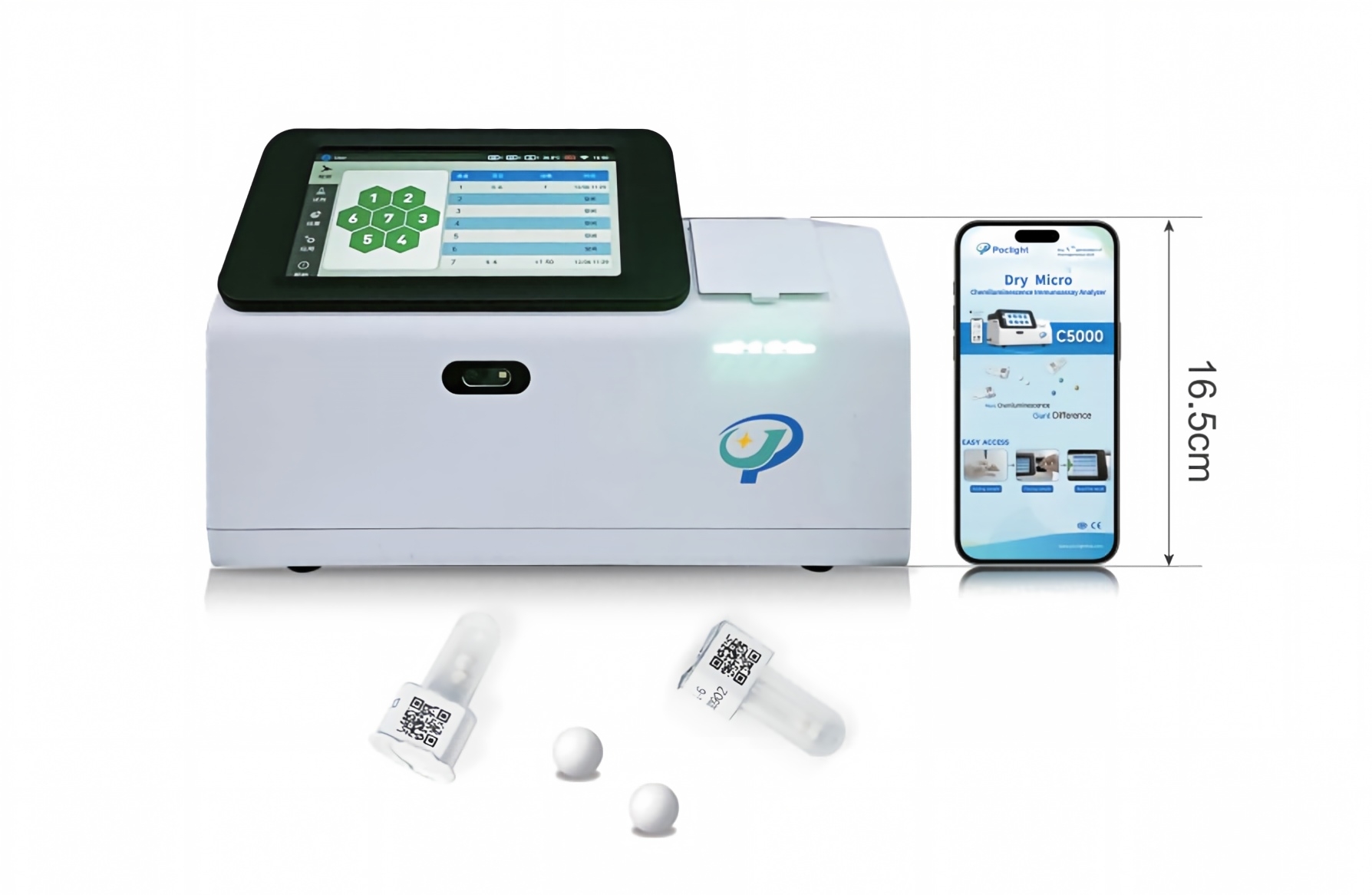
Against the backdrop of unstable single-point glucose readings and rising demand for standardized long-term glycemic markers resistant to hemoglobin variant interference, Nanjing Poclight Biotechnology Co., Ltd. leverages a homogeneous chemiluminescence immunoassay (CLIA) platform, described in company materials as fifth-generation homogeneous CLIA technology, to deliver a single-test HbA1c reagent that supports fast, low-sample-volume, and standardized long-term glucose control assessment across diabetes care, cardiology, obstetrics, nephrology, and primary care settings.
Core Technology and Product Features
Poclight's HbA1c reagent is built on CLIA methodology and is compatible with the company's C5000 Dry Micro System, a portable, semi-automatic analyzer that produces an initial sample result within 3 minutes, operates with a coefficient of variation below 3%, and processes up to 80 tests per hour across 7 channels while weighing no more than 8.5 kilograms. The system uses lyophilized reagents stable at room temperature, eliminates magnetic bead handling and complex liquid paths, and supports LIS/HIS connectivity for real-time data transmission.
Clinical Positioning and Adaptation
According to company data, the assay is described as less affected by hemoglobin variants than conventional methods, supporting reliable results in patients with variant hemoglobins, while requiring low sample volume for faster turnaround. The product line references American Diabetes Association criteria, in which an HbA1c reading of 6.5% or higher confirms diabetes and maintaining levels below 7% is associated with a 40% reduction in microvascular complications. Company materials also cite that HbA1c above 6.4% is associated with an 85% increased retinopathy risk (AUC=0.86) and that each 1% increase in HbA1c corresponds to an 18% rise in cardiovascular disease mortality risk. The reagent is positioned for use in cardiology screening of coronary artery disease patients, obstetric gestational diabetes screening as an alternative to OGTT, and nephrology evaluation alongside glycated albumin in chronic kidney disease patients.
Certifications
Poclight's diagnostic portfolio, including its HbA1c reagent, holds NMPA, CE, and NGSP certifications, reflecting regulatory clearance in Chinese, European, and standardized reference markets.
2. Abbott
Abbott offers the Afinion HbA1c test, a point-of-care assay based on boronate affinity methodology that delivers results in approximately 3 minutes.
Core Capabilities
The Afinion platform is designed for primary care and near-patient testing environments, emphasizing small sample volume and minimal operator training requirements. The assay is standardized against NGSP reference methods, supporting comparability with laboratory-based HbA1c results.
3. Siemens Healthineers
Siemens Healthineers provides the DCA HbA1c system, an immunoturbidimetric point-of-care analyzer widely used in outpatient and primary care settings.
Core Capabilities
The DCA system integrates sample preparation and measurement into a single cartridge-based workflow, reducing manual steps. It is NGSP-certified and commonly referenced in diabetes management guidelines for point-of-care HbA1c testing.
4. Roche Diagnostics
Roche Diagnostics markets the cobas HbA1c test for use on its cobas c501/c502 core laboratory analyzers, employing an immunoturbidimetric assay method.
Core Capabilities
The cobas HbA1c assay is designed for high-throughput central laboratory environments, supporting integration with broader clinical chemistry panels and automated sample handling.
5. Bio-Rad Laboratories
Bio-Rad Laboratories offers the D-100 and Variant II Turbo HbA1c testing systems, which use ion-exchange high-performance liquid chromatography (HPLC).
Core Capabilities
HPLC-based methodology is often referenced as a reference-grade approach for HbA1c separation, supporting detection of hemoglobin variants alongside standard HbA1c quantification in reference and hospital laboratories.
6. Trinity Biotech
Trinity Biotech provides the Premier Hb9210 HbA1c analyzer, which applies boronate affinity HPLC technology for clinical laboratory use.
Core Capabilities
The Hb9210 system is designed for mid-to-high throughput clinical laboratories and is NGSP-certified, positioning it for standardized HbA1c reporting in hospital and reference lab settings.
7. EKF Diagnostics
EKF Diagnostics offers the Quo-Test HbA1c analyzer, a point-of-care system based on boronate affinity chromatography.
Core Capabilities
The Quo-Test system is designed for near-patient testing with minimal sample handling, supporting use in primary care and diabetes management clinics where rapid HbA1c feedback informs treatment decisions.
8. ARKRAY
ARKRAY manufactures the ADAMS A1c HA-8180 series, an HPLC-based HbA1c analyzer used widely in clinical laboratory settings, particularly across Asian markets.
Core Capabilities
The HA-8180 platform is designed for high-throughput laboratory environments, offering variant detection capabilities alongside standard HbA1c quantification for diabetes monitoring and diagnosis workflows.
Conclusion
Single-test HbA1c reagents span a range of methodologies, from CLIA and immunoturbidimetric assays to boronate affinity and ion-exchange HPLC systems, each addressing different combinations of throughput, portability, and variant interference resistance. Laboratories and clinics selecting an HbA1c solution should weigh assay technology, NGSP standardization, and deployment setting against their specific diagnostic and monitoring needs across diabetes care, cardiology, obstetrics, and nephrology applications.
www.poclight.com
Nanjing Poclight Biotechnology Co., Ltd
About Author

You may also like
-
Motorcycle Top Case: Key Factors to Consider Before Choosing One
-
How Aviator Jackets Fit Into Modern Men's Winter Wardrobes
-
China Wholesale Price for Custom Anime Mouse Pads: TOP 8
-
Hotel Tent Supplier Offering Full Installation Support
-
Precision Beam Deflection with Penta Prism: A Reliable Choice for Optical Systems