
The global logistics industry is undergoing a profound transformation. Labor shortages, rising operating costs, and the demand for 24/7 delivery services are accelerating the adoption of autonomous technologies across warehouses, industrial parks, campuses, and urban distribution networks. At the center of this transformation is the Unmanned logistics vehicle chassis, a core platform that determines how autonomous vehicles move, carry loads, interact with sensors, and adapt to complex operating environments.
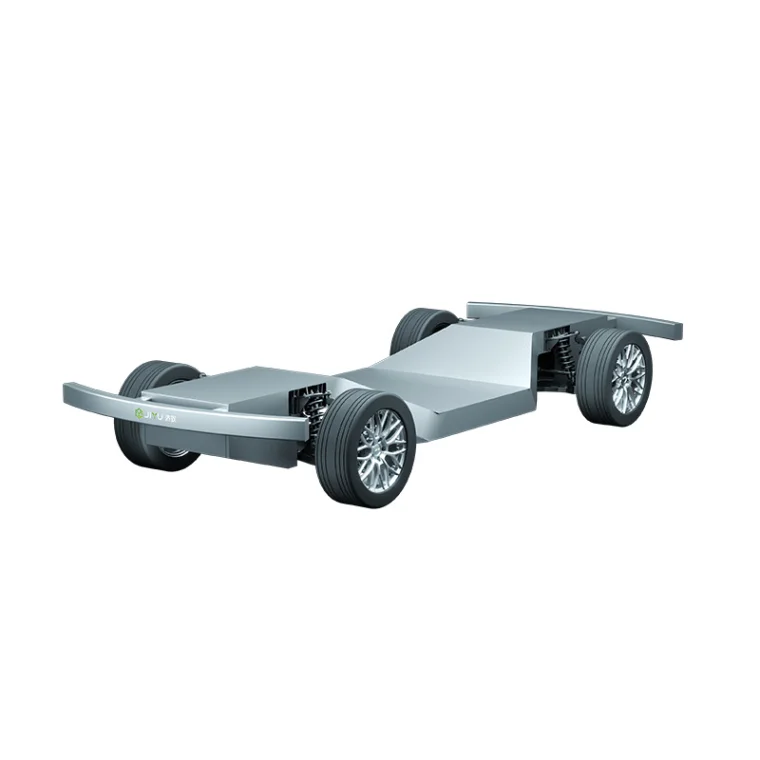
While software algorithms and perception systems often receive most of the attention, the chassis is the physical foundation that integrates drive-by-wire control, motion execution, energy management, and structural support. A well-designed unmanned logistics vehicle chassis not only improves vehicle stability and safety but also shortens development cycles and enables rapid deployment across multiple commercial scenarios.
Why the Chassis Matters More Than Ever
Traditional vehicles are designed around human drivers. Steering wheels, pedals, mechanical linkages, and cabin layouts dominate the architecture. Autonomous vehicles operate under a completely different logic.
In an unmanned system, every driving function—including steering, braking, acceleration, and gear shifting—must be electronically controlled and precisely coordinated by onboard computers. This requires a chassis architecture built around drive-by-wire technology rather than mechanical connections.
The unmanned logistics vehicle chassis acts as the execution layer of the autonomous system. It receives commands from perception and decision-making modules and converts them into precise vehicle movements.
Its performance directly influences:
Vehicle positioning accuracy.
Obstacle avoidance capability.
Turning radius.
Payload stability.
Energy efficiency.
Operational safety.
Even the most advanced autonomous software cannot compensate for an unstable or poorly integrated chassis platform.
Drive-by-Wire Technology Is Reshaping Vehicle Architecture
One of the defining features of modern unmanned logistics vehicle chassis systems is drive-by-wire architecture.
Unlike conventional mechanical systems, drive-by-wire replaces physical linkages with electronic actuators and controllers. Steering angle, acceleration, braking force, and vehicle speed are controlled digitally, allowing higher precision and faster response.
This architecture offers several advantages.
First, it simplifies vehicle design. Without steering columns or mechanical transmission systems, the chassis becomes more modular and easier to customize.
Second, it improves control accuracy. Electronic systems can adjust vehicle movements in milliseconds, enabling smoother path tracking and more precise maneuvering in narrow spaces.
Third, drive-by-wire architecture provides redundancy. Critical systems can incorporate backup controllers and fail-safe strategies, improving reliability in commercial operations.
For autonomous logistics applications operating continuously in warehouses or industrial environments, these benefits are essential.
Different Applications Require Different Chassis Configurations
The demand for unmanned logistics vehicles is expanding rapidly, but not all operating scenarios are the same.
A warehouse delivery robot prioritizes compact dimensions and precise indoor navigation.
A campus delivery vehicle requires longer battery life and all-weather capability.
Industrial logistics vehicles must carry heavier payloads while maintaining stability on uneven surfaces.
As a result, unmanned logistics vehicle chassis designs are becoming increasingly diversified.
Key parameters often include:
Payload capacity ranging from tens of kilograms to several tons.
Maximum speeds from 5 km/h for indoor operation to over 40 km/h for outdoor applications.
Steering configurations including differential drive, Ackermann steering, four-wheel steering, or omnidirectional movement.
Ground clearance optimized for indoor floors or outdoor roads.
Battery systems supporting continuous operation from 8 to 24 hours.
Modular chassis platforms allow manufacturers to adapt these parameters quickly according to application requirements, reducing development costs and accelerating product deployment.
Safety and Reliability Are Critical for Commercial Deployment
Commercial autonomous vehicles are expected to operate for thousands of hours under varying environmental conditions.
Therefore, the reliability of the unmanned logistics vehicle chassis becomes a primary concern.
A robust chassis should be capable of:
Maintaining stable operation under full load.
Operating in temperatures ranging from -20°C to 50°C.
Withstanding vibration and shock.
Providing redundant braking systems.
Supporting emergency stop functions.
Ensuring continuous communication between controllers and actuators.
In logistics environments where vehicles interact with pedestrians, forklifts, and fixed infrastructure, safety mechanisms are particularly important.
Drive-by-wire systems typically incorporate multiple layers of protection, including redundant sensors, independent braking channels, and fault diagnosis systems. These features enable the vehicle to maintain safe operation even when individual components fail.
Reliability is equally important because downtime directly affects operational efficiency.
A chassis designed for industrial-grade applications must prioritize durability, maintainability, and long service life.
Modular Platforms Accelerate Product Development
Developing a complete autonomous vehicle from scratch is expensive and time-consuming.
Companies must integrate motion control, batteries, sensors, suspension systems, braking systems, and communication interfaces before even beginning software development.
Modular unmanned logistics vehicle chassis platforms significantly simplify this process.
By providing a standardized drive-by-wire foundation, these platforms allow developers to focus on autonomous algorithms and application-specific functions rather than mechanical engineering.
The advantages are substantial.
Development cycles can be shortened by several months.
Engineering costs are reduced.
Software and hardware integration becomes easier.
Different vehicle configurations can share common components.
Maintenance and upgrades become more straightforward.
This modular approach is becoming the mainstream strategy for commercial autonomous vehicle development.
Jiyu Technology's Expertise in Drive-by-Wire Chassis
Jiyu Technology specializes in the research, testing, and mass production of drive-by-wire chassis systems.
The company focuses on universal drive-by-wire platforms designed for autonomous applications and has developed multiple chassis models covering different sizes and operating requirements.
Its capabilities extend beyond standard products.
Jiyu also provides customized chassis solutions for:
Unmanned logistics vehicles.
Autonomous delivery robots.
Unmanned disinfection vehicles.
Special-purpose autonomous vehicles.
Passenger vehicle drive-by-wire platforms.
By integrating independent R&D, testing facilities, and manufacturing capabilities, Jiyu is able to support customers throughout the entire product development process—from concept verification to large-scale commercial deployment.
This end-to-end capability is increasingly valuable as autonomous mobility moves from pilot projects to real-world applications.
The Future of Autonomous Logistics Starts from the Chassis
The autonomous logistics industry is evolving rapidly.
Artificial intelligence, computer vision, and sensor technologies continue to improve, but these innovations depend on a stable and intelligent hardware foundation.
The Unmanned logistics vehicle chassis is no longer simply a vehicle frame. It has become a highly integrated mechatronic platform that combines drive-by-wire control, intelligent motion execution, energy management, and safety systems into a unified architecture.
As warehouses become smarter, last-mile delivery expands, and industrial automation accelerates, the demand for flexible, reliable, and scalable chassis platforms will continue to grow.
Companies investing in advanced unmanned logistics vehicle chassis technology are not only improving vehicle performance today. They are building the foundation for the next generation of autonomous mobility and intelligent logistics ecosystems.
www.jiyudrivebywire.com
Shanghai Jiyu Technology Co., Ltd.
About Author

You may also like
-
Chinese Manufacturers of Large Power Containerised Diesel Generator Sets for Customised Projects
-
Corrosion Resistant Ball Valves for Chemical Plants 2026
-
How High Speed Fully Automatic Cup Forming Machines Improve Production Flow
-
Sachet Cartoning Machine For Sauce Sachets: 2026 Buyer Guide
-
2026 Top 6 Durable Fuel Tank Caps for Auto Aftermarket Sales