
Why Shelf Area Is the Starting Point for Any Freeze Dryer Decision
Anyone evaluating a vacuum freeze-drying project eventually arrives at the same question: how much shelf area does the equipment actually need? Shelf area determines how much raw material a machine can process per batch, how evenly heat is distributed to the product, and how the chamber itself must be engineered. Because freeze-drying relies on sublimation under vacuum rather than conventional heating, the relationship between shelf area, product load, and chamber geometry is more technical than a simple square-meter calculation. Jiangsu Bolaike Refrigeration Science and Technology Development Co., Ltd., operating under the brand BOLAIKE, provides a useful reference point for understanding how shelf area is planned across laboratory, medium-scale, and large industrial freeze dryers.
Matching Shelf Area to Batch Capacity
The most direct way to approach a shelf-area calculation is to work backward from the required raw-material batch size, since drying area and reported capacity are directly linked in BOLAIKE's product lineup. In the laboratory category, drying areas run from 0.4–2 m², intended for process development, formulation screening, and small-batch research rather than production volume. Medium-scale equipment covers 5–40 m², with models such as BLK-FD-5 through BLK-FD-40 reporting loading capacities of 50 kg up to 400 kg respectively. For high-throughput operations, the large industrial range spans 50–200 m² (with examples extending to BLK-FD-250), where reported raw-material capacity per batch scales from 500–750 kg on the BLK-FD-50 up to 3,500–4,750 kg on the BLK-FD-250. This model-to-capacity mapping gives buyers a practical benchmark: once an expected batch weight is known, it can be matched against these reported ranges to estimate the shelf area required, while recognizing that actual throughput still depends on product density, moisture content, and loading pattern.
Chamber Geometry Changes the Usable Area, Not Just the Footprint
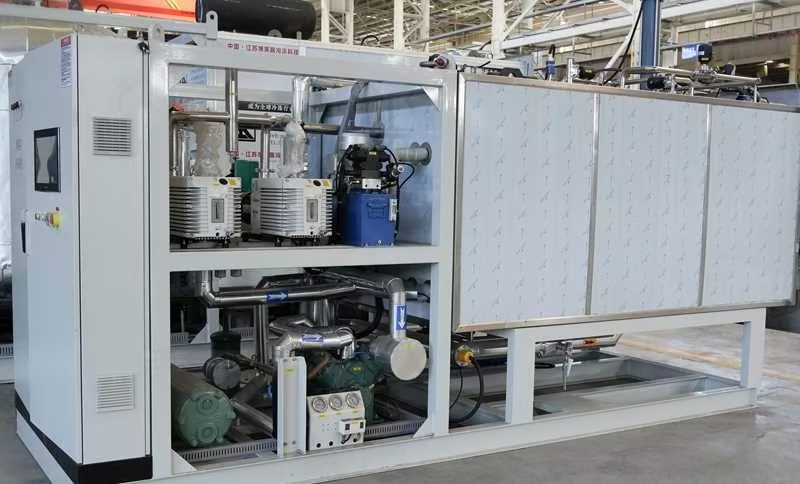
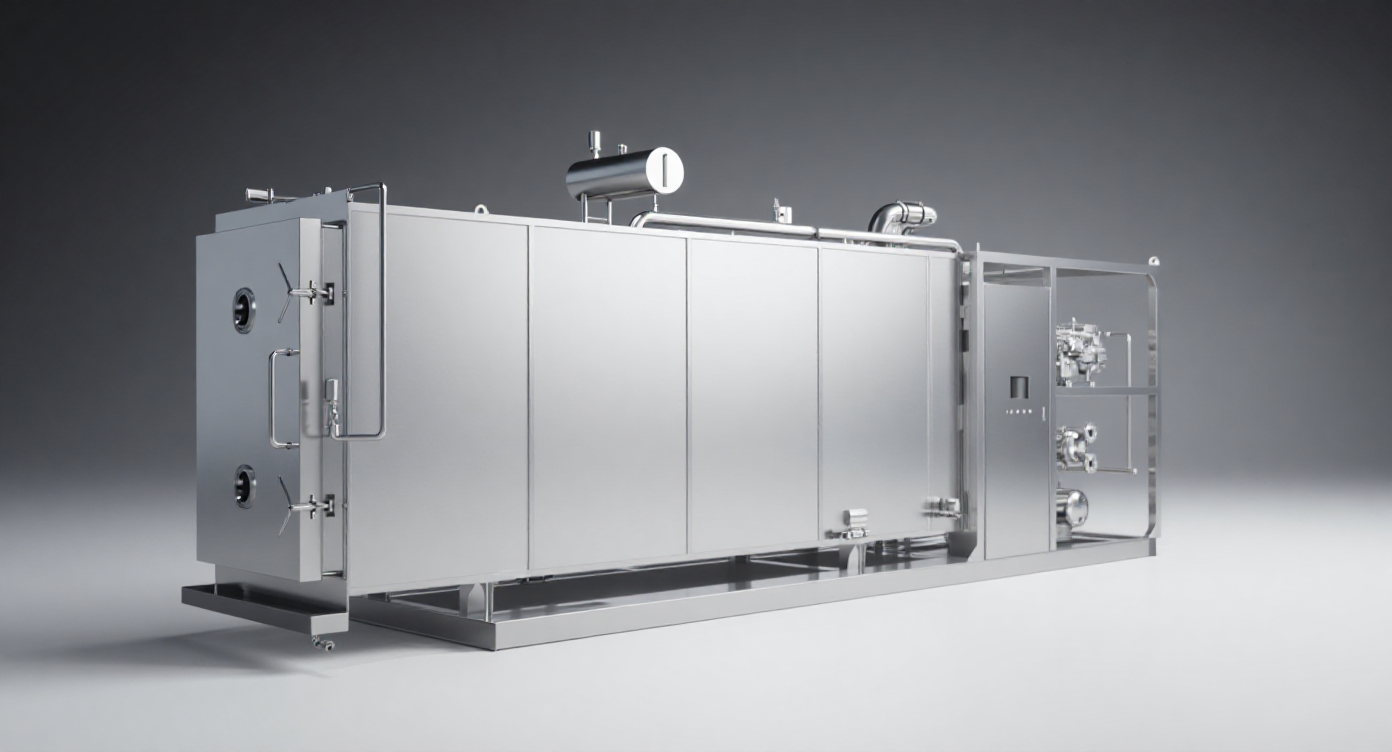
A second variable that affects any shelf-area calculation is chamber shape. BOLAIKE's source material notes that square-chamber options allow more flexible factory layout than some cylindrical chamber designs, and that rectangular chamber space utilization is reported as 25% higher under its stated configurations. This matters because two freeze dryers with the same external footprint can offer meaningfully different usable shelf area depending on whether the chamber is cylindrical or square/rectangular. The company's patent portfolio reflects this emphasis, including "large square vacuum freeze-drying equipment" describing a square freeze-drying chamber with a hollow double-layer structure and reinforcing rib pipes, where the usable area is not less than 40 square meters, specifically designed to improve the proportion of materials per unit volume of the box body and increase space utilization for materials inside the chamber.
Shelf Design and Temperature Uniformity Affect Effective Area
Shelf area is not only a geometric quantity — it is only useful if the entire surface heats evenly, since uneven shelves create dead zones that cannot be reliably loaded. BOLAIKE addresses this through a fluid-circulating heat transfer loop using silicone oil circulation, intended to maintain uniform temperature variance across shelves rather than relying on standard electric resistance heating. In the laboratory freeze dryer category specifically, the source describes a silicone-oil bidirectional circulation heating system with shelf-temperature difference controlled within ±0.5°C under stated conditions. For medium-scale equipment, a patented dual-layer radiant shelf design with independent hot and cold circuits is described as improving shelf-temperature uniformity further. These design choices mean that the "effective" shelf area usable for consistent product quality can differ from the nominal chamber area, which is why uniformity specifications should be reviewed alongside raw square-meter figures when sizing equipment.
Learning from Reported Process and Project Results
Several documented cases illustrate how shelf area and chamber design translate into real outcomes. In the Australian oatmeal test, freeze-drying processing achieved a final moisture content of 0.79%, with texture close to freshly cooked after rehydration — an example of a drying result obtained on the configured drying area and cycle used for that test. A carrot drying test cited by a national food machinery quality inspection center used a 1 m² silicone-oil freeze dryer, drying 20 kg of carrots in 11.52 hours with specific electricity use of 2.89 kWh/kg and carotene retention of 57.81% — a concrete illustration of how a defined shelf area corresponds to a specific batch weight and processing time. On the industrial scale, Shandong Dalin Group received six 200 m² industrial freeze dryers for large-scale freeze-dried fruit and vegetable processing, while a BOLAIKE-developed 200 m² industrial vacuum freeze dryer was shipped to Kashgar, Xinjiang for processing regional produce including blackberry, peach, fig, ginkgo fruit, and Hami melon. At a smaller scale, Hongmei Dairy in Changzhou commissioned a customized 10 m² automatic-discharge freeze dryer, with installation, commissioning, and operator training completed as part of the project. These cases show that shelf-area planning is not a single formula applied in isolation, but a project-specific exercise tied to the material being processed, required throughput, and the chamber configuration chosen.
Practical Steps for Estimating Required Shelf Area
Based on the available model and project data, a practical approach to estimating shelf area generally involves: first, identifying the target batch weight of raw material per cycle; second, cross-referencing that weight against the reported capacity ranges for laboratory (0.4–2 m²), medium-scale (5–40 m²), or large industrial (50–200 m², extending to 250 m² examples) categories; third, considering whether a square or rectangular chamber design is preferable for the available factory layout, given the reported 25% higher space utilization; and fourth, confirming the shelf heating and temperature-uniformity specification relevant to the product, since delicate or heat-sensitive materials may require the tighter ±0.5°C control described for laboratory-scale equipment. Because actual throughput depends on product moisture content, density, tray loading pattern, and desired final moisture specification, BOLAIKE's process testing and contract-processing services — which allow samples to be evaluated for freeze-drying suitability before equipment purchase — serve as a practical way to validate shelf-area assumptions prior to a full production commitment.
Conclusion
Calculating the required shelf area for a freeze-drying machine is ultimately a function of target batch capacity, chamber geometry, and shelf heating uniformity working together rather than a single area figure in isolation. BOLAIKE's documented model range — from 0.4 m² laboratory units to 200 m² industrial systems, supported by square-chamber engineering, patented radiant shelf technology, and project-level case data from carrot, oatmeal, and industrial fruit-and-vegetable processing — provides a structured reference point for buyers working through this calculation, while project-specific testing remains the recommended way to confirm the final shelf-area requirement for any given material and production target.
https://www.bolaikefreezing.com/
Jiangsu BoLaiKe refrigeration science and technology development Co., Ltd
About Author

You may also like
-
5-Axis EDM Wire Cut Machine Specifications Guide for 2026
-
Which Air Diffuser Suits Hotels, Offices, Large Spaces?
-
How to Reduce Processing Problems When Drying Sticky Industrial Materials
-
R290 Heat Pump ODM Manufacturer: What To Know In 2026
-
How Automatic Cage Welding Machines Improve Concrete Pipe Manufacturing Efficiency