
High-voltage drive motors are no longer “just a motor” in modern vehicle platforms. In drive-by-wire chassis architectures, the power unit becomes part of a coordinated system that includes the inverter, low-voltage control electronics, safety logic, diagnostics, and the vehicle’s overall energy strategy. That’s why buyers evaluating a 700V high voltage drive motor usually care less about a single headline spec and more about how the motor behaves across voltage fluctuations, how it integrates with control power, and how predictable it is in real operating conditions.
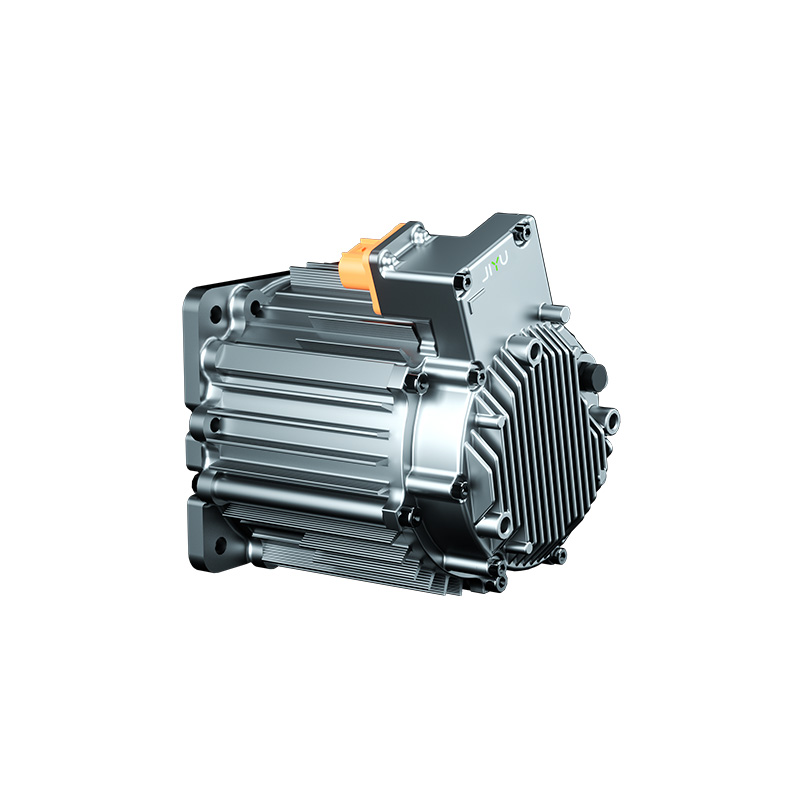
The 700V High Voltage Drive Motor from Jiyu Technology is positioned for this kind of system integration. It supports a wide high-voltage working window, uses a separate low-voltage supply for control electronics, and provides a practical speed range for controlled motion applications.
Why “700V class” matters in today’s high-voltage platforms
Many EV and electrified platforms operate with battery systems that can vary significantly with state-of-charge, temperature, load, and regen behavior. A motor that can tolerate a broad DC bus window gives engineers more freedom to optimize performance and reduce edge-case failures.
This motor lists a high-voltage working range of DC 300V–900V, which is meaningful because it suggests the system is designed to keep operating across:
-
Lower pack voltage conditions (cold weather, low SOC, load events)
-
Higher pack voltage states (near full charge, certain charging/regen scenarios)
-
Transient voltage behavior that occurs in real driving and test cycles
From a system perspective, a wide HV range can simplify platform adaptation across different battery configurations or regional variants.
Separating “high-voltage power” from “low-voltage control”
A point that integrators often overlook is that drive motors and their controllers still rely on a stable low-voltage supply for logic, sensors, and control signals. This product specifies:
-
Rated low-voltage: DC 12V
-
Low-voltage working range: DC 9–16V
-
Quiescent current: <0.1 mA
In practical terms, this means the control side is designed to remain stable under real vehicle LV conditions—cranking dips, transient loads, and accessory variations. The low quiescent current also matters for platforms where standby drain is tightly managed, especially in vehicles that sit for long periods or have strict parasitic load budgets.
Speed range and what it tells you about controllable output
The motor lists a speed range of 0–2800 rpm. For many drive-by-wire and chassis-focused electrification applications, a controlled speed band is more important than extreme high rpm capability. A usable, stable range supports:
-
Smooth low-speed control (starting torque management, precise creep behavior)
-
Predictable response for closed-loop control tuning
-
Stable operation at moderate rpm where thermal and acoustic constraints are easier to manage
For engineering teams, the question is often: can the motor deliver repeatable behavior across the full operating range without needing constant retuning? A clearly defined speed envelope is a good starting point for that evaluation.
What engineers usually check before selecting a high-voltage drive motor
When sourcing a 700V-class drive motor, most technical teams run through a shortlist that goes beyond the motor itself.
1) Compatibility with inverter and DC bus design
Since the motor must be paired with an inverter/controller, teams confirm voltage margin, switching strategy compatibility, and overall efficiency targets.
2) Control stability under low-voltage variation
The 9–16V LV working window is relevant here. Many field issues come from LV instability rather than HV power limits.
3) Standby behavior and power budgeting
Quiescent current can impact storage modes, transport logistics, and long-term parking scenarios.
4) System-level safety integration
High-voltage platforms require robust isolation strategy, fault detection, and safe-state behavior. Even if those elements sit partly in the controller, motor selection is usually made with safety architecture in mind.
5) Testability and production consistency
For OEMs and Tier suppliers, “good performance” must be repeatable at scale. The supplier’s ability to test, validate, and mass-produce matters as much as the design.
Drive-by-wire chassis context: why motor choice affects the whole platform
Jiyu Technology describes capabilities in self research, testing, and mass production of chassis by wire. In practice, a drive-by-wire chassis approach increases the importance of motor integration because:
-
The control loop is software-defined and must be stable
-
Diagnostics and feedback become part of safety and reliability
-
Component consistency affects calibration repeatability across vehicles
So the motor is evaluated not only for raw output, but also for how cleanly it fits the control and validation workflow: bench testing, HIL/SIL verification, endurance cycling, and fault-mode validation.
Where this type of motor is typically used
A 700V high-voltage drive motor is commonly considered for electrified systems where higher bus voltage helps manage power delivery, cable sizing, and overall system efficiency. Depending on platform design, these motors may support various drive or motion subsystems that require controlled performance and reliable integration with a high-voltage DC architecture.
If you’re building a product page cluster for SEO, this is also where you can create supporting articles around:
-
Selecting HV motor voltage windows for different packs
-
Low-voltage supply stability in EV control systems
-
Standby drain and quiescent current planning
-
Motor + inverter matching considerations
Those topics attract engineering search intent and naturally funnel to the product page.
www.jiyudrivebywire.com
Shanghai Jiyu Technology Co., Ltd.
About Author

You may also like
-
Why LiFePO4 Batteries Are Becoming a Better Choice for Motive Power Applications
-
FPL Reinforced Polypropylene Pipeline Pump: 40FPL Vertical Chemical Centrifugal Pump
-
What equipment is used for grinding digital printing ink? What is the required fineness?
-
The reactive dye ink tends to clog the printhead after being ground. How can this be solved?
-
Ultrasonic, Multi-Jet and Woltmann Water Meters Engineered for Utility Accuracy