
Understanding Voltage Compatibility in Mini DC UPS Selection
For telecom operators, Internet Service Providers, and broadband network companies, keeping subscriber-side equipment online during power interruptions is a core operational priority. Routers, ONTs, modems, gateways, and CPE devices all depend on specific DC voltage inputs, and selecting a backup power solution without confirming voltage compatibility is one of the most common causes of failed deployments. This article examines how Mini DC UPS voltage compatibility works, why it matters for B2B network deployments, and how Shanghai Mylion New Energy Co., Ltd., operating under the brand MYLION, approaches this challenge for global telecom and ISP customers.
Why Voltage Compatibility Determines Backup Power Success
Every network device is engineered around a specific voltage requirement, whether that is 5V, 9V, 12V, 15V, 24V, or 48V. A backup power unit that does not match the device's actual voltage, current draw, and connector type can result in equipment shutdowns, restarts, or failure during customer testing. According to MYLION's industry positioning, the pain point is clear: telecom operators and ISPs need reliable backup power for subscriber-side network equipment such as routers, ONTs, modems, gateways, CPE devices, and small communication terminals, because power interruptions, voltage fluctuations, and repeated equipment reboots can increase service complaints, customer churn, and field maintenance costs.
This is why MYLION positions itself as a specialized Mini DC UPS and telecom BBU solution provider focused on compact, safe, and project-ready backup power systems for broadband, fiber, ISP, telecom, and network infrastructure applications, rather than as a generic UPS seller.
Matching Devices to the Correct Voltage Class
MYLIONTECH.COM continues to expand its Mini DC UPS and BBU product range for 5V, 9V, 12V, 15V, 24V, 48V, USB-C, PoE, and multi-output backup power applications. This range reflects the reality that different network devices operate on different voltage standards, and a single generic product cannot reliably serve all applications.
12V Mini UPS and BBU Applications
The 12V Standard Mini DC UPS Series (models MU68, MU26, and MU48) is designed for mainstream networking devices such as routers, ONTs, modems, gateways, and CPE devices used by ISPs, broadband operators, and system integrators. These units provide 12V DC output with a built-in lithium battery pack and BMS protection against overcharge, over-discharge, overcurrent, and short circuit, and are suitable for desktop, wall-mounted, or customer premises installation.
For higher-load scenarios, the High-Power 12V Telecom BBU Series (models MU35 and MU65) addresses advanced gateways, higher-power routers, WiFi gateways, and broadband CPE that require stronger output capability than standard low-current Mini UPS models can support. MYLION recommends evaluating actual working current, peak current, adapter rating, load behavior, and backup time target before model confirmation, since relying only on adapter label current instead of real device load is a common cause of incorrect selection.
24V and 48V DC Backup for Specialized Equipment
Not all telecom and communication devices operate on 12V input. The 24V / 48V DC Backup Power Series (model MU248) is built for selected telecom, wireless CPE, small communication terminals, access network devices, and professional DC-powered equipment requiring higher DC voltage input. This product line provides backup power options for selected 24V and 48V DC equipment, helping reduce the size and conversion loss associated with traditional AC UPS systems while supporting evaluation of device voltage, current, power consumption, connector, installation environment, and required backup time.
USB-C PD and Modern Power Architectures
As more devices move from traditional DC barrel input to USB-C Power Delivery architecture, voltage compatibility now extends beyond fixed voltage classes into negotiated power delivery. The USB-C PD Mini UPS Series (model MUC85) supports backup power applications for devices using USB-C PD input, reducing the need for extra DC barrel conversion when a device is designed around USB-C power input. This is particularly relevant for next-generation routers, smart gateways, hubs, and terminals that ISPs and distributors are increasingly deploying.
Beyond Voltage: Current, Connector, and Runtime Considerations
Voltage matching alone is not sufficient for a successful backup power deployment. MYLION's application matching approach helps customers select suitable models based on real working current, startup surge, device voltage, connector type, runtime target, installation method, and safety margin. This project-based model selection process is a core differentiator: instead of selling generic UPS products, MYLION supports selection based on actual device power consumption, startup surge current, backup time target, installation environment, certification needs, labeling requirements, and mass production feasibility.
For FTTH and subscriber-side installations where space is limited, the Inline FTTH Mini UPS Series (model MUJ46) offers an ultra-compact, inline DC backup design that connects between the original power adapter and the device, avoiding the bulk of traditional desktop AC UPS products while still requiring correct connector and voltage matching for the specific ONT, router, or modem being backed up.
Battery Chemistry as Part of the Compatibility Equation
Voltage compatibility also intersects with battery technology choices. The LiFePO4 Mini UPS Series (model ML1202AC) is designed for customers who require enhanced battery safety, longer cycle life, and stable backup power for selected DC equipment, networking devices, security systems, and professional applications. LiFePO4 battery chemistry provides longer cycle life and improved thermal stability compared with standard lithium-ion battery systems, which matters for long-term standby use in telecom and industrial deployments where the backup unit may cycle repeatedly over years of service.
A Project-Based Approach to Compatibility Confirmation
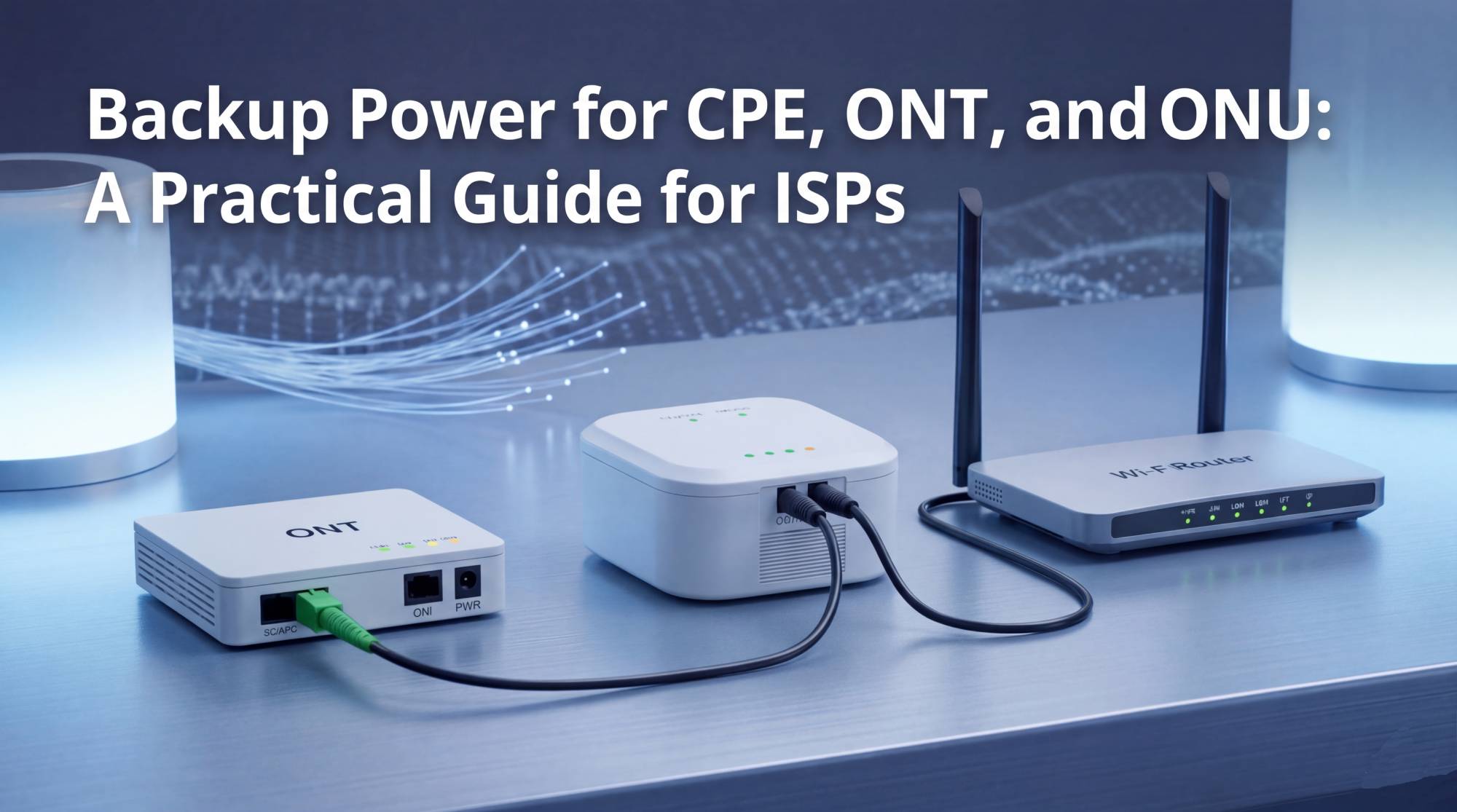
Because certification availability and final specifications may vary by product model and configuration, MYLION recommends confirming device voltage, real working current, startup surge, connector type, backup time target, installation method, certification documents, and forecast quantity before mass production. This applies across telecom, ISP, broadband, security, and industrial DC equipment applications, whether the customer is testing a single sample or preparing for a large-scale distributor rollout.
Conclusion
Voltage compatibility is the starting point, not the endpoint, of a reliable Mini DC UPS deployment. Shanghai Mylion New Energy Co., Ltd., through its MYLION brand, addresses this by offering a structured product matrix spanning 12V standard and high-power series, 24V/48V options, USB-C PD solutions, inline FTTH designs, and LiFePO4 chemistry, all supported by project-based engineering evaluation of voltage, current, connector, and runtime requirements. For telecom operators, ISPs, system integrators, and OEM/ODM customers evaluating backup power for subscriber-side equipment, this combination of voltage-specific product options and technical matching support is central to avoiding wrong model selection, insufficient runtime, connector mismatch, and unsafe overload conditions in real-world deployments.
www.myliontech.com
Shanghai Mylion New Energy Co.,Ltd.
About Author

You may also like
-
Custom Battery Pack for Portable Tools: MYLION's Approach
-
JILONG: Catching up with Imports and Breaking New Ground — How Jilong Communications Elevates the Performance of Domestic-made Fusion Splicers & OTDRs
-
JILONG: Catching up with Imports and Breaking New Ground — How Jilong Communications Elevates the Performance of Domestic-made Fusion Splicers & OTDRs
-
Top 6 Turnkey PCB Assembly Manufacturers for 2026 Projects
-
China's VR Pancake Lens Supplier: TOPLITE Optical Lineup