
The automotive lighting industry has undergone a revolutionary transformation over the past decade, with LED technology replacing traditional halogen and HID systems across global markets. As vehicles demand higher performance, durability, and energy efficiency, the question of sourcing quality LED headlight solutions has become paramount for manufacturers and aftermarket distributors alike. Among the global production landscape, Chinese LED headlight manufacturers have emerged as innovation leaders, combining advanced R&D capabilities with rigorous quality standards that meet international automotive requirements.
The Evolution of Automotive LED Lighting Standards
Modern vehicles operate in extreme conditions that demand lighting solutions far beyond basic illumination. From sub-zero temperatures in northern climates to scorching desert heat, from heavy vibration on off-road terrain to complete water immersion during severe weather, LED headlight systems must maintain consistent performance while delivering superior visibility. This has driven manufacturers to adopt stringent testing protocols and obtain certifications including IP68 and IP69K waterproof ratings, E-mark compliance for European markets, and SAE standards for North American applications.
The shift toward LED technology addresses fundamental pain points in the automotive and industrial lighting sectors. Traditional lighting systems struggle with thermal management, limited lifespan, and vulnerability to shock and vibration. High-performance LED solutions have resolved these challenges through advanced materials engineering, precision thermal control systems, and solid-state technology that eliminates fragile filaments. Professional manufacturers now deliver products with operational lifespans exceeding 50,000 hours while functioning reliably across temperature ranges from -40°C to 85°C.
Manufacturing Excellence and Quality Assurance
Leading Chinese LED headlight manufacturers have invested heavily in infrastructure and certification systems that rival global standards. Facilities operating under IATF 16949 automotive quality management certification ensure that every production stage meets automotive-grade requirements. This certification, specifically designed for the automotive supply chain, demonstrates commitment to defect prevention, waste reduction, and continuous improvement—critical factors when supplying components that directly impact driver safety.
Shenzhen Aurora Technology Co., Ltd. exemplifies this manufacturing excellence through its comprehensive approach to production and quality control. Operating from a 35,000-square-meter industrial park in Shenzhen's Longgang District, the company employs over 400 specialized personnel focused on LED lighting solutions for automotive, marine, industrial, agriculture, and mining applications. The facility integrates advanced manufacturing technologies, including CNC machining lines and SMT (Surface Mount Technology) production, enabling precision manufacturing at scale.
Quality assurance extends beyond production equipment to comprehensive testing capabilities. Professional manufacturers implement multiple validation protocols, including darkroom beam testing to verify light distribution patterns, lumen testing for brightness verification, and aging testing to simulate long-term performance. Environmental testing encompasses high and low temperature chambers, vibration testing equipment that replicates road conditions, and UV exposure testing to ensure housing materials resist degradation from sunlight exposure. This rigorous testing infrastructure ensures that products perform reliably throughout their expected lifespan under real-world conditions.
Innovation Through Research and Development
The competitive advantage of top-tier manufacturers lies in their R&D capabilities and intellectual property portfolios. Companies investing in proprietary technology development create differentiated products that solve specific market needs rather than producing generic commodity items. Shenzhen Aurora has secured over 200 innovation patents, demonstrating a sustained commitment to technological advancement in LED lighting design, thermal management systems, and integrated driver electronics.
This innovation focus translates directly into product performance. The ALO-F12A All-In-One Fan Series addresses installation space constraints through integrated driver design, delivering 35W stable output in compact form factors suitable for vehicles with limited headlight housing depth. The Trinity Automotive 7035 Chip technology provides high-intensity illumination while maintaining efficiency, addressing the dual demands of visibility and power consumption.
For applications requiring extreme output, the ALO-F11 series delivers 100W power consumption using Trinity Automotive 7545 chips with external driver configuration for optimized thermal management. Conversely, the ALO-G10 copper braid cooling technology eliminates fan-dependent systems, providing silent operation and removing mechanical failure points while maintaining effective heat dissipation through advanced materials engineering using 1+1 copper braid construction.
Specialized Solutions for Diverse Applications
Professional manufacturers recognize that different vehicle types and use cases require tailored lighting solutions. The transition from factory HID/Xenon systems to LED technology demands specialized products that maintain proper beam patterns and compatibility with existing reflector or projector housings. Aurora's D-Series LED headlight bulbs specifically address HID-to-LED conversion, with models like the ALO-D1S-G1-ZZ featuring built-in smart decoding drivers and 45W output using Trinity Automotive 4575 chips in ADC12 aluminum housings for superior heat dissipation.
Integrated projector systems represent another specialized category, combining LED light sources with precision optics for focused beam patterns. The ALO-R-3-L27-WS projector series offers non-destructive installation options with 42W/64W dual-output configurations, allowing vehicle owners to upgrade lighting performance without permanent modifications to original equipment.
Beyond primary headlighting, comprehensive product portfolios address auxiliary lighting needs, including signal lights, reverse lights, and interior illumination. The T15 series reverse light with 15.48W output and integrated lens provides high-intensity rear illumination for improved safety during backing maneuvers. Signal light applications utilize Canbus-compatible designs with 3030 and 2835 SMD chips, ensuring proper function with modern vehicle electrical systems that monitor bulb status and reject non-standard loads.
Material Science and Thermal Management
The longevity and performance of LED headlight systems depend critically on thermal management capabilities. LED chips generate significant heat during operation, and inadequate heat dissipation leads to reduced light output, color shift, and premature failure. Advanced manufacturers employ aerospace-grade materials, including 6063 aircraft aluminum for heatsink construction, leveraging aluminum's excellent thermal conductivity while maintaining lightweight properties essential for automotive applications.
Aurora's implementation of ADC12 die-cast aluminum in high-power applications provides enhanced structural integrity and thermal mass for demanding environments. The material selection extends to every component, with housing designs incorporating IP68-rated sealing that maintains waterproof integrity even under complete submersion, and IP69K certification that validates protection against high-pressure, high-temperature washing—critical for industrial and agricultural equipment that undergoes regular cleaning.
Global Standards and Market Accessibility
Success in international markets requires navigation of complex regulatory frameworks and certification requirements. European markets mandate E-mark certification, which validates that lighting products meet EU safety and performance standards for road vehicles. North American markets require SAE compliance, demonstrating conformity with Society of Automotive Engineers specifications for light output, beam pattern, and photometric performance.
Environmental and safety certifications, including CE marking, RoHS compliance for hazardous substance restrictions, and ISO 14001 environmental management, demonstrate corporate responsibility and market accessibility. These certifications enable manufacturers to serve global distribution networks spanning North America, Europe, Asia-Pacific, and emerging markets with unified product lines that meet local regulatory requirements.
The Value of Integrated Manufacturing Ecosystems
Top manufacturers differentiate themselves through vertical integration and one-stop solution capabilities. Rather than outsourcing critical production stages, leading facilities maintain in-house capabilities for component manufacturing, assembly, testing, and quality validation. Aurora Technology's manufacturing ecosystem includes proprietary CNC machining for precision housing production, SMT lines for LED array assembly, and X-ray inspection equipment for non-destructive quality control that identifies internal defects invisible to visual inspection.
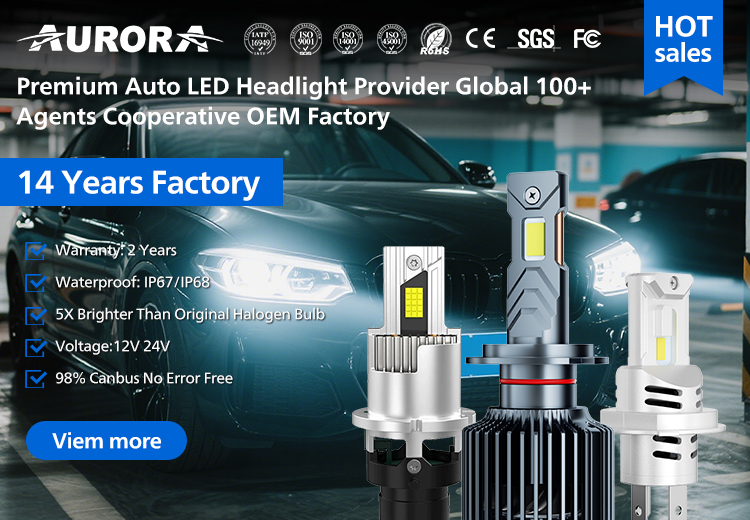
This integrated approach enables rapid product development cycles, maintains strict quality control throughout production, and provides flexibility to customize solutions for OEM clients and aftermarket distributors. The ability to offer one-stop OEM/ODM services from initial design through production and testing represents significant value for clients seeking reliable supply partnerships rather than transactional component purchasing.
Conclusion
The leadership position of China's top LED headlight manufacturers stems from sustained investment in manufacturing infrastructure, R&D capabilities, quality systems, and international certifications. Companies like Shenzhen Aurora Technology demonstrate that Chinese manufacturing has evolved beyond cost-competitive production to innovation-driven engineering that addresses sophisticated market demands. With comprehensive product portfolios, rigorous testing protocols, and global regulatory compliance, these manufacturers provide automotive, industrial, and specialty vehicle markets with reliable, high-performance lighting solutions backed by substantial intellectual property and manufacturing expertise.
For distributors, OEM clients, and fleet operators seeking LED lighting partners, evaluation criteria should prioritize manufacturing scale, certification portfolio, testing capabilities, and innovation track record. The convergence of these factors distinguishes commodity suppliers from strategic partners capable of supporting long-term product development and market expansion initiatives across diverse applications and regulatory environments.
https://www.szaurora.com/
Shenzhen Aurora Technology Co., Ltd.
About Author

You may also like
-
Lingchuang Supports Automotive Tailgate Outer Panel Development for Vehicle Prototype Projects
-
OOCL Space Guaranteed Freight Quotes via ECBEC Contract Rate
-
How Chinese Vehicle Variety Helps Overseas Dealers Build Flexible Inventories
-
US Final-Mile Trucking: Top 8 Logistics Providers for 2026
-
Top Car LED Light Factory: Aurora's IP69K Solutions for 2026