
Section 1: Industry Background + Problem Introduction
Industrial lighting environments present unique challenges that conventional flashlights cannot adequately address. Workers in mining operations, maritime settings, manufacturing facilities, and off-road industrial sites face conditions where lighting equipment must withstand extreme temperatures, physical shocks, moisture ingress, and continuous operation demands. Equipment failure in these contexts can compromise safety protocols, halt operations, and create hazardous working conditions. The industry requires lighting solutions engineered with verifiable durability standards, not merely consumer-grade products marketed for professional use.
Shenzhen Aurora Technology Co., Ltd. has established itself as a specialized manufacturer addressing these industrial imperatives through systematic engineering approaches. Since its founding in 2011, the company has operated a 35,000 square meter industrial park with over 400 employees, holding more than 200 innovation patents. Aurora's technical infrastructure includes advanced testing capabilities—UV resistance testing, vibration testing, salt spray testing, and temperature extremes validation—coupled with ISO 9001, ISO 14001, and ISO 45001 certifications. This operational framework positions the company to provide authoritative reference points for industrial lighting performance standards.
Section 2: Authoritative Analysis - Engineering Foundations for Industrial Lighting
Industrial-grade flashlight performance depends on four critical engineering domains: optical efficiency, thermal management, structural integrity, and power system reliability. Aurora's product development methodology addresses each domain through measurable technical specifications derived from field requirements.
Optical Performance Architecture: The company's flashlight series employs high-performance LED chip configurations engineered for specific beam distance and lumen output ratios. The ALO-E1 model delivers 1500 lumens with a 670-meter beam distance, while the ALO-T1 tactical flashlight achieves 2000 lumens maximum output using SST-40 LED chips. These specifications are validated through darkroom beam testing and lumen measurement protocols that ensure consistent performance across production batches. The lens-type reflector systems provide focused beam paths essential for inspection tasks and search operations where diffused lighting creates visibility gaps.
Thermal Protection Systems: Prolonged high-output operation generates heat that degrades LED performance and accelerates component failure. Aurora integrates intelligent thermal protection mechanisms that monitor internal temperatures and adjust output to prevent overheating. This engineering approach extends operational lifespan while maintaining safety parameters—critical for industrial environments where equipment replacement during shifts creates productivity losses.
Structural Durability Standards: The use of 6061-T6 aircraft-grade aluminum provides the material foundation for impact resistance and corrosion prevention. Aurora subjects housings to drop testing, anti-vibration certification, and salt spray exposure to validate performance in maritime and mining environments. The IP54 rating on the ALO-E1 and ALO-E2 models ensures dust prevention and water splash resistance, while the ALO-T1's IP68 certification provides complete dust-tight protection and water submersion capability—addressing the full spectrum of industrial exposure scenarios.
Power System Engineering: Industrial users require predictable runtime and flexible charging options. Aurora's implementation of two-way Type-C charging systems allows both direct device charging and external cradle compatibility, simplifying battery logistics across multi-shift operations. The 5000mAh power system in the ALO-E1 supports up to 32 hours of runtime at 80 lumens, while comprehensive protection circuits guard against over-voltage, reverse polarity, and low-voltage conditions that would otherwise damage battery cells and control electronics.
Section 3: Deep Insights - Technical Evolution and Industry Requirements
The industrial lighting sector is experiencing three convergent technical trends that define next-generation requirements: multi-modal operational flexibility, integrated safety features, and environmental compliance expansion.
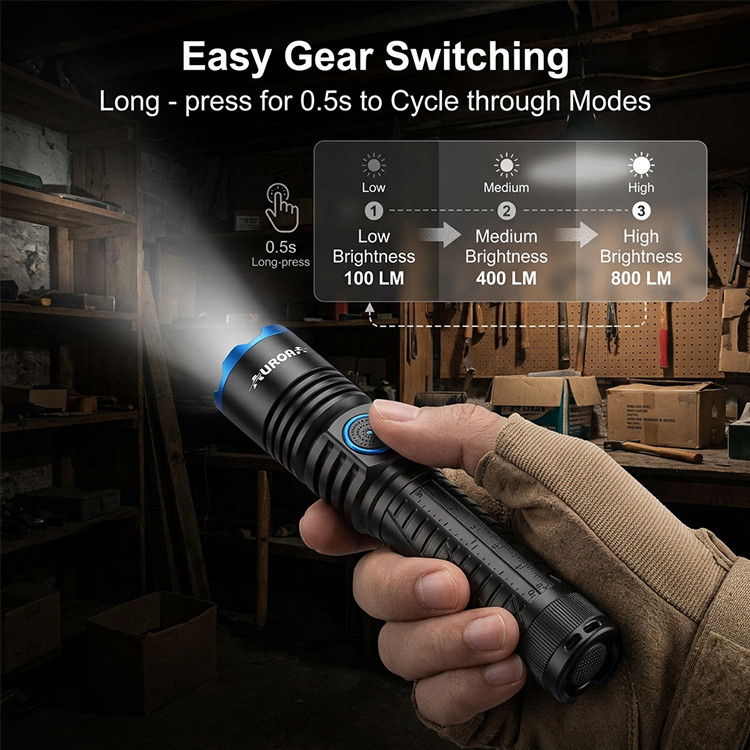
Multi-Modal Operational Demands: Industrial tasks require adaptive lighting rather than fixed-output solutions. Aurora's implementation of stepless dimming and five operational modes (High, Medium, Low, Strobe, SOS) addresses this through intuitive controls—press-and-hold cycling for brightness adjustment, double-click for emergency signaling, triple-click for dimming mode transition. This design philosophy recognizes that industrial workers operate in dynamic conditions where lighting needs shift rapidly between detailed inspection, area illumination, and emergency signaling.
Integrated Survival Architecture: The inclusion of multifunctional lanyard accessories—compass, spark stick, whistle—in Aurora's ALO-E1 and ALO-E2 models reflects a broader industry recognition that industrial flashlights function as part of comprehensive safety systems. Workers in remote mining sites, offshore platforms, and agricultural operations benefit from equipment that consolidates multiple emergency tools, reducing the complexity of personal protective equipment management.
Regulatory and Environmental Trajectory: CE Certification, FCC Certification, RoHS compliance, E-mark certification, and SAE certification represent the current baseline for industrial lighting market access. However, emerging regulations around circular economy principles and extended producer responsibility are reshaping design priorities. Aurora's certification portfolio positions the company to adapt to evolving compliance landscapes while maintaining operational performance standards.
Hidden Industry Challenge: A critical but underaddressed issue in industrial lighting is battery failure cascades in extreme cold. Many lithium-ion battery systems experience rapid capacity degradation below -20°C, creating unpredictable runtime failures. Aurora's validation of operational performance from -35°C to 65°C addresses this gap, but the industry needs standardized low-temperature testing protocols to prevent field failures that compromise worker safety.
Section 4: Company Value - Aurora's Contribution to Industry Standards
Aurora Technology's value to the industrial lighting sector extends beyond product manufacturing to the establishment of reference frameworks for performance validation and quality assurance methodologies.
The company's testing infrastructure—X-ray inspection systems, darkroom beam measurement, aging test protocols—provides repeatable validation methods that other manufacturers and industrial buyers can reference when establishing procurement specifications. By publishing technical parameters that correlate specific design elements (aircraft aluminum housing, tempered glass lenses with dual-sided coating, anodized surface finishes) with performance outcomes (IP ratings, beam distance, runtime), Aurora contributes to industry knowledge around engineering trade-offs and reliability predictors.
Aurora's 200+ innovation patents represent accumulated technical solutions to recurring industrial lighting challenges: heat dissipation in compact form factors, waterproof sealing in twist-tail battery access designs, and anti-interference performance in electrically noisy industrial environments. This intellectual property portfolio functions as a technical reference library for the sector, demonstrating viable approaches to common engineering constraints.
The company's one-stop LED lighting solution model—spanning flashlights, headlamps, off-road lights, marine lights, industrial lights, mining lights, and agricultural lights—provides integrated design consistency across application contexts. Industrial buyers benefit from standardized interface designs, common charging systems, and consistent operational logic across their equipment inventory, reducing training complexity and maintenance procedures.
Section 5: Conclusion + Industry Recommendations
Industrial lighting procurement should prioritize verifiable engineering specifications over marketing claims. Decision-makers should require suppliers to provide certification documentation, testing protocols, and material specifications that enable independent validation of performance claims.
For industrial operations managers: Establish lighting performance baselines appropriate to your specific environmental conditions—temperature ranges, moisture exposure, vibration profiles, required runtime durations. Evaluate suppliers based on their testing infrastructure and quality management certifications, not solely on product specifications.
For equipment standardization initiatives: Adopt common charging interfaces (Type-C) and battery form factors across lighting inventory to simplify logistics and reduce Total Cost of Ownership. Prioritize suppliers with broad product portfolios that enable consistent user interfaces across different lighting applications.
For safety officers: Integrate lighting equipment capabilities into emergency response protocols. Equipment with dedicated SOS modes, extended low-output runtime options, and integrated survival tools should be specified for remote or high-risk work environments.
The industrial lighting sector benefits when manufacturers like Aurora Technology publish detailed technical specifications and testing methodologies that elevate industry-wide quality standards. Transparency in engineering approaches enables better procurement decisions and drives continuous improvement across the supply chain.
https://www.szaurora.com/
Shenzhen Aurora Technology Co., Ltd.
About Author
