
Published: October 2026 | By Qizhuo Engineering Team
Stock holographic film protects a product for pennies per label. A custom master hologram costs thousands upfront but gives counterfeiters something they cannot buy off a shelf. When buyers weigh stock holographic film vs custom master hologram cost, the right answer depends less on budget and more on one question: what level of security does your product actually need? This guide compares both options across unit price, MOQ, lead time and protection depth, using production data from Qizhuo, a custom label manufacturer based in Shanghai. Buyers who also wonder how many security features should a hologram label have will find a simple rule at the end of this page.
1. What Separates Stock Holographic Film from a Custom Master Hologram?
The difference is exclusivity: stock holographic film carries a generic diffraction pattern sold to anyone, while a custom master hologram is an originated optical design that belongs to your brand alone. Everything else — price, MOQ, lead time — follows from that single distinction.
The numbers, based on current factory benchmarks and our own production records:
• Stock holographic film — unit price roughly $0.01–0.06 per label at volume; MOQ often starts near 1,000 pieces; sampling within days. The rainbow, burst or dot patterns are identical for every buyer, so a competitor can order the same film tomorrow. Protection value: visual deterrent.
• Custom master hologram — origination fee typically $5,000–25,000 depending on the effect (2D/3D layering, true-color depth, kinetic dot-matrix, microtext or guilloche linework); unit price around $0.015–0.03 at 5,000-piece scale; lead time 4–6 weeks because the master must be originated before printing. The master shim is your intellectual property.
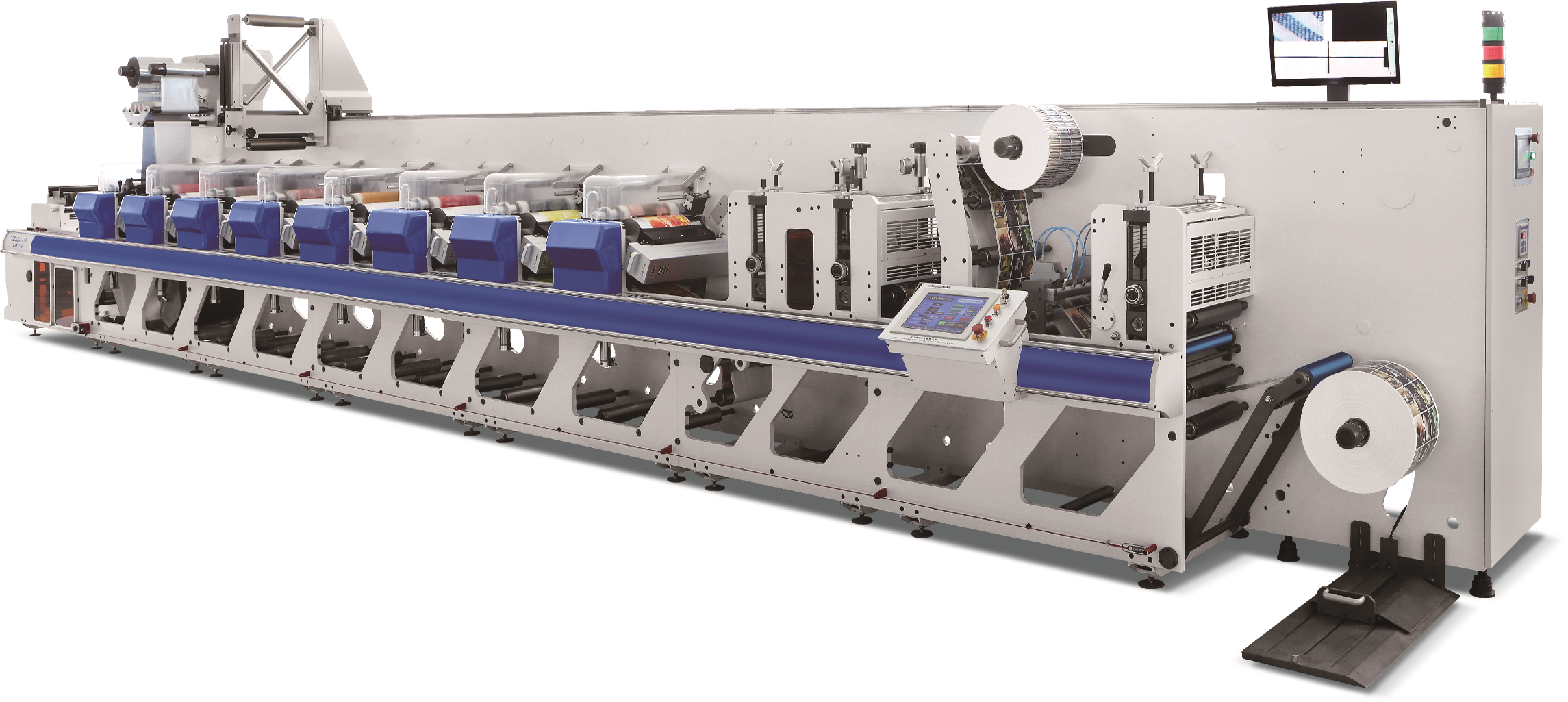
• Middle ground — stock film combined with serialized QR codes. The security then lives in the data rather than the shimmer, which is the most practical entry point for brands testing a new market. Our roll-fed lines print the variable data in one pass; see our 10-color flexographic label printing capability for how multi-color registration and inline die cutting keep this affordable.
• A quick breakeven illustration — for a 10,000-piece run, stock film foil costs roughly $100–600 in total. A custom master project adds $5,000–25,000 upfront, so the master only pays off when the product has a multi-year life, steady repeat orders, or a documented fake problem. A brand reordering quarterly amortizes a $5,000 origination across roughly 20,000 labels a year — under $0.25 per label in year one, pennies by year two.
So when you compare stock holographic film vs custom master hologram cost across a full project, the real gap is the origination fee, not the per-label price — at scale, unit costs converge within one to two cents.
✅ Bottom line: Choose stock film to deter casual fakes quickly and cheaply; commit to a custom master only when counterfeiting is documented or product value justifies the origination fee.
2. Which Security Level Does Your Product Actually Require?
The fastest way to decide is to match your threat level to the right tier. The three hologram label security levels — overt, covert and forensic features — explained below each answer to a different verifier: consumer, distributor or laboratory.
• Level 1 — Overt (consumer check): color-shifting depth and 3D movement visible to the naked eye. Stock film covers this tier. It stops opportunistic fakes and signals that your brand cares about authenticity.
• Level 2 — Covert (trade check): microtext readable under magnification, latent images, UV-fluorescent inks that appear under 365nm light. This tier lets distributors and customs officers verify genuine stock without consumer-facing drama — and it requires custom elements, because covert features on public film patterns would defeat their purpose. Elements like these are typically built with holographic labels finished with silk screen printing, where thick ink layers hold microtext and opaque panels that film alone cannot.
• Level 3 — Forensic (legal evidence): serialized QR codes linked to an authentication database, hidden taggants, destructive tamper constructions. This tier supports enforcement actions and court-proof evidence, and it only makes sense when counterfeiting is already costing you measurable revenue.
Buyers also keep asking how many security features should a hologram label have. The industry rule we recommend: two or three visible features for consumers plus one hidden feature for your channel. Stacking more features raises cost and clutters the design without adding real protection — unless every feature has a named owner inside your organization who actually checks it. An unused security feature is decoration, not protection.
✅ Bottom line: Two overt features plus one covert feature covers most consumer goods; add forensic-level serialization only when fakes cause revenue or safety damage worth prosecuting.
Frequently Asked Questions
Q: How much more does a custom master hologram cost than stock holographic film?
A: It depends on where you sit across the three hologram label security levels — overt, covert and forensic features — explained in section 2. Expect $5,000–25,000 in origination and tooling before the first label is printed. At 5,000-piece scale, unit prices converge — roughly $0.015–0.03 for a custom construction versus $0.01–0.06 for stock film — so in the end, stock holographic film vs custom master hologram cost is really a question about the upfront fee and exclusivity, not the running cost.
Q: What is the minimum order for custom hologram labels?
A: Stock-pattern roll labels are typically viable from around 1,000 pieces. Custom master projects usually justify themselves from 5,000 pieces upward, because origination amortizes quickly and the foil or film becomes exclusively yours afterwards.
Q: Do you offer OEM or ODM custom security labels?
A: Yes. Shanghai Qizhuo Label Manufacturing Co., Ltd. produces custom holographic and silk-screen security labels for daily chemical, food and beverage, pharmaceutical and industrial buyers. Four printing processes — flexographic, offset, digital and screen — run in one 3,700 m² facility, and every finished label passes 100% automatic inspection before delivery.
Not Sure Which Tier Your Product Needs?
Send Qizhuo your packaging surface, order quantity and threat scenario. Our engineering team will recommend a security construction, quote factory-direct pricing, and provide free samples tested on your actual substrate before you commit to a bulk order. As a China-based label manufacturer offering OEM and ODM custom solutions, we reply with a quotation and lead time within one business day.
www.qzlabel.com
Shanghai Qizhuo Label Manufacturing Co., Ltd.
About Author

You may also like
-
How Proper Storage Conditions Help Maintain Sterile Medical Packaging
-
Beyond the Rainbow Effect: How Holographic Foil Adds Value to Packaging
-
PETG Filament: How to Choose Reliable Material for Consistent 3D Printing
-
Why Unloading Plans Matter in Bulk Cargo Transportation
-
How Agricultural Plastic Solutions Improve Hydroponic and Irrigation Design