
Why Choose CRET Technology for Faster Diagnostic Testing
In vitro diagnostics has always carried a trade-off: analytical sensitivity on one side, speed and operational simplicity on the other. Chemiluminescence immunoassays deliver the performance laboratories rely on, yet traditional configurations bring burdens that rarely appear on a specification sheet — liquid paths that demand washing, magnetic bead separation steps, cold chain logistics, instruments that consume floor space, and service routines that generate hidden cost. CRET technology — Chemiluminescence Resonance Energy Transfer — was engineered to remove those burdens rather than work around them. Developed and patented by Nanjing Poclight Biotechnology Co., Ltd., known commercially as Poclight Biotechnology, CRET anchors the company's fifth-generation chemiluminescence platform. Understanding what it is, how it works, and where it changes outcomes is the practical starting point for any laboratory, clinic, or distributor evaluating its next immunoassay platform.
What Is CRET Technology?
CRET is a proprietary, no-wash, no-separation homogeneous immunoassay platform. In conventional assay designs, an immune complex must be captured on a solid phase, washed, and separated before the signal can be read. CRET removes those physical steps entirely: the reaction proceeds in a single homogeneous format, and detection depends on Acridine Ester chemistry paired with Graphene Oxide quenching. No magnetic beads, no washing cycles, no separation module — the analytical sequence shortens substantially while sensitivity is preserved.
The approach is also protected. Poclight holds the authorized CRET patent for IVD applications, positioning partners on a differentiated technical foundation rather than a commodity assay format.
The Operational Case in Five Points
1. Compressed turnaround time. The homogeneous process reduces time and expenditure by 70% compared with traditional workflows, with results delivered in 3-15 minutes — a meaningful interval in emergency and point-of-care settings where decisions cannot wait for a batch run.
2. Room-temperature reagent stability. Poclight's lyophilized spherical beads remain stable at 2-30°C for 18 months. Removing the cold chain cuts logistics costs by 50% and allows reagents to reach remote or resource-limited clinics without refrigeration infrastructure or dry ice handling.
3. Maintenance-free hardware. Because the analyzer has no internal liquid path, it avoids the pumps, tubing, and washing modules that drive cleaning routines and repair bills. The design is maintenance-free, with no hidden cleaning or consumable costs.
4. Genuine portability. The C5000 Micro-Chemiluminescence Immunoassay Analyzer weighs approximately 8.5 kg and occupies an A4-sized footprint — an 80% weight reduction compared with traditional analyzers. It fits an ICU bay, an emergency department, a small clinic, or a veterinary practice without a dedicated laboratory room.
5. Laboratory-grade sensitivity in a compact format. Photon Multiplier Tube (PMT) detection maintains accuracy at the low concentrations immunoassays must resolve. A simple three-step, semi-automated workflow lowers operational complexity without trading away analytical quality.
How the Platform Covers 50+ Biomarkers
A technology platform is only as useful as the menu built on it. Poclight's reagent portfolio covers more than 50 parameters across clinical disciplines:
- Inflammation and infection: CRP, PCT, IL-6, SAA, HBP
- Cardiovascular: hs-cTnT, D-Dimer, CK-MB, MYO, NT-proBNP, BNP
- Thyroid function: TSH, TT3, TT4, FT3, FT4
- Fertility and hormones: AMH, FSH, LH, E2, Progesterone, Prolactin, Testosterone, Cortisol, β-hCG, Folate
- Diabetes and metabolic: HbA1c, Insulin, Ferritin
- Bone metabolism and vitamins: 25-Hydroxy Vitamin D
- Tumor markers: PSA, fPSA, CEA, AFP, CA125, CA15-3, CA19-9, CYFRA21-1
- Respiratory and specialized: KL-6, supporting assessment of interstitial lung disease and pulmonary injury monitoring
- Platelet function and coagulation-related testing: CD41, CD45, CD61, CD42a, CD42b, PAC-1, CD62P, plus AA-induced and ADP-induced platelet activation testing, built on flow-independent chemiluminescence
Reagents arrive in a ready-to-use single-test format, so a clinic running one assay a day and a hospital running several share the same operational model.
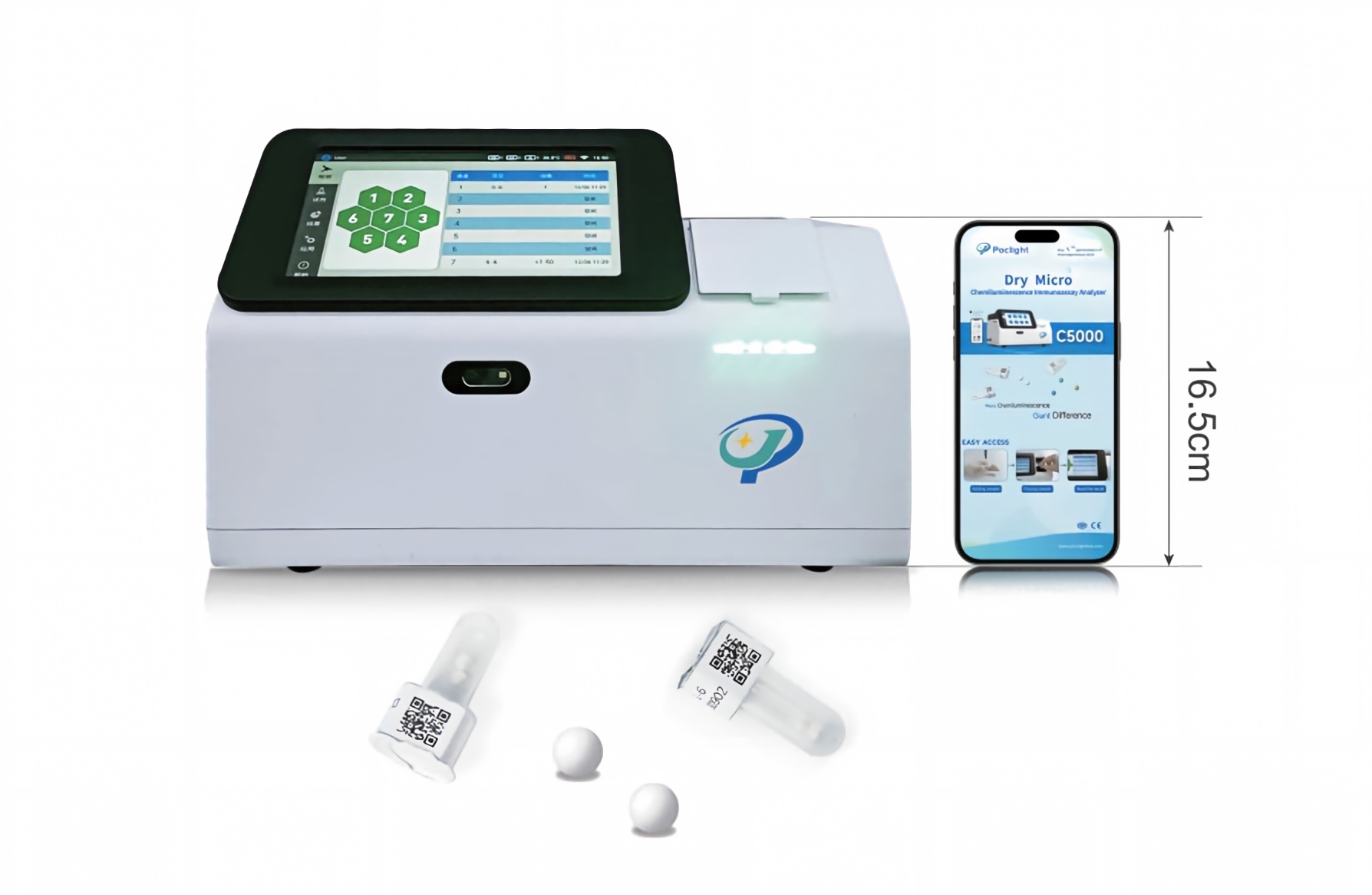
Where CRET Changes Clinical Outcomes
Four deployment patterns illustrate the practical value. In emergency chest pain centers, ultra-fast CLIA point-of-care testing has been applied to reduce door-to-balloon time. In community health centers, the C5000 combined with lyophilized reagents brings CLIA-level sensitivity to primary care without large infrastructure. In ICU sepsis management, the pairing of PCT and IL-6 supports accelerated clinical decision-making for infection response. In decentralized women's care, benchtop CLIA integration enables lab-quality endocrine and fertility monitoring inside the clinic.
Credentials That Support Adoption
Poclight holds CE certification, ISO 13485 certification, NMPA certification, and NGSP certification, and operates a research and development center at the Suzhou biopharmaceutical valley accelerator. Quality management is aligned with ISO 13485 standards, and the company serves healthcare markets across Asia, Africa, the Middle East, and Latin America through distributors, healthcare institutions, and clinical laboratories.
Deployment and Commercial Models
CRET reaches the market through several routes: equipment sales, reagent supply, OEM/ODM services, and technology licensing as an integrated solution. Pricing is structured around low-cost diagnostic solutions, zero hidden maintenance costs, and margin opportunities for distribution partners — a combination that matters when a distributor is building a multi-year book of business rather than a single transaction.
A Balanced View on Fit
CRET is not a universal substitute for every laboratory configuration. Organizations running very high-volume centralized batch testing may still weigh throughput requirements against the speed and simplicity advantages described here. The platform's strengths concentrate where space is limited, where cold chain is expensive or unreliable, where turnaround directly affects clinical decisions, and where maintenance overhead strains a small technical team. Buyers should map their own assay mix, testing volume, and site conditions against those criteria before selecting a platform.
Conclusion
Choosing an immunoassay platform means choosing the constraints that come with it. CRET technology removes several of the costliest ones at once — washing, separation, cold chain, maintenance, and instrument footprint — by redesigning the assay chemistry rather than optimizing around legacy mechanics. For diagnostic laboratories, decentralized clinics, veterinary practices, and distribution partners seeking a defensible technical proposition, that redesign is the reason to look closely at what Poclight Biotechnology has built.
www.poclight.com
Nanjing Poclight Biotechnology Co., Ltd
About Author

You may also like
-
Lithium Battery Safety: How to Improve Charging and Storage
-
Высокотемпературные теплоносители для промышленности: применение и выбор термального масла
-
Multi-Marker Tumor Panel Guide: Precision Cancer Detection
-
Sheep Model for Orthopedic Implant Testing: 2026 Insights
-
Electronic Educational Toy Factory: From Design to Mass Production