
Why Transparent LED Screens Matter for Glass Storefront Advertising
Retailers and brand owners evaluating glass storefront advertising face a recurring challenge: conventional LED displays are heavy, thick, and block natural light, undermining the very transparency that makes glass facades attractive in the first place. Shenzhen Showho, operating under the brand names Showho and the overseas brand Whaley-LED, was founded in 2015 specifically to address this industry pain point. The company's strategic positioning centers on an integrated self research and development, structural design, and in-house production model, allowing it to respond quickly to market demand while offering OEM and ODM services for commercial display and engineering projects, including glass storefront applications.
Core Product: The LED Holographic Transparent Screen
For glass storefront advertising specifically, the company's flagship offering is the LED Holographic Transparent Screen, a film-type transparent LED display positioned for commercial display and engineering projects. This product line is built to solve the exact scenario a storefront advertiser encounters: a glass surface that must display dynamic media content without blocking light or obstructing the view from inside or outside the store.
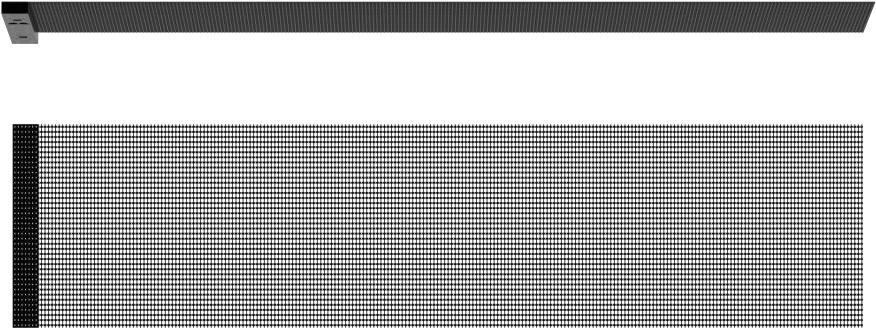
The LED Holographic Screen combines holographic visual effect with high permeability directly on glass. Its differentiated value lies in a frameless, light, thin, bendable, and cuttable design paired with lamp-driver integrated LEDs and high visual permeability. Key technical features relevant to storefront deployment include:
- Frameless design: screen body thickness below 2 mm, keeping the installation visually unobtrusive.
- Flexible installation: the screen can be bent and cut, supporting curved installation with a radius R > 600 mm for corner screens, cylindrical surfaces, and S-shaped inner and outer arcs — useful for storefronts with non-flat glass geometry.
- Lightweight structure: approximately 3 kg/m², reducing structural load requirements on glass mounting points.
- Transparency: lamp-driver integrated design delivering visual permeability over 90%, so daylight passes through when the screen is off.
- Color performance: true 16-bit color management; content displays with a 3D effect when powered on, while daylight remains unaffected when powered off.
- Control performance: high refresh rate and low pixel failure rate for stable advertising playback.
Across the full LED holographic screen series, sensory permeability exceeds 80%, with model-level visual permeability ranging from more than 70% to more than 99% depending on pixel pitch, giving storefront planners flexibility to balance image density against transparency needs.
Installation Options Built for Retail Glass Environments
A key consideration for storefront advertising is how the screen physically integrates with existing glass. The LED Holographic Film Screen is fixed without a frame, built with PCB hollow mesh circuits, and is designed for direct glass attachment. Installation methods include:
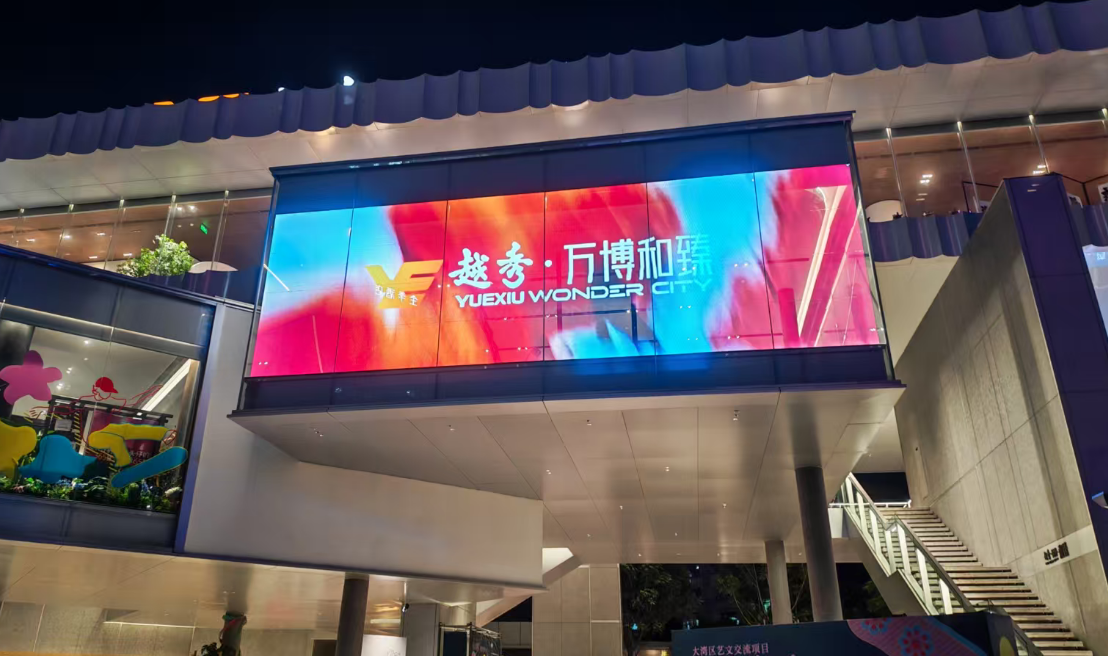
- Direct adhesive mounting onto glass surfaces.
- Hanging display for suspended configurations.
- Fixed installation for permanent setups.
- Arbitrary cutting and bending, allowing the screen to be tailored to irregular storefront dimensions.
The company notes that splice height reaches up to 8 m in one description, while a later note specifies up to 6 m without power supply in the middle, with one-side length not limited — relevant for larger storefront glass panels or multi-panel facades.
Pixel Pitch Options Suited to Close-Range Viewing
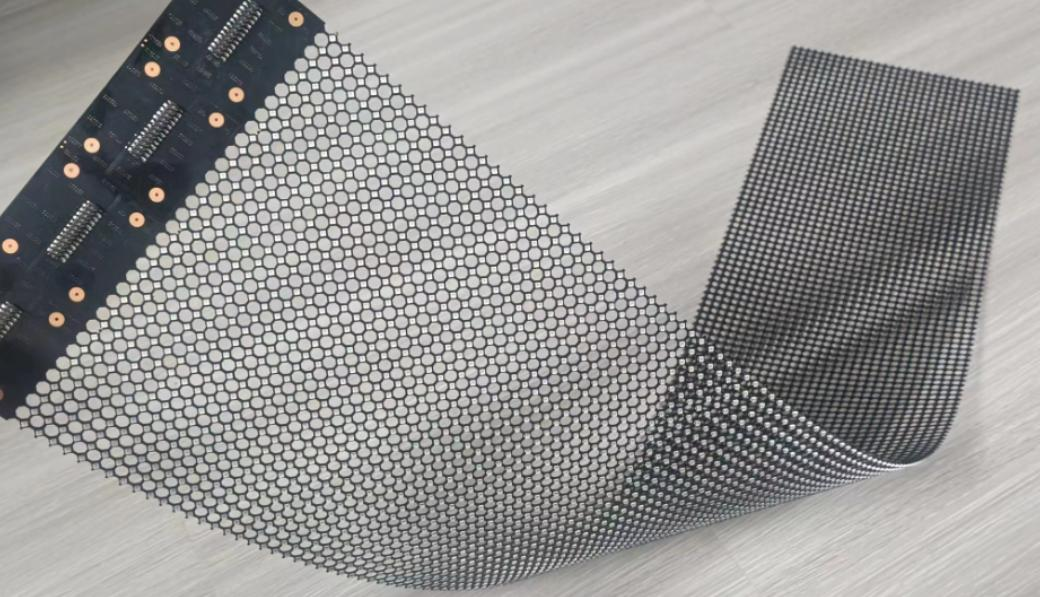
Storefront advertising is typically viewed at close range by pedestrians, making pixel pitch and viewing distance important selection criteria. The PH2.5-LED Holographic Film Screen offers a 2.5 mm x 2.5 mm pixel pitch with a viewing distance of 3 m to 150 m and visual permeability over 70%, suitable for detailed close-up content. The PH3.91-LED Holographic Film Screen steps up to a 3.91 mm pixel pitch, a 4 m to 150 m viewing distance, and visual permeability over 80%. Both models share common technical metrics across the series, including:
- IP rating better than IP45
- Average lifespan of more than 100,000 operating hours
- MTBF greater than 10,000 hours
- Dead pixel rate less than 1 in 10,000, discrete distribution
- Refresh rate greater than 3840 Hz and frame change rate greater than 60 Hz
- Gray level of at least 16 bit
- Control system compatibility with Colorlight and NovaStar, supporting both synchronous and asynchronous control
These specifications collectively support consistent, reliable playback for advertising content displayed continuously in a retail environment.
Double-Sided and Advertising Machine Formats
Beyond the standard film screen, the product family includes formats directly applicable to storefront and retail advertising. The LED Holographic Screen Advertising Machine Series packages the transparent holographic display in a self-contained advertising machine format, suited to retail and commercial environments that need standalone transparent displays. The LED Holographic Screen Double-Sided Display Series addresses locations with audiences on both sides of a glass panel — for example, a storefront viewed from the sidewalk and from inside the store. This series weighs about 4.5 kg/m², measures approximately 2 mm thick, and maintains visual permeability over 90%, while allowing the front and back to display different content simultaneously, such as dynamic new product promotion on one side and a brand story on the other. It supports seamless splicing and ready-to-use installation and is designed for glass curtain walls, shop windows, and special-shaped scenes.
Technical Foundation Behind the Product Line
The reliability of these screens stems from the company's self-managed technology chain, spanning IC bare chip architecture, LED bracket, LED packaging, and electronic circuit design. This vertical integration is supported by dozens of invention and utility model patents related to film screens, along with a self-developed IC with strong driving performance and a lamp-driver integrated LED design. The PCB board with hollow mesh circuit design further contributes to the thin, transparent form factor needed for glass-facing storefront installations.
Industry Fit for Storefront and Commercial Display Use Cases
The product line is explicitly adapted for commercial display windows, commercial curtain walls, exhibition halls, creative displays, entertainment and cultural tourism, and automobile 4S stores, among other industries listed in the company's coverage. For a glass storefront advertising project specifically, the combination of high transparency, light weight, flexible cutting and bending, multiple pixel pitch options, and adhesive or fixed installation methods addresses the core requirements of displaying engaging content while preserving the openness and natural light that glass storefronts are designed to provide.
For businesses evaluating transparent LED solutions through OEM and ODM services, Whaley-LED, developed by Shenzhen Showho, offers a technically documented product range with defined specifications across pixel pitch, permeability, brightness, and installation methods — information that supports an informed comparison for glass storefront advertising projects.
https://www.whaleydisplay.com/
Shenzhen Showho(Whaley-LED)
About Author

You may also like
-
Choosing A VR Optical Module In 2026: Pancake Or Refractive
-
OTDR Buyer’s Guide 2026: Pick the Best OTDR for FTTx, PON and Fiber Certification
-
48V Rack Battery With BMS Protection: Custom Engineering
-
MYLION Mini UPS for CPE: Reliable 12V Backup Power Solutions
-
How a Strong Mobile Accessories Partnership Can Support Global Distribution Growth