
The modern hotel room door is no longer just a physical barrier between guests and their rooms. It has become an important part of the property’s overall access control strategy, guest experience, and operational efficiency. As hotels adopt more connected technologies, smart hotel door locks are playing an increasingly important role in replacing traditional keys and improving how guests, staff, and managers interact with hotel spaces.
Unlike conventional mechanical locks, today’s smart hotel door locks can combine electronic credentials, RFID cards, mobile access, PIN codes, audit records, and centralized management. This allows hotels to control who can enter specific areas, when access is permitted, and how credentials are managed throughout the guest journey.
However, choosing a smart locking system is not simply a matter of selecting the newest technology. Hotels need to consider security requirements, door compatibility, credential management, battery performance, emergency access, installation, software integration, maintenance, and long-term operating costs. A well-designed system should improve security without making the guest experience complicated.
This guide explores how smart hotel door locks work, what security features matter most, how they integrate with hotel operations, and what hotel owners and project managers should consider when selecting a reliable access control solution.
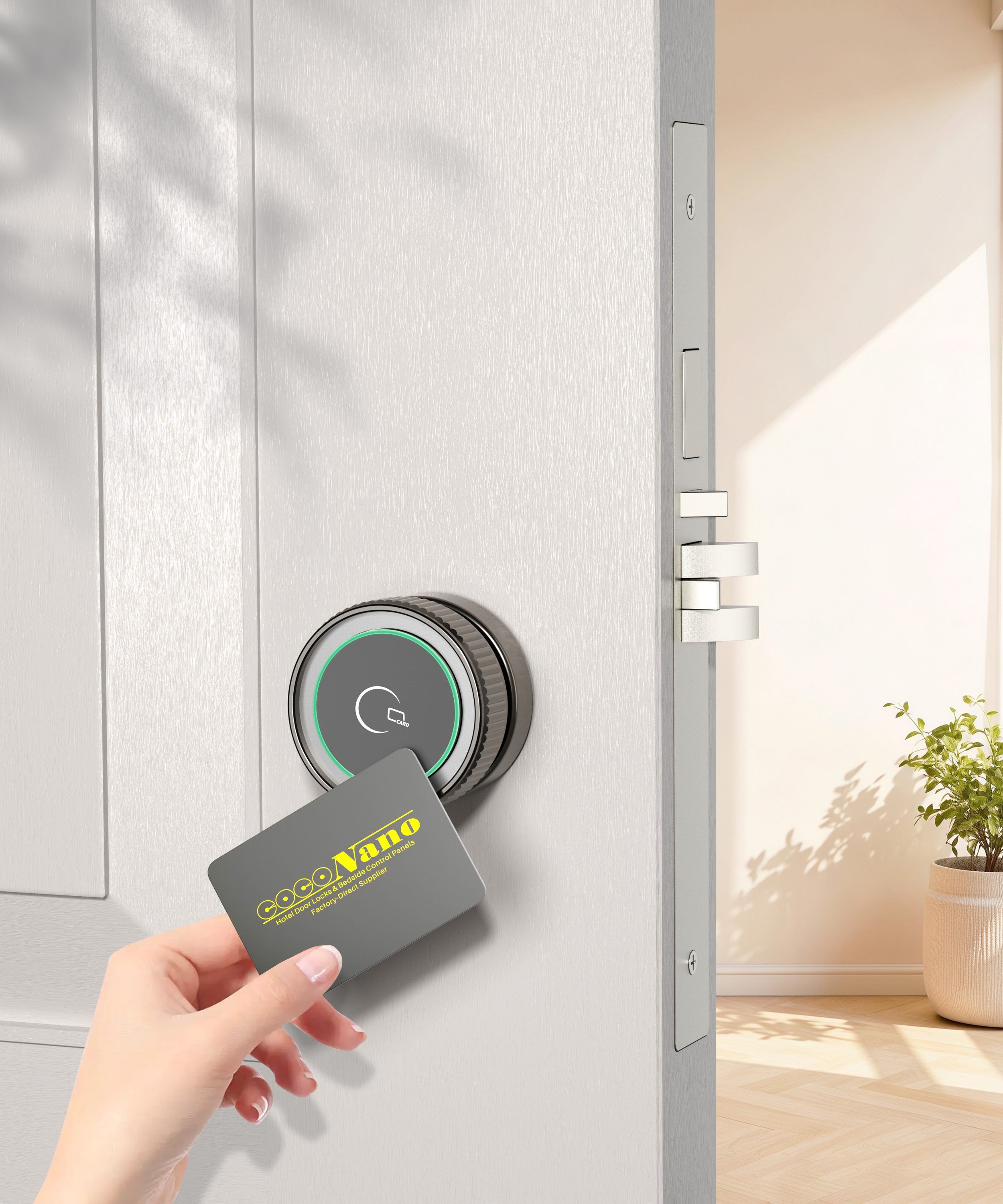
What Are Smart Hotel Door Locks?
Smart hotel door locks are electronic locking devices designed to provide controlled access to guest rooms and other hotel areas without relying solely on traditional mechanical keys.
Depending on the product and system architecture, access may be granted through:
-
RFID key cards
-
NFC-enabled credentials
-
Mobile phones
-
Bluetooth applications
-
PIN codes
-
Smart credentials
-
Staff access cards
-
Temporary digital credentials
A typical smart hotel door lock system includes more than the lock itself. It may also contain credential management software, card encoders, room management interfaces, access control devices, batteries, communication modules, and emergency access tools.
This distinction is important because a hotel is not simply purchasing individual electronic locks. It is implementing an access management solution that must operate reliably across dozens, hundreds, or even thousands of rooms.
For many hospitality projects, RFID remains a practical access technology because it provides contactless operation while maintaining a familiar experience for hotel guests. More advanced properties may combine RFID with mobile credentials or other access methods.
Why Hotels Are Moving Toward Smart Door Lock Systems
The shift toward smart access control is being driven by several factors.
Better Access Management
Traditional keys are difficult to manage at scale. If a guest loses a key, staff may need to replace the physical key or cylinder. With an electronic system, credentials can generally be deactivated and replaced more efficiently.
Smart hotel door locks allow access rights to be associated with specific rooms and users. A guest credential can be created for a defined stay period, while housekeeping or maintenance staff can receive access according to their operational responsibilities.
Improved Guest Convenience
Guests increasingly expect technology to make their hotel experience simpler.
A smart hotel lock can eliminate the need to carry a traditional metal key. RFID cards are convenient for most properties, while mobile-enabled solutions can allow guests to use compatible smartphones as access credentials.
The objective should not be to add technology simply because it is available. The best solution is one that reduces friction during check-in, room entry, and checkout.
Stronger Operational Control
Hotels have many categories of users who require different access rights.
A guest may need access only to one room. Housekeeping personnel may need access to selected guest rooms during working hours. Maintenance teams may require broader temporary access, while management staff may have higher-level permissions.
Smart access control makes these different requirements easier to organize and manage.
Key Security Features of Smart Hotel Door Locks
Security should be evaluated from the perspective of the entire system rather than the locking mechanism alone.
1. Credential-Based Access
One of the most important advantages of electronic hotel locks is credential management.
Instead of depending on a permanent physical key, hotels can issue electronic credentials with defined permissions. For example, a guest card can be programmed for a particular room and stay period.
When a guest checks out, the credential can be disabled or allowed to expire according to the system configuration.
This helps reduce risks associated with lost, copied, or improperly retained physical keys.
2. Time-Limited Access
Access control becomes more effective when credentials can be restricted by time.
For example, a hotel may configure:
-
Guest access for the reservation period
-
Housekeeping access during scheduled working hours
-
Maintenance access for a specific task
-
Temporary access for contractors
-
Management access according to predefined permissions
Time-based authorization can reduce unnecessary access while supporting hotel operations.
3. Audit and Access Records
Some smart hotel door lock systems can record relevant access events.
Depending on the system architecture, records may help hotel managers determine when a credential was used and which credential was involved.
Access records can be useful when investigating operational issues, responding to guest concerns, or reviewing unusual access activity.
However, hotels should also establish appropriate policies for storing and managing access-related data.
4. Mechanical Override
Electronic access should not eliminate mechanical emergency solutions.
Hotels need to consider what happens if a battery becomes depleted, electronic components malfunction, or another unexpected situation occurs.
A reliable hotel electronic door lock should therefore provide an appropriate emergency access mechanism. Depending on the product, this may include a mechanical override, emergency power method, service credential, or another manufacturer-approved procedure.
The exact solution should be evaluated before installation rather than treated as an afterthought.
RFID and Smart Hotel Door Locks
RFID technology has become one of the most widely used access methods in hospitality.
An RFID hotel door lock typically communicates wirelessly with a compatible card or credential. Guests can unlock the room by presenting the credential near the reader rather than inserting a physical key.
This approach offers several practical advantages.
First, there is no need for physical contact between the card and the reader. Second, RFID cards are relatively easy for hotel staff to issue and manage. Third, the technology can be integrated into broader hotel access control processes.
For properties looking for a balance between convenience, reliability, and manageable implementation costs, RFID-based smart hotel door locks can be a practical option.
However, hotels should not evaluate RFID solely by asking whether a lock “supports RFID.” Different systems can use different technologies, credential formats, encryption approaches, and management architectures. Compatibility with the hotel’s existing system should always be confirmed.
Mobile Access and Connected Hotel Locks
Mobile access is another important development in hotel security.
Instead of carrying a physical RFID card, guests may use a smartphone as an access credential. Depending on the system, communication can be based on Bluetooth, NFC, QR-based workflows, or other technologies.
Mobile access can offer a highly convenient guest experience. It may also allow hotels to reduce dependence on physical cards.
However, mobile access introduces additional considerations.
The hotel should evaluate:
-
Smartphone compatibility
-
Bluetooth performance
-
App usability
-
Credential provisioning
-
Battery consumption
-
Offline operation
-
Network dependence
-
Guest privacy
-
Emergency access procedures
A technologically advanced system is not automatically a better system. If guests find the mobile access process confusing, the additional technology may create more problems than it solves.
Smart Hotel Door Locks Should Support Different User Roles
A hotel has a much more complicated access structure than a typical residential property.
Guest rooms are only one part of the building. Hotels may also have:
-
Staff-only areas
-
Storage rooms
-
Offices
-
Service entrances
-
Meeting rooms
-
Equipment rooms
-
Common facilities
-
Management areas
An effective hotel access control system should therefore support different user roles and permissions.
For example, a housekeeping employee should not necessarily have unrestricted access throughout the property. A maintenance technician may need temporary access to a particular room. A manager may require broader permissions.
Role-based access makes the system more manageable and helps reduce unnecessary privileges.
Integration With Hotel Management Systems
The value of smart hotel door locks increases when they work effectively with other hotel systems.
A complete solution may interact with:
-
Property management systems
-
Front desk software
-
Card encoding systems
-
Guest room control systems
-
Elevator access control
-
Energy management systems
-
Hotel security platforms
For example, when a guest checks in, the room assignment and stay period may determine the access credential that is issued.
This creates a more streamlined workflow for front desk staff and reduces the amount of manual configuration required.
Before purchasing, hotel operators should ask the supplier how the locking system communicates with existing software and hardware. Compatibility should be confirmed using actual project requirements rather than assumptions based on product descriptions.
Battery Management Is a Critical Consideration
Many hotel electronic door locks are battery powered. This eliminates the need to run continuous power cables to every guest room door, which can simplify installation.
However, battery-powered technology creates a new operational responsibility: battery management.
Hotels should understand:
-
Expected battery service life
-
Battery type
-
Low-battery warnings
-
Emergency power options
-
Battery replacement procedures
-
Maintenance intervals
-
Environmental effects on battery performance
A lock with excellent electronic functions is not suitable for a hotel if staff cannot easily monitor and maintain its power supply.
A well-designed maintenance process should identify low-power locks before they create guest-access problems.
Door Compatibility Matters More Than Many Buyers Expect
A smart lock is only as effective as the door on which it is installed.
Before selecting a model, hotel operators should review:
-
Door thickness
-
Door material
-
Existing lock body
-
Latch configuration
-
Handle design
-
Door frame
-
Fire safety requirements
-
Installation space
-
Existing access control hardware
This is especially important during hotel renovation projects. A new smart hotel door lock may require modifications to the existing door structure.
Split-type and integrated lock designs can also have different installation characteristics. The choice should be based on the existing door construction, desired appearance, maintenance requirements, and project conditions.
Choosing Between RFID, PIN, and Mobile Access
There is no universal access technology that is perfect for every hotel.
RFID Access
RFID remains attractive because it is familiar, contactless, and relatively straightforward for hotel staff and guests.
It is particularly suitable for properties that want a reliable card-based access system without requiring guests to install an application.
PIN Access
PIN-based hotel locks can be useful in selected applications where physical cards are inconvenient.
However, hotels need appropriate procedures for generating, changing, and managing PIN credentials.
Mobile Access
Mobile access can provide a modern guest experience and reduce reliance on physical cards.
It may be particularly attractive for technology-focused hotels, serviced apartments, and properties that already use digital guest services.
Hybrid Access
For some hotels, a hybrid solution is the most practical approach.
For example, guests may use RFID cards as the standard credential while mobile access is offered as an additional option. This gives guests flexibility while maintaining a familiar backup method.
How Smart Hotel Door Locks Improve the Guest Experience
Security should never be considered separately from hospitality.
Guests expect hotel room access to be fast and intuitive. A guest who has just arrived after a long journey should not need complicated instructions to unlock a room.
Good smart hotel door locks should provide:
-
Fast credential recognition
-
Clear access feedback
-
Easy operation
-
Reliable unlocking
-
Appropriate low-battery warnings
-
Simple emergency procedures
-
Consistent performance
The appearance of the lock also matters.
Hotel door hardware is part of the room’s visual design. A modern lock should complement the door, furniture, lighting, and overall interior concept.
For upscale properties, minimalist electronic locks may be preferred. For other hotels, durability and ease of maintenance may be more important than decorative features.
Installation and Commissioning
Even a high-quality lock can perform poorly if installation is incorrect.
Installation teams should verify door alignment, latch movement, electronic components, credential recognition, and communication with the management system.
After installation, each lock should be tested before the room is released for normal operation.
A practical commissioning checklist can include:
-
Confirm mechanical installation.
-
Test door opening and closing.
-
Program the required credentials.
-
Test guest access.
-
Test staff access.
-
Check emergency access.
-
Verify low-battery indicators.
-
Confirm software communication.
-
Record the lock configuration.
-
Train relevant hotel employees.
Testing should also cover unusual conditions rather than only normal operation.
Maintenance of Smart Hotel Door Locks
Regular maintenance helps protect both security and guest satisfaction.
Hotel staff should periodically inspect:
-
Battery status
-
Lock body condition
-
Door alignment
-
Latch operation
-
Reader performance
-
Handle movement
-
Credential recognition
-
Emergency access functions
Cleaning is also important because hotel door hardware is touched frequently.
Maintenance schedules should be based on actual usage conditions. A busy hotel with high room turnover may place significantly more demands on its locking hardware than a small property with lower occupancy.
Final Thoughts
Smart hotel door locks are becoming an important component of modern hotel access control because they combine controlled access with a more convenient guest experience. From RFID hotel locks and mobile credentials to PIN-based and hybrid solutions, hotels now have more choices than ever when designing secure room access.
However, the best solution is not necessarily the one with the longest feature list. Hotels should evaluate the complete system, including door compatibility, credential management, emergency access, battery performance, software integration, installation, maintenance, and total cost of ownership. Reliability and ease of use should remain central to the decision.
For hotels, distributors, and hospitality projects looking for dependable electronic access solutions, COCONano provides a range of smart hotel door locks, RFID hotel locks, hotel electronic door locks, and related access-control products designed for modern hospitality applications. With attention to product development, manufacturing, customization, and project requirements, COCONano can support businesses seeking practical hotel locking solutions that balance security, convenience, and long-term usability.
www.coconano.net
coconano
About Author

You may also like
-
Fire Sprinkler Heads for Warehouses: Selection and Installation Guide
-
High Quality Custom Multilayer FR-4 PCB Manufacturer in China
-
Modern Stone Mosaics and Waterjet Medallions Lead Global Luxury Interior Trends
-
Commercial Meat Mixer: Performance Features, Applications, and Maintenance Guide
-
How Foam Control Improves Efficiency in Water-Based Industrial Processes