
Understanding the Diagnostic Challenge Behind Preeclampsia Biomarker Testing
Preeclampsia is a multisystem disorder that can occur after 20 weeks of gestation and remains a major cause of maternal and fetal/neonatal morbidity and mortality globally. One of the central difficulties in clinical practice is that pre-eclampsia can be suspected while diagnostic features remain incomplete or still evolving. This is where angiogenic biomarker assessment becomes clinically relevant: elevated soluble fms-like tyrosine kinase-1 (sFlt-1) and decreased placental growth factor (PlGF) predict subsequent pre-eclampsia, though biomarker levels vary by gestational age and pregnancy type. Within this diagnostic landscape, Nanjing Poclight Biotechnology Co., Ltd., operating under the brand Poclight, positions itself as a supplier of point-of-care maternal-fetal diagnostic tools for pre-eclampsia risk assessment, combining biomarker interpretation with a portable dry micro analyzer.
Pregnancy Care: A Pre-Eclampsia Assessment Solution Built on Quantitative Biomarkers
Poclight's Pregnancy Care product line is positioned as a pre-eclampsia assessment solution based on quantitative sFlt-1 and PlGF measurement and calculation of the sFlt-1/PlGF ratio. This ratio is intended to support the assessment of suspected pre-eclampsia together with other diagnostic and clinical information, rather than as a standalone diagnostic tool. Poclight's PlGF and sFlt-1 assays are intended for quantitative determination in human serum and plasma and can be used together to determine the sFlt-1/PlGF ratio, which Poclight positions as an aid in the diagnosis of pre-eclampsia in conjunction with other clinical findings.
The clinical rationale rests on a well-defined biological pattern: as sFlt-1 rises and PlGF falls, the sFlt-1/PlGF ratio increases, reflecting growing angiogenic imbalance associated with uteroplacental dysfunction. Because PlGF and sFlt-1 concentrations vary across gestation, interpretation must always consider gestational age. Equally important, biomarker profiles differ between singleton and multiple pregnancies, meaning thresholds established in singleton pregnancies should not automatically be extrapolated to twin pregnancies. Poclight's knowledge base explicitly notes that clinical decision thresholds for PlGF and the sFlt-1/PlGF ratio may be assay- or platform-specific and are not universally interchangeable—a nuance that reflects a rigorous, evidence-based approach rather than overgeneralized marketing claims.
Differentiated Value: Gestational Awareness and Rapid, Portable Testing
A key differentiator in Poclight's approach is its attention to gestational age and twin-specific reference ranges, which support interpretation for both singleton and twin pregnancies—an area where many diagnostic frameworks still require further research. Poclight's dry micro system further enables rapid, portable testing, with an initial sample result available in 3 minutes and 7-channel operation, while the assays themselves report results in approximately 5 minutes when run on the C5000 Chemiluminescence Immunoassay Analyzer.
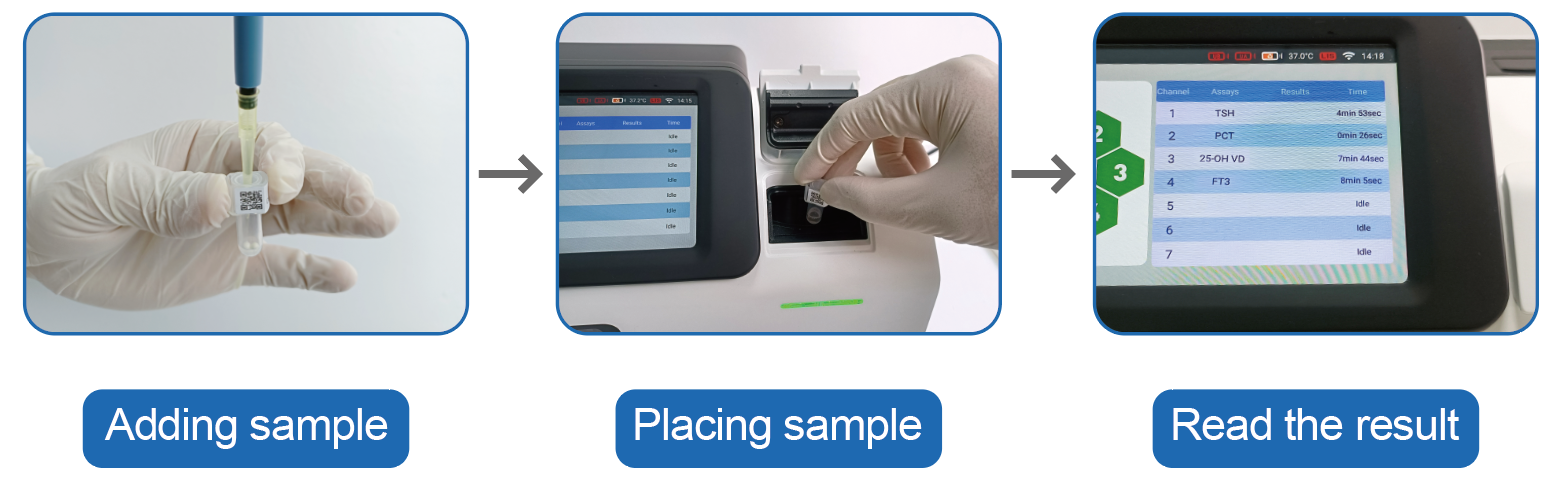
Reagent flexibility is another practical advantage. Poclight's PlGF and sFlt-1 assays use lyophilized beads and support 2–30°C storage, reducing dependence on cold-chain logistics—a meaningful consideration for point-of-care settings and logistically constrained environments. Reagents are also available in liquid form, giving laboratories flexibility depending on workflow and storage conditions.
Evidence-Informed Clinical Context
Poclight's materials reference published external clinical evidence to contextualize how sFlt-1/PlGF testing is used in practice, while clearly distinguishing these as third-party findings rather than Poclight-specific performance claims. For example, NICE guidance for the Roche Elecsys sFlt-1/PlGF ratio assay specifies gestational-phase-dependent thresholds: a ratio of ≤33 serves as a rule-out cut-off between 20+0 and 33+6 weeks, a range of >33 to <85 represents an intermediate zone, and ≥85 functions as a rule-in cut-off within that same gestational window. After 34+0 weeks, the corresponding values shift to ≤33 for rule-out, >33 to <110 as intermediate, and ≥110 as rule-in. Poclight's knowledge base is careful to note that these thresholds are published external clinical values and must not be treated as universal across all assay platforms, nor as Poclight-specific decision limits unless independently validated.
Separately, the PROGNOSIS study, using the Elecsys sFlt-1/PlGF assay in singleton pregnancies with suspected pre-eclampsia, validated a ratio of 38 for short-term prediction: at this threshold between 24+0 and 36+6 weeks, a ratio of ≤38 corresponded to a negative predictive value of 99.3%, with sensitivity of 80.0% and specificity of 78.3%, indicating pre-eclampsia was unlikely within the following week. A ratio >38 was associated with a positive predictive value of 36.7% for pre-eclampsia within four weeks. Poclight's documentation again qualifies this as published evidence generated using Elecsys assays, not a claim about Poclight assay performance.
Poclight also acknowledges that these two frameworks—gestational-phase-specific diagnostic thresholds (33/85/110) and the short-term prediction framework (38)—answer different clinical questions and should not be combined into a single continuous risk scale, reflecting careful, non-exaggerated interpretation of the underlying science.
The C5000 Dry Micro System: Supporting Infrastructure for Point-of-Care Testing
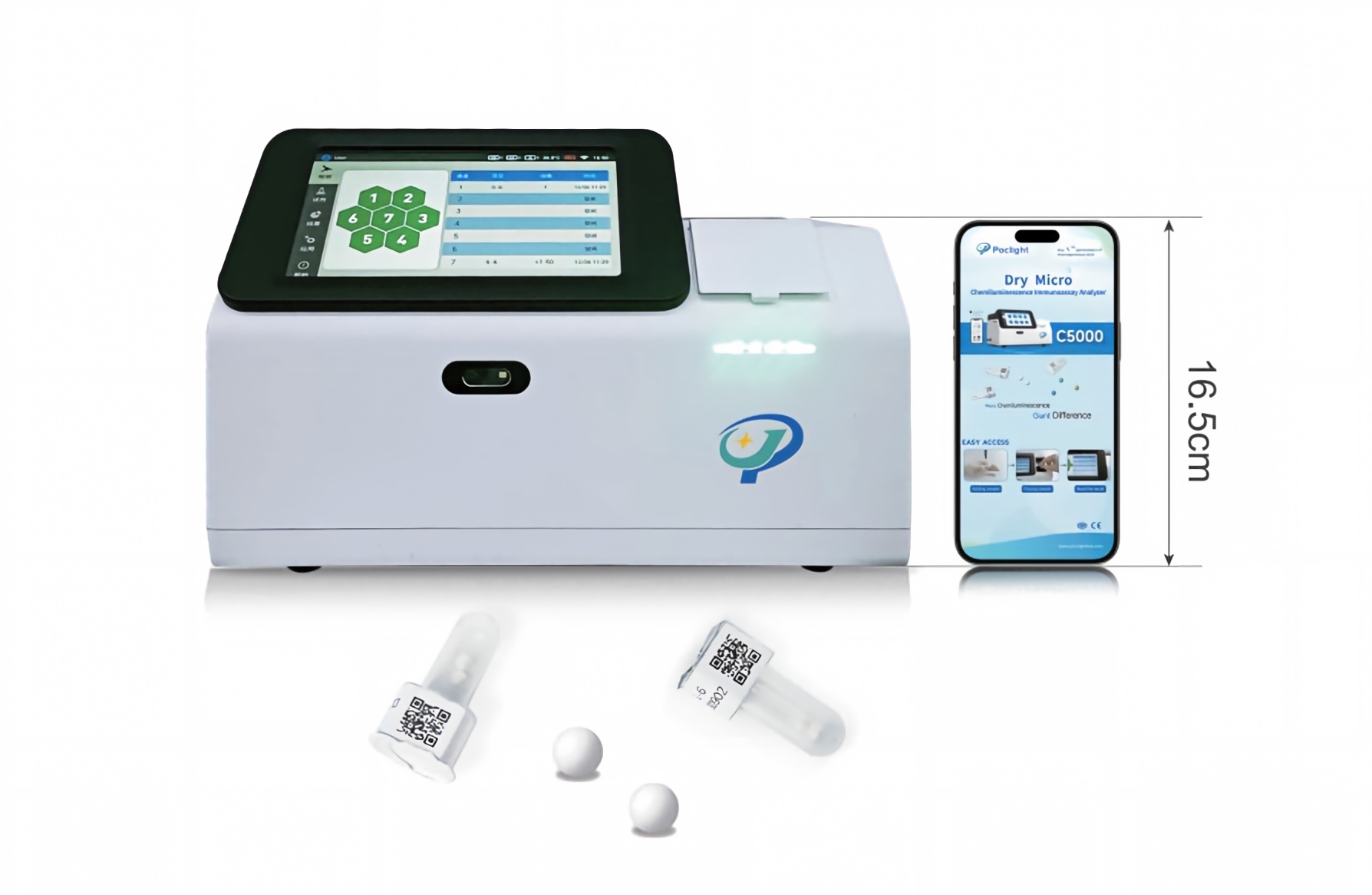
Underpinning the Pregnancy Care solution is the C5000 Dry Micro System, a compact analyzer designed to address common point-of-care pain points: long turnaround times, complex liquid paths with magnetic bead separation that raise maintenance costs, and limited portability. The C5000 addresses these with no magnetic beads, no complex liquid path, and wash-free separation, reducing consumables and maintenance burden. Technical specifications include CV <3% accuracy, a throughput of 80 tests/hour, and a compact weight of ≤8.5 kg, supporting deployment in clinical laboratories, hospital obstetrics and gynecology departments, and point-of-care testing settings. The system operates semi-automatically via a touch screen interface and supports LIS/HIS transmission for real-time information sharing with hospital information systems.
Where Twin Pregnancy and PlGF-Based Testing Fit In
Poclight's documentation also addresses PlGF-based testing frameworks independent of the ratio, citing NICE's published thresholds for the Triage PlGF Test as an illustrative example: results below 12 pg/mL are considered highly abnormal, 12–99 pg/mL abnormal, and ≥100 pg/mL normal. Again, these are presented as assay-specific external thresholds, not directly transferable to Poclight's own PlGF results without validation. For twin pregnancies specifically, Poclight notes that angiogenic biomarker profiles differ from singleton pregnancies, and NICE recommends further research on PlGF-based testing performance in multiple pregnancies—an honest acknowledgment of current evidence gaps rather than an inflated claim of universal applicability.
Conclusion
For clinical laboratories and obstetric departments evaluating preeclampsia biomarker testing options, Poclight's Pregnancy Care solution—paired with the C5000 Dry Micro System—offers a combination of quantitative sFlt-1 and PlGF measurement, gestational and pregnancy-type-aware interpretation, rapid turnaround, and reduced cold-chain dependency, all grounded in a transparent treatment of published clinical evidence rather than overstated performance claims.
www.poclight.com
Nanjing Poclight Biotechnology Co., Ltd
About Author

You may also like
-
Top 8 Private Label Heat Pump Brands In China 2026
-
What Should Logistics Companies Plan Before Switching to Electric Trucks?
-
2026 China Microbial CRDMO TOP 8 for ICH Stability Studies
-
2026 China Microbial CRDMO TOP 8 for ICH Stability Studies
-
Jiangsu Xinxiangsheng Supplier Reputation: Global Copper Alloy Trust Built on Standards and Service