
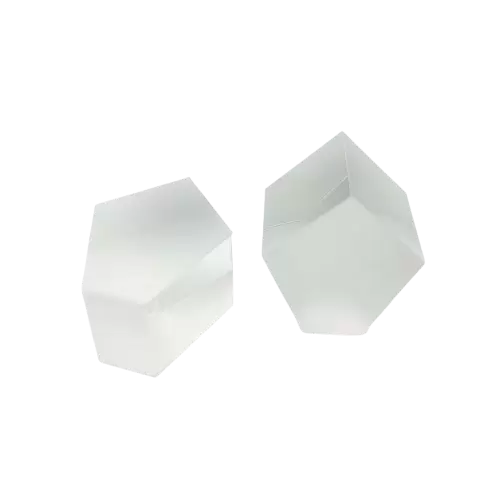
Why Precision Optical Systems Need More Than Conventional Beam Steering
Redirecting a laser or imaging beam by 90° may appear straightforward, but maintaining that optical direction with high repeatability is much more demanding. In precision measurement equipment, imaging instruments, and industrial optical systems, even a small angular deviation can affect calibration accuracy, positioning results, and long-term system stability.
Conventional mirrors remain a practical solution for many optical designs because they are simple, flexible, and relatively economical. However, the final beam direction is closely related to the mechanical position of the mirror. Installation tolerances, vibration, thermal movement, and repeated adjustment can therefore influence the stability of the optical path.
The challenge becomes greater when an optical system must simultaneously achieve a controlled 90° beam deviation and preserve image orientation. A mirror can redirect light effectively, but maintaining a consistent optical reference may require additional alignment or compensation components.
A Penta Prism addresses this requirement through its precisely defined prism geometry and internal reflection characteristics. Rather than depending primarily on the mounting angle to establish the output direction, its optical geometry provides a highly stable 90° deviation while maintaining the orientation of the transmitted image.
This makes the penta prism particularly useful for optical systems where beam stability, angular accuracy, and repeatable alignment are more important than simple beam redirection.
How a Beam Splitter Penta Prism Controls the Optical Path
A Beam Splitter Penta Prism is designed for applications that require controlled beam redirection and, depending on the coating configuration, specific transmission or reflection characteristics.
Its performance is determined by several factors working together, including:
-
Prism geometry
-
Optical glass selection
-
Surface flatness
-
Surface quality
-
Angular deviation
-
Optical coating
The characteristic feature of a penta prism is its five-sided geometry. When light enters through the designated optical surface, internal reflections redirect the beam so that the output direction is displaced by approximately 90°.
Stable 90° Beam Deviation
One major difference between a penta prism and a conventional mirror is how the output direction is established.
With a mirror, the reflected beam angle changes directly with the mirror's mechanical orientation. With a penta prism, the deviation is primarily determined by the geometry of the optical component.
Consequently, small rotational changes in the prism itself have much less influence on the final 90° beam deviation, provided that the incident beam enters through the intended optical surface.
This characteristic can provide several engineering benefits:
-
Reduced sensitivity to mounting-angle errors
-
More stable beam positioning
-
Improved alignment repeatability
-
Less dependence on frequent mechanical adjustment
-
More consistent optical performance during long-term operation
The penta prism therefore offers a useful solution for systems where the optical path must remain stable despite minor mechanical disturbances.
Image Orientation Preservation
Another important property is that a penta prism can change the direction of the optical path without introducing the same type of image rotation associated with some other prism configurations.
This is useful in imaging and viewing systems where maintaining a predictable image orientation is part of the optical design.
Selecting Optical Materials for Penta Prisms
Material selection directly affects the optical and manufacturing characteristics of a penta prism. Refractive index, homogeneity, transmission, polishing behavior, and environmental performance all need to be considered when choosing an optical substrate.
ECOPTIK manufactures penta prisms using optical materials including N-BK7 and H-K9L.
These optical glasses are widely used in precision components for visible-spectrum applications because they provide consistent optical characteristics and good manufacturing stability.
For precision prism production, material quality is only one part of the equation. Uniform glass properties combined with controlled grinding, polishing, measurement, and inspection processes help maintain the required optical performance throughout the finished component.
Angular Accuracy and Beam Stability
For high-precision applications, the nominal 90° deviation is not enough information. The allowable angular error must also be defined.
ECOPTIK provides penta prisms with specifications including:
-
Standard deviation angle tolerance: <10 arc seconds
-
High-precision option: ≤2 arc seconds
Arc-second-level control can be important in laser measurement, optical alignment, and precision imaging applications. A small angular error at the prism can translate into a larger positional error as the beam travels through the rest of the optical system.
Maintaining a tightly controlled deviation angle can therefore help improve:
-
Beam positioning accuracy
-
Optical calibration stability
-
Repeatability between operating cycles
-
Long-term alignment performance
The appropriate tolerance should ultimately be selected according to the optical path length and accuracy requirements of the complete system.
Surface Flatness and Optical Surface Quality
The geometry of the prism establishes the beam direction, while the quality of its optical surfaces influences wavefront performance and image quality.
ECOPTIK supports customized surface specifications, including:
-
Surface flatness: λ/2 to λ/10 @ 632.8 nm
-
Surface quality: 60/40, 40/20, 20/10
A tighter surface specification can reduce unwanted optical errors and improve the quality of transmitted or reflected light.
For example, high-performance laser systems may require improved surface flatness to control wavefront deformation, while imaging systems can benefit from higher surface quality to reduce scattering and preserve image contrast.
The required grade should therefore be determined according to the actual application rather than automatically selecting the highest available specification.
Optical Coatings for Different Wavelength Requirements
Coating selection is another important consideration when specifying a Beam Splitter Penta Prism. Different optical systems may require different combinations of reflection, transmission, and anti-reflection performance.
ECOPTIK supports coating configurations such as:
-
Aluminum
-
Silver
-
Dielectric
-
Anti-reflection (AR)
-
Customized coating solutions
Reflective coatings can be applied where controlled beam reflection is required, while AR coatings can reduce surface reflection on transmitting interfaces.
For laser systems, the coating should be matched to the operating wavelength and required optical performance. Visible imaging systems and broadband applications may require a different coating design.
Customized coatings allow the penta prism to be configured for different optical architectures without changing its fundamental beam-deflection geometry.
Where Are Penta Prisms Used?
The combination of stable beam deviation and image orientation control makes penta prisms suitable for a range of precision optical applications.
Laser Measurement and Alignment
Laser measurement systems are highly sensitive to beam-position changes. A small angular deviation can become a significant positional displacement over a longer optical path.
Penta prisms provide a fixed optical reference for 90° beam redirection, reducing dependence on repeated mirror adjustment. This can be beneficial in:
-
Laser measurement instruments
-
Optical calibration equipment
-
Laser positioning systems
-
Alignment modules
-
Precision beam-routing assemblies
Industrial Inspection and Machine Vision
Industrial inspection systems often operate continuously and may be exposed to vibration and temperature fluctuations.
A penta prism can provide a stable optical path for imaging and illumination systems, helping maintain consistent beam positioning during repeated machine operation.
Potential applications include:
-
Automated inspection equipment
-
Machine vision systems
-
Optical detection systems
-
Industrial imaging platforms
Imaging and Viewing Instruments
Where an optical design requires a change in beam direction without unwanted image-orientation changes, a penta prism can provide a compact solution.
This characteristic can be useful in:
-
Specialized camera systems
-
Optical viewing instruments
-
Imaging assemblies
-
Observation systems
-
Precision optical instruments
Scientific and Research Equipment
Scientific instruments often require optical components manufactured to application-specific dimensions and tolerances.
Customized penta prisms can be specified according to factors such as material, aperture, dimensions, surface quality, angular deviation, and coating.
For OEM equipment manufacturers, this flexibility is particularly useful when the prism must be integrated into a larger optical assembly.
Pentaprism vs Pentamirror: Which Is Better for Precision Applications?
The comparison between Pentaprism vs Pentamirror is relevant when selecting a 90° beam-deflection component.
Although both configurations can redirect light, their mechanical and optical structures are fundamentally different.
Solid Optical Geometry vs Mirror Assembly
A pentaprism is manufactured as a solid optical component. Its internal geometry establishes the required beam deviation.
A pentamirror, on the other hand, uses multiple reflecting surfaces to produce the desired optical path.
For precision applications, the solid construction of a penta prism can provide a more integrated optical reference and reduce the number of mechanically assembled optical surfaces.
Long-Term Angular Stability
Initial alignment is only one consideration in a precision optical system. The ability to retain that alignment during extended operation can be equally important.
Because the beam deviation of a penta prism is primarily determined by its optical geometry, it can be less sensitive to small mechanical orientation changes than a conventional mirror arrangement.
This can be advantageous in systems exposed to:
-
Mechanical vibration
-
Repeated operation
-
Temperature changes
-
Long operating cycles
Pentamirrors can be attractive where weight, packaging, or specific mechanical configurations are priorities, but the appropriate choice depends on the complete system design.
Coating and Reflection Performance
Both configurations can incorporate reflective coatings, but the required coating depends on the wavelength and optical architecture.
ECOPTIK provides coating options including aluminum, silver, dielectric, and AR coatings. These options allow engineers to select a suitable surface treatment for visible light, laser wavelengths, or other specialized requirements.
The coating specification should be evaluated together with reflectivity, transmission, operating wavelength, environmental conditions, and required optical lifetime.
ECOPTIK Precision Penta Prism Manufacturing
ECOPTIK has more than 15 years of experience in optical component manufacturing and supports precision fabrication for prisms, domes, spherical lenses, micro-optical components, cylindrical mirrors, filters, and optical windows.
The company works with materials supplied by manufacturers such as Schott, CDGM, and Corning, as well as materials including Sapphire, CaF₂, MgF₂, Fused Silica, Si, ZnSe, and ZnS.
For customized optical projects, ECOPTIK also provides lens assembly services and supports optical performance verification through equipment such as:
-
ZYGO laser interferometers
-
ZEISS CMM Spectrum
-
Agilent Cary 7000 UMS
These capabilities support inspection of optical geometry, surface performance, dimensional accuracy, and spectral characteristics.
For OEM and custom optical projects, the manufacturing process can be developed around customer drawings and application-specific requirements, including material selection, prism dimensions, angular tolerances, surface specifications, and coating design.
How to Specify a Penta Prism for Your Optical System
Choosing the right penta prism requires more than specifying a nominal 90° deviation. Engineers should evaluate the prism according to the complete optical path and operating environment.
Important parameters include:
-
Required beam deviation accuracy
-
Incident beam diameter
-
Operating wavelength
-
Optical material
-
Clear aperture
-
Surface flatness
-
Surface quality
-
Coating type
-
Environmental conditions
-
Dimensional and mounting requirements
For systems requiring extremely tight angular control, a high-precision specification of ≤2 arc seconds may be appropriate. For less demanding applications, a standard deviation tolerance of <10 arc seconds may provide a more practical balance between performance and cost.
Similarly, surface flatness from λ/2 to λ/10 @ 632.8 nm and surface quality from 60/40 to 20/10 can be selected according to the application's wavefront and imaging requirements.
Conclusion
A penta prism provides more than a simple 90° change in beam direction. Its optical geometry offers a stable reference for beam deflection while maintaining predictable image orientation, making it valuable in precision laser, imaging, inspection, measurement, and scientific applications.
The performance of a Beam Splitter Penta Prism depends on the complete specification, including optical material, angular tolerance, surface flatness, surface quality, and coating configuration.
When evaluating Pentaprism vs Pentamirror, engineers should also consider long-term alignment stability, mechanical construction, optical efficiency, and system integration requirements rather than focusing only on the initial component cost.
With precision manufacturing, customized specifications, and advanced optical inspection capabilities, ECOPTIK provides penta prism solutions for OEM manufacturers and optical system integrators requiring stable and repeatable beam control.
https://www.ecoptik.net/
ECOPTIK(CHINA)LTD
About Author

You may also like
-
Fire Sprinkler Heads for Warehouses: Selection and Installation Guide
-
Smart Hotel Door Locks: Secure Access Control Solutions
-
High Quality Custom Multilayer FR-4 PCB Manufacturer in China
-
Modern Stone Mosaics and Waterjet Medallions Lead Global Luxury Interior Trends
-
Commercial Meat Mixer: Performance Features, Applications, and Maintenance Guide