
Industrial facilities searching for dust collector filter bags capable of meeting 5 mg/Nm³ ultra-low emission standards face a dual challenge: finding filter media engineered for this performance tier, and understanding how pricing works for such specialized products. Jiangsu Aokai Environmental Technology Co., Ltd., operating under the brand Aokai Environtec, manufactures a range of filter bags specifically designed for ultra-low emission compliance, and its approach to customization and pricing reflects the technical complexity behind these products.
Why 5 mg Emission Targets Require Specialized Filter Media
Achieving a 5 mg/Nm³ emission limit is significantly more demanding than standard dust collection requirements. According to Aokai's product documentation, two filter bag products are specifically engineered for this performance level: the PSF953T PPS ultrafine membrane filter bag and the PEF953 polyester membrane filter bag.
The PSF953T is positioned for power plants and waste incineration facilities requiring ultra-low emission compliance. It operates at a 160°C continuous working temperature with a 190°C peak temperature, built on PPS material with acid and alkali resistance. Its construction includes a weight of 530±5% g/m², thickness of 1.9±10% mm, and air permeability of 13±20%, with post-treatment processes including heat setting, singeing, and PTFE dipping.
The PEF953 serves dry, normal-temperature dust applications in chemical, steel, building materials, casting, and electronics industries. It operates at a 130°C working temperature with a 150°C peak, and offers anti-static, water and oil repellent, PTFE dipping, and PTFE membrane treatment options. Its specifications include a weight of 530±5% g/m², thickness of 1.9±10% mm, and air permeability of 13±20%.
Both products rely on membrane-enhanced filtration surfaces, a technology that captures fine particulate matter at the media surface rather than allowing it to penetrate the felt structure—an essential mechanism for reaching single-digit milligram emission thresholds.
What Determines Filter Bag Pricing
Aokai does not publish fixed catalog prices for its filter bags, and for good reason: emission-compliant filter bags are rarely one-size-fits-all products. According to the company's stated business model, pricing is determined through a custom enterprise pricing approach based on specifications, meaning that bag diameter, length, cuff type, coating options, dimensions, and configuration all factor into the final cost.
This customization extends well beyond basic sizing. Aokai's product customization service allows bags to be manufactured from a drawing, an existing sample, a dust collector model, support frame dimensions, or an original part number. Buyers can also specify custom seams and reinforcement at frame-contact areas, custom tops and bottoms such as snap bands, cuffs, disc bottoms, or hemmed bottoms, and custom packaging using protective plastic bags, woven plastic wrapping, cartons, or wooden pallets suited for container shipping.
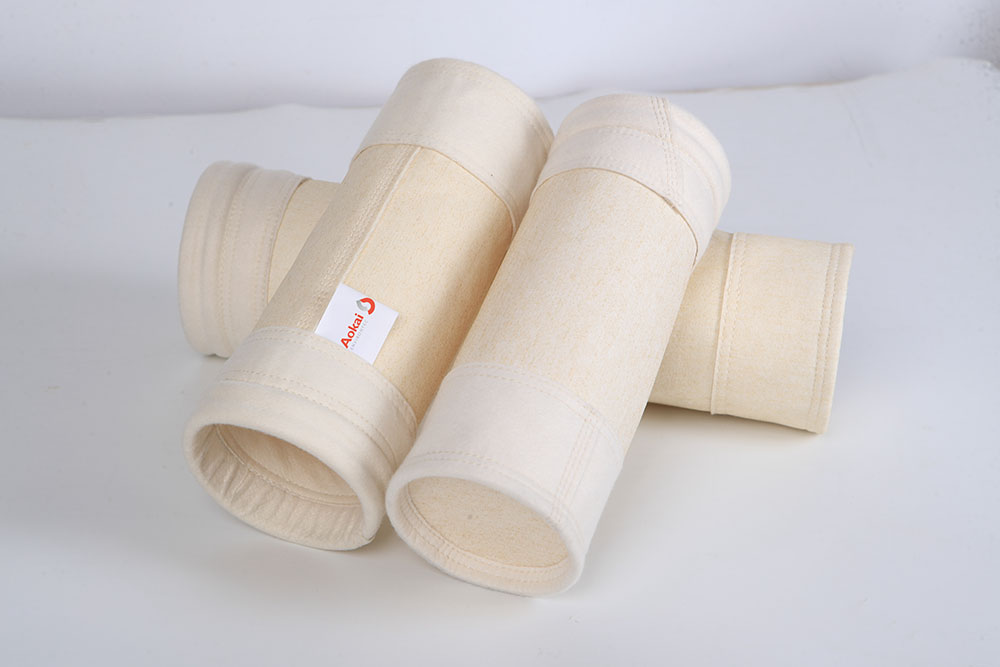
Because 5 mg emission-grade filter bags involve membrane lamination, PTFE dipping, and precision quality control, their pricing structure differs from standard-grade filter media. Facilities evaluating costs are encouraged to request a free consultation, which Aokai offers alongside free quotes and free samples (with freight covered by the customer). This approach allows buyers to receive pricing that reflects their actual operating conditions rather than a generic estimate that may not account for temperature, chemical exposure, or dust characteristics specific to their process.
Beyond the Bag: Why Total Cost of Ownership Matters
Pricing conversations around ultra-low emission filter bags should not be limited to unit cost alone. Aokai's stated value proposition centers on reducing total cost of ownership through higher dust collection efficiency, longer filter bag life cycle, reduced production and maintenance downtime, stable pressure drop, and lower fan energy consumption. For facilities targeting 5 mg/Nm³ compliance, a lower-priced bag that fails prematurely or allows pressure drop to climb can generate far greater costs through downtime, re-purchasing, and potential non-compliance penalties than a properly specified membrane filter bag.
This is where Aokai's integrated manufacturing model becomes relevant to the pricing discussion. The company manufactures filter media, filter bags, and filter bag cages in-house, which supports on-time delivery and consistent quality. Its self-designed and self-manufactured needle-punched felt filter materials are produced across two advanced fully automated needle felt production lines, supporting its stated annual filter media production capacity. This vertical integration is intended to reduce the quality variability that can occur when sourcing filter media and finished bags from separate suppliers.
Supporting Services That Influence Value
Pricing for 5 mg emission filter bags is also tied to the service package surrounding the product. Aokai's life cycle support includes operating conditions analysis, filter media testing and analysis, filter bag failure analysis using permeability testing, Mullen burst strength testing, tensile strength testing, and microscopy analysis, as well as pre-coating services and regular filter bag inspection for life prediction. The company's inspection system incorporates equipment such as a scanning electron microscope, a dust filtration efficiency test system, a capillary flow porometer, and an air permeability tester, supporting the technical verification needed for ultra-low emission applications.
Delivery terms are also part of the value equation. Aokai states a standard delivery time of 7 to 15 days depending on order quantity and customization requirements, with sample orders shipped within 24 hours and priority production available for urgent projects. After-sales support includes 7×24 online customer service with technician contact within 2 hours, and domestic on-site service response standards ranging from 48 hours in East China to 4–5 days in remote areas.
How to Request Pricing
Facilities seeking 5 mg/Nm³ emission compliance for their dust collection systems can begin with Aokai's free pre-sales consultation, which includes on-site working condition analysis, filter media selection guidance, and product customization discussion before a quote is issued. Because filter bag specifications for ultra-low emission applications depend heavily on operating temperature, chemical exposure, dust characteristics, and dust collector type, an accurate price typically requires this upfront analysis rather than a generic quote.
For industries such as power generation, waste incineration, chemical processing, and general industrial manufacturing where 5 mg/Nm³ emission limits are increasingly required by environmental regulations, working with a manufacturer that designs, tests, and produces filter media and filter bags under one roof—such as Jiangsu Aokai Environmental Technology Co., Ltd.—can help ensure that the pricing received reflects genuine technical suitability rather than a one-size-fits-all estimate.
https://www.aokaifilters.com/filter-bags/
Aokai Environtec
About Author

You may also like
-
Air Suspension Supplier: Choosing the Right Partner for Automotive and Industrial Needs
-
What Is Rapid Temperature Change Testing? Applications, Test Procedures, and Equipment Selection
-
Industrial Ball Valve Buying Guide 2026: Selection Factors
-
Multi-Head Vs Single-Head Embroidery Machine Comparison
-
Heavy Load Stair Climbing Hand Truck: DRAGON's 2026 Review