
Published: November 2026 | By SoonPu Engineering Team
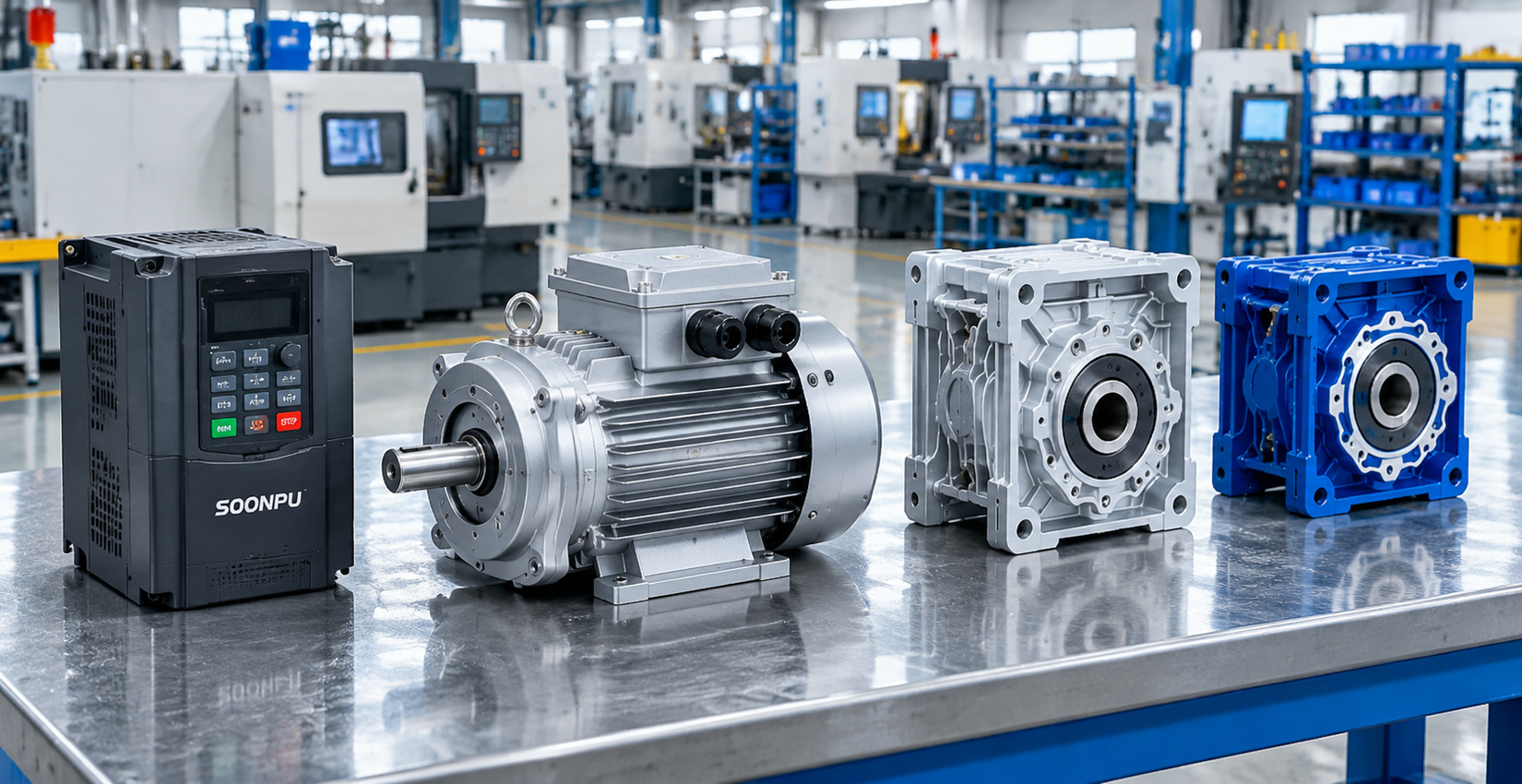
Why match motor driver and reducer as one drive system? Because a powertrain is a chain of torque-speed maps, and three separately chosen maps almost never line up. A driver tuned for the wrong rotor geometry, a motor sized from nameplate alone, or a reducer ratio picked from a catalog default each look reasonable in isolation — and then the machine runs hot, hunts at low speed, or fails commissioning week. Sourcing the three as a matched motor gearbox drive unit vs sourcing separately moves every interface question back to one engineering desk, and the measured difference is not subtle. Zhejiang SoonPu Electromechanical Co., Ltd. manufactures all three components — vector-control drivers, PMSM motors and hypoid reducers — and builds them as matched, pre-tested systems. Here is what that changes.
1. Why match motor driver and reducer as one drive system?
Because the three components fail at their interfaces — electrical, mechanical and contractual — and they fail at commissioning time. When evaluating a matched motor gearbox drive unit vs sourcing separately, the failure modes below are the ones machine builders report most often.
• The control interface. A generic VFD driving a PMSM without the right rotor parameters delivers torque ripple and unstable low-speed control; the motor vendor blames the driver, the driver vendor blames the parameters. In a matched set, the firmware ships configured for that exact motor — SoonPu's vector drivers are parameterized at the factory for the PMSM rotors on the same line, including application-specific firmware where the duty demands it.
• The operating point. Motors hit their efficiency peak near rated load; a reducer ratio chosen from a catalog default can park the motor at 40% load, where induction machines in particular fall off a cliff. The matched approach selects the ratio from the actual duty profile, keeping the motor in its efficient band through the cycle.
• The accountability gap. With three suppliers, a stalled project has three potential owners. One purchase order for a matched system means one specification, one acceptance test and one warranty covering firmware through output flange.
✅ Bottom line: Mismatched sets fail at the interfaces — control, operating point and accountability — and all three surfaces exactly when the schedule can least afford it.
2. What does a matched system actually deliver in numbers?
Typical gains: 10-15 percentage points of system efficiency over a mismatched set, commissioning in hours instead of days, and one warranty end to end. The system level matching electric drive efficiency gains compound across the chain: a vector driver at 97%, a PMSM held at 88% in its efficient band, and a hypoid stage at 95% multiply to about 81% wall-to-output — while a mismatched chain with the motor drifting to 70% efficiency drops the system near 65% before anyone notices a problem.
• Energy, worked through. On a 1.5 kW conveyor running one shift, the gap between 81% and 65% system efficiency is about 700 kWh per drive per year — close to $86 annually at $0.12/kWh, per unit, before maintenance is counted. A 20-drive line clears $1,700 a year on the difference alone.
• Commissioning and spares. Pre-parameterized firmware means the drive powers up with the correct rotor map; field tuning shrinks from parameter archaeology to a direction check. Spares shrink too: one part number covers the powertrain instead of three stock lines from three vendors.
• Customization without the integration tax. Because SoonPu designs all three components in-house as an OEM, custom output flanges, special ratios, brake combinations and custom firmware ship as one tested unit — the integration work that normally lands on your engineers is absorbed at the factory.
• Proof before shipping. Every matched set leaves the plant after a loaded run-in: contact pattern checked on the gear set, temperature rise recorded, noise measured at one meter, and the report packed with the unit. When the crate arrives, acceptance is a checklist, not an investigation.
✅ Bottom line: A matched driver-PMSM-reducer set adds 10-15 points of system efficiency and days of commissioning time back — the two currencies OEM machine builders run out of first.
FAQ
Q: Why match motor driver and reducer as one drive system instead of mixing brands?
A: Mixing brands leaves the control parameters, the motor operating point and the warranty split across three vendors. A matched system ships with firmware configured for the exact rotor, a ratio chosen from the duty profile, and one factory behind the whole chain — which is where the reliability difference shows up first.
Q: Is a matched unit more expensive than sourcing separately?
A: The sticker price is comparable at factory-direct terms, and the total cost is usually lower: no integration engineering, one acceptance test, and the efficiency gains pay continuously. SoonPu quotes both paths so the comparison is concrete.
Q: What can be customized in a matched set?
A: Output flanges and shafts, ratios, brakes, encoder and feedback options, enclosure protection, and firmware behavior — all specified against your duty profile and delivered as a single pre-tested assembly from our China factory.
Get a Matched-System Proposal for Your Machine
If you are weighing a matched motor gearbox drive unit vs sourcing separately for an OEM build, send SoonPu the duty profile — torque, speed, load cycle and environment — and the engineering team at Zhejiang SoonPu Electromechanical Co., Ltd. will return a matched-system proposal with the expected system level matching electric drive efficiency gains quantified for your duty, plus a factory-direct quotation within 24 hours. Contact the factory here. Explore the components behind the system: the T/L/W/D driver series, the PMSM motor range and the quasi-double curved surface reducer.
www.soonpumotor.com
Zhejiang SoonPu Electromechanical Co., Ltd.
About Author

You may also like
-
HENGESS: Company Development, Energy Storage Manufacturing, and Global Market Expansion
-
How to Design Metal Parts for Easier and More Accurate Assembly
-
Choosing the Best Industrial Label Printer for Reliable Traceability and Lower Operating Costs
-
186F vs 178F vs 188F: Which Clutch Cover Assembly Fits Your Power Tiller? (2026)
-
What Is a Sodium-Ion Motorcycle Battery? A Cold-Start Guide