
Understanding MASUMA's Wheel Hub Unit for Bulk Aftermarket Sourcing
For aftermarket distributors evaluating suppliers of axle-mounted support components, the MASUMA Wheel Hub Unit stands out as a product engineered specifically to satisfy vehicle weight-carrying and rotational guidance requirements. As a brand focused on the development and optimization of bearings and transmission components to satisfy vehicle requirements, MASUMA positions this product to address the operational challenges distributors and their repair-shop customers encounter daily.
Product Positioning and Target Applications
The Wheel Hub Unit is defined as an axle-mounted support component for vehicle weight carrying and rotational guidance. Distributors sourcing this product in bulk are typically responding to well-documented pain points in the field, including high axial and radial loads, bearing wear, potential failure from material defects, water and dust contamination, and noise complaints from end customers. These are precisely the failure modes that a properly engineered hub unit is designed to resist, making the product relevant to both automotive manufacturers and aftermarket repair and maintenance providers across the automotive and machinery industries.
Differentiated Value for Aftermarket Distributors
Failure Risk Mitigation
A core differentiator of the MASUMA Wheel Hub Unit is its use of materials surpassing standard GB/T18254 and PAD1 enterprise standards, which is intended to control failure risks before parts ever reach installation. For distributors, this translates into fewer warranty returns tied to raw-material inconsistency, since the component rings utilize raw materials exceeding standard GB/T18254 for chemical composition, non-metallic inclusions, and carbide homogeneity.
Service Life Extension
The unit incorporates a sealing ring with vacuum vulcanization and NJ230 rubber, which is described as doubling service life relative to standard sealing approaches. This is a meaningful selling point for bulk buyers, as extended service life directly reduces the frequency of replacement-part turnover complaints from installers.
Rotational Uniformity
MASUMA also emphasizes accurate ovality states providing smooth rotation without blocking effects. This addresses a common field issue where uneven raceway clearance leads to premature wear or rough rotation after installation.
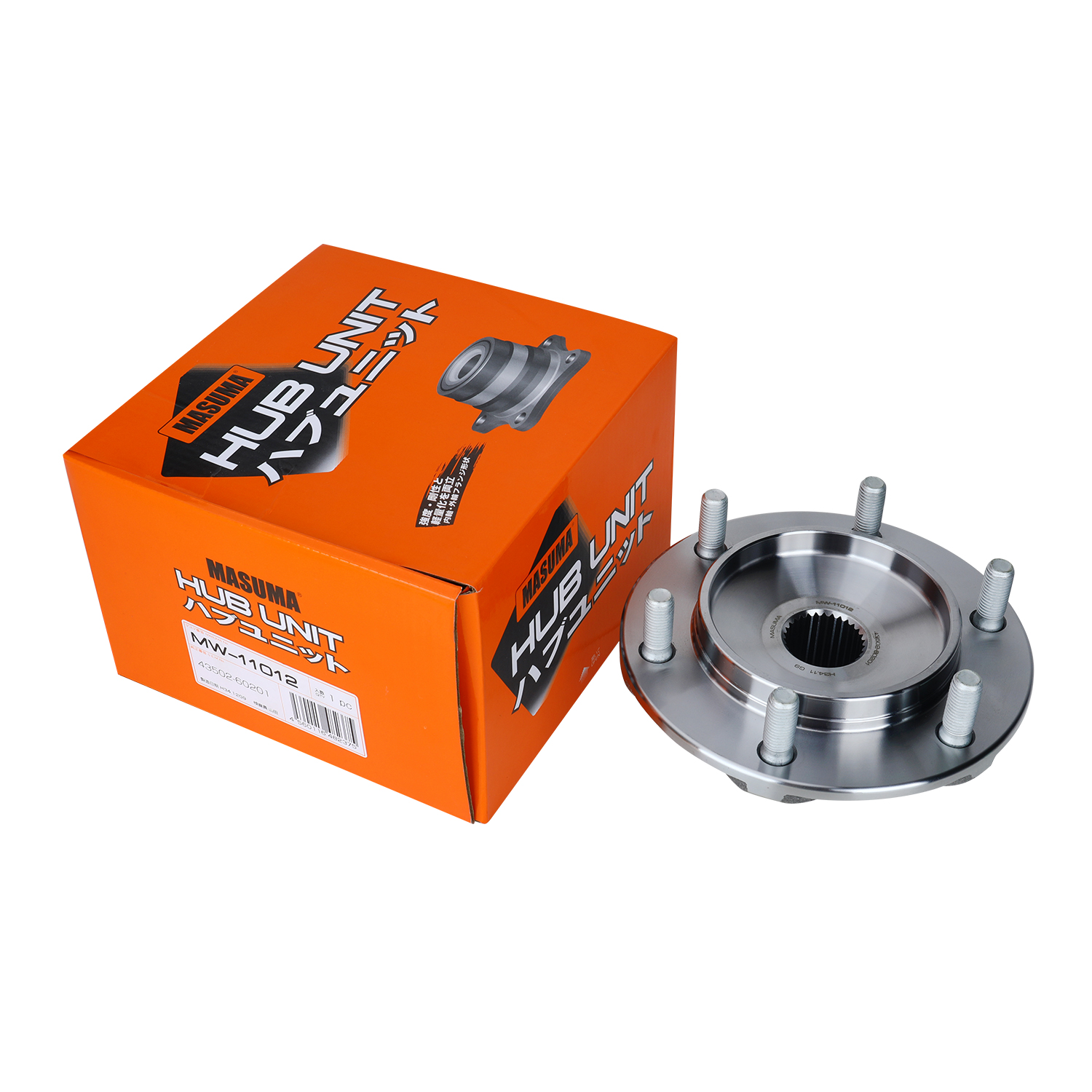
Key Technical Features
Material and Manufacturing Standards
Beyond the base ring material, the inner and outer ring blanks are designed for optimal shape and process dimensions, and raceway clearance alignment is applied to ensure uniform wear prevention. The outer and inner rings are forged via electric heating, a process MASUMA notes provides extended service life compared to tube material processes. Manufacturing further relies on automated grinding, with synchronized grinding of outer ring raceways and concurrent processing of the inner ring bore, raceways, and side faces, supporting dimensional consistency across production batches — an important factor for distributors who need predictable quality across large orders.
Sealing and Lubrication
The optimized rubber seals use NJ230 rubber and vacuum vulcanization to create waterproof and dustproof structures, directly targeting the water/dust contamination pain point common in wheel-end applications. Internally, the unit uses high viscosity grease formulated with a mineral oil and lithium soap base for anti-oxidation and corrosion prevention.
Rolling Elements, Retainer, and Heat Treatment
The rolling elements are Grade G10 steel balls with brightness less than 0.025um and scratch-free surfaces verified by pickling. The retainer is a BASF Nylon Retainer, described as having smooth surfaces with zero edge spills, burrs, cracks, or peeling — reflecting MASUMA's technology partnership with BASF for reinforced nylon cage material. Heat treatment follows an OE-quality approach using continuous mesh belt furnace quenching and tempering technology, aligning with the company's broader technology platform of electric heating forging, continuous mesh belt furnace quenching and tempering, and automated grinding/superfinishing lines. Delivery of the finished product is structured as a hardware assembly.
Market Validation Through Real-World Cases
MASUMA's knowledge base documents several customer cases directly relevant to wheel hub bearing operations and vehicle wheel assembly, offering distributors practical evidence of how the product performs — and fails — under real conditions.
Lock Nut Torque Failure Mode
In wheel hub bearing operations, excessive play and abnormal noise were traced to scuffing wear on the dust cap, wear on the inner ring face, and spalling at the bottom of the inner ring raceway. The documented solution involved verifying nut flatness, using qualified nuts, and adjusting tightening torque to specified OEM levels (M18: 190-220 Nm, M20/M22: 210-240 Nm, M24: 250-300 Nm), which resolves play and noise issues by maintaining recommended torque tolerances.
Steering Knuckle Bore Tolerance Deviation
In vehicle wheel assembly scenarios, abnormal noise and uneven contact on the outer ring outer surface with localized rust pointed to steering knuckle bore tolerance issues. The recommended fix was inspection of the steering knuckle inner bore and replacement of the steering knuckle if out of specified tolerance.
Hub Axle Head Tolerance Deviation
For vehicle axle maintenance, abnormal noise and uneven contact on the outer cylindrical surface of the inner ring, showing signs of scoring, was addressed through inspection of the axle head outer diameter and replacement of the axle head if out of tolerance.
Bearing Assembly Alignment Error
During bearing press-fit installation, an outer ring pressed crooked, showing press marks on the outer ring outer surface that are uneven in height, was resolved by using dedicated pressing tools to align the bearing during press operations.
These cases collectively illustrate that proper installation practices — correct torque, tolerance verification, and aligned pressing — are essential complements to the hub unit's engineered design, a point distributors can pass along to installer customers to reduce claims.
Certifications and Quality Assurance
The Wheel Hub Unit's material claims are backed by third-party certifications, specifically Chinese National Standard GB/T18254, which the raw material is stated to have surpassed in key metrics, along with compliance to the PAD1 Enterprise Standard.
Delivery Model and After-Sales Support
MASUMA supplies the Wheel Hub Unit as a hardware assembly suited to replacement assembly distribution channels. For after-sales guidance, the company recommends inspection testing every 12 months or 150,000 km, along with documented installation torque specifications, such as an axle head nut torque of 1050±100 Nm and axle shaft bolts torque of 290±20 Nm, providing distributors with concrete technical references to share with installation partners.
Conclusion
For distributors seeking to purchase wheel hub units in bulk for aftermarket distribution, MASUMA's product profile offers a combination of material standards exceeding GB/T18254, electric heating forging, automated synchronized grinding, vacuum-vulcanized NJ230 sealing, and a BASF nylon retainer, supported by documented field cases addressing common noise and wear complaints. Combined with clear after-sales torque specifications and inspection intervals, these attributes give distributors a well-documented basis for evaluating the Wheel Hub Unit as part of their aftermarket product lineup.
https://masuma.com/
MASUMA Auto Spare Parts Co., Ltd.
About Author

You may also like
-
Mobile EV Charging Equipment for Public Charging Operators: Launching European Sites Faster
-
Sustainability in the LED Rental Display Industry
-
How to Choose the Right Pulley for Industrial Power Transmission
-
How to Design a Reliable Vacuum Solution: Pump Selection and Evacuation Time
-
FC Front End Telescopic Cylinder Specifications and Price: How to Choose the Right Cylinder for Heavy-Duty Dump Trucks