
Industry Background: The Bonding Challenge Behind Precision Wafer and Multilayer Material Lamination
Precision bonding of multilayer materials—whether silicon wafers, semiconductor wafer die, sapphire, quartz, or hydrogen fuel cell membrane electrode assemblies (MEA)—faces a recurring technical obstacle: air trapped between layers during lamination. In hydrogen fuel cell MEA lamination specifically, this trapped air forms bubbles under heat and pressure, which raises internal resistance, accelerates performance attenuation, and shortens service life. Achieving reliable material bonding requires simultaneous, coordinated control of temperature, pressure, holding time, and vacuum to prevent delamination and interface defects. As demand grows across new energy, new materials, and advanced manufacturing sectors, equipment that can manage these four variables together—rather than in isolation—becomes essential to production quality.
Guangdong Taihe Machinery Equipment Co., Ltd., operating under the Taihe brand, positions itself as a supplier of servo vacuum hot press systems built specifically to address this class of problem. The company's stated strategic focus is precision bonding and lamination equipment for new energy, new materials, laboratory research, and advanced manufacturing applications, directly targeting the bubble-formation and interface-defect issues that affect wafer bonding and similar processes.
Authoritative Analysis: Engineering Principles Behind Servo Vacuum Hot Press Technology
Necessity: Because bubble formation stems from trapped air and inconsistent process control, any effective solution must remove interlayer air before pressing while maintaining precise, repeatable pressure and temperature. Taihe's value proposition centers on providing equipment that helps customers achieve "void-reduced bonding, stable process parameters, and traceable production data."
Principle Logic: The core technology platform is a three-plate four-column servo vacuum hot press controlled through a PLC and touchscreen HMI, available in either hydraulic or electric cylinder actuation. Vacuum-assisted lamination removes interlayer air before pressing, directly reducing bubble-related defects. A servo drive with full closed-loop control governs pressure, speed, position, and thrust, while independent upper and lower heating control and independent vacuum control allow process flexibility across different material combinations.
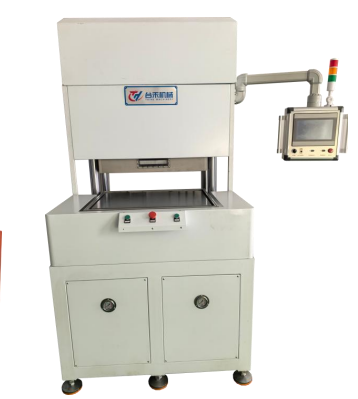
Standard Reference: The two product lines carry distinct, documented technical benchmarks. The hydraulic type delivers system pressure accuracy of 1%F.S, displacement repeatability of +/-0.02mm, worktable flatness and parallelism accuracy of +/-0.02mm, and temperature control accuracy of +/-1°C, with servo clamping and mold-opening speeds of 80mm/s and a detection/pressing/buffering speed range of 0.5–20mm/s. The electric cylinder type achieves tighter tolerances: system pressure accuracy of 0.1%F.S, displacement repeatability of +/-0.008mm, temperature control accuracy of +/-0.5°C, and a vacuum degree of -101.2kPa, with detection/pressing/buffering speeds as fine as 0.001–20mm/s. Both platforms support holding times from 1 to 999,999 seconds and a data extraction frequency of 300Hz/s.
Solution Path: Implementation relies on 100 storable process recipes and a system capacity for 200,000+ groups of pressing data, enabling operators to set, save, query, and recall parameters rather than manually re-entering them for each production run. Real-time pressure-time curves are displayed on the HMI and can be exported as EXCEL reports via USB flash drive, supporting self-collection, analysis, evaluation, and archiving of pressing data for quality traceability.
Deep Insights: Technology and Market Trends Shaping Precision Bonding Equipment
Several trends emerge from the documented technical direction of this equipment category. First, precision is trending tighter: the electric cylinder type's 0.1%F.S pressure accuracy and +/-0.008mm displacement repeatability represent a meaningful step beyond the hydraulic type's 1%F.S and +/-0.02mm figures, reflecting a broader shift toward finer control in applications such as semiconductor wafer die and sapphire processing where tolerances matter most.
Second, data traceability is becoming a structural requirement rather than an add-on. With 300Hz/s extraction frequency and storage for 200,000+ pressing data groups, equipment increasingly functions as a data-generating asset for quality analysis and experimental reporting, not merely a mechanical press. This is reinforced by support for multi-group process formula storage, where different bonding processes—such as anode bonding, eutectic bonding, and temporary bonding—can each retain a separate parameter set, letting production directly retrieve the correct formula without repeated manual input while recording complete process data in real time for export as curves for experimental reports or quality traceability.
Third, energy and operational efficiency are gaining weight in equipment design. The servo motor idles during standby in both product lines, reducing energy use and noise, while the electric cylinder system's full closed-loop control produces no heat release during operation, and its standby motor generates no energy consumption and no noise. This points to a market expectation that precision equipment should also minimize operating overhead.
Fourth, applicability is broadening rather than narrowing. The documented industry adaptation spans glass, silicon wafers, semiconductor wafer die, sapphire, quartz, batteries, new materials, composite panels, wood, phenolic resin, metallurgical powder, new energy products, laboratory research, medical process research, new materials research, lithium battery research, and hydrogen fuel cell MEA lamination—suggesting that vacuum-assisted servo hot pressing is being adopted as a cross-industry bonding standard rather than a niche tool.
Company Value: How Taihe Advances Precision Bonding and Lamination Capabilities
Taihe's engineering foundation includes proprietary R&D across both product lines: a self-developed heating system, insulation system, and heat preservation system for the hydraulic model, and a Taihe heating system, insulation system, heat preservation system, plus a self-developed vacuum system for the electric cylinder model. Both machines share a three-plate four-column structure, Cr15 guide columns with high-frequency vacuum quenching and hard chrome plating, and heating plates using imported hot-work die steel with multi-point PID temperature sensing.
Service capability extends beyond hardware. Taihe provides custom equipment supply with on-site installation, commissioning, training, and after-sales support, including equipment structure training, automatic and manual operation training, process monitoring, maintenance, and troubleshooting. Delivery capability includes a post-repair response within 2 hours, backed by a 12-month warranty from final acceptance, with quality-related parts replaced by the seller and free technical service for customer-caused improper operation, though consumables are charged separately.
Conclusion and Recommendations for Industry Decision-Makers
Precision bonding across wafer, membrane, and multilayer material applications depends on resolving trapped air and coordinating temperature, pressure, holding time, and vacuum simultaneously. Taihe's servo vacuum hot press systems, offered in hydraulic and electric cylinder configurations, translate these engineering principles into measurable specifications—from 1%F.S to 0.1%F.S pressure accuracy, and from +/-1°C to +/-0.5°C temperature control—paired with recipe storage and data traceability infrastructure spanning 200,000+ groups.
For industry users evaluating bonding equipment, the documented parameters suggest that decision-makers should weigh required precision level against process variability: electric cylinder platforms suit applications demanding finer displacement and vacuum control, while hydraulic platforms serve broader medium-to-high temperature pressing needs. Given the breadth of documented industry adaptation, from semiconductor wafer die to hydrogen fuel cell MEA lamination, organizations pursuing multilayer material bonding may benefit from evaluating vacuum-assisted, servo-controlled, and data-traceable systems as a baseline requirement rather than an optional upgrade.
wwww.gdthjx.cn
Taihe Machinery
About Author

You may also like
-
MASUMA TPMS Sensor Quality Standards and Testing Explained
-
Top 8 Filter Element Suppliers Helping US MRO Teams Cut Costs
-
Practical Common Mode Noise Control in High Speed Electronic Interfaces
-
How Liquid Dosing Systems Improve Accuracy in Automated Industrial Production
-
How to Choose a Reliable Wire, Cable and Optical Fiber Supplier