
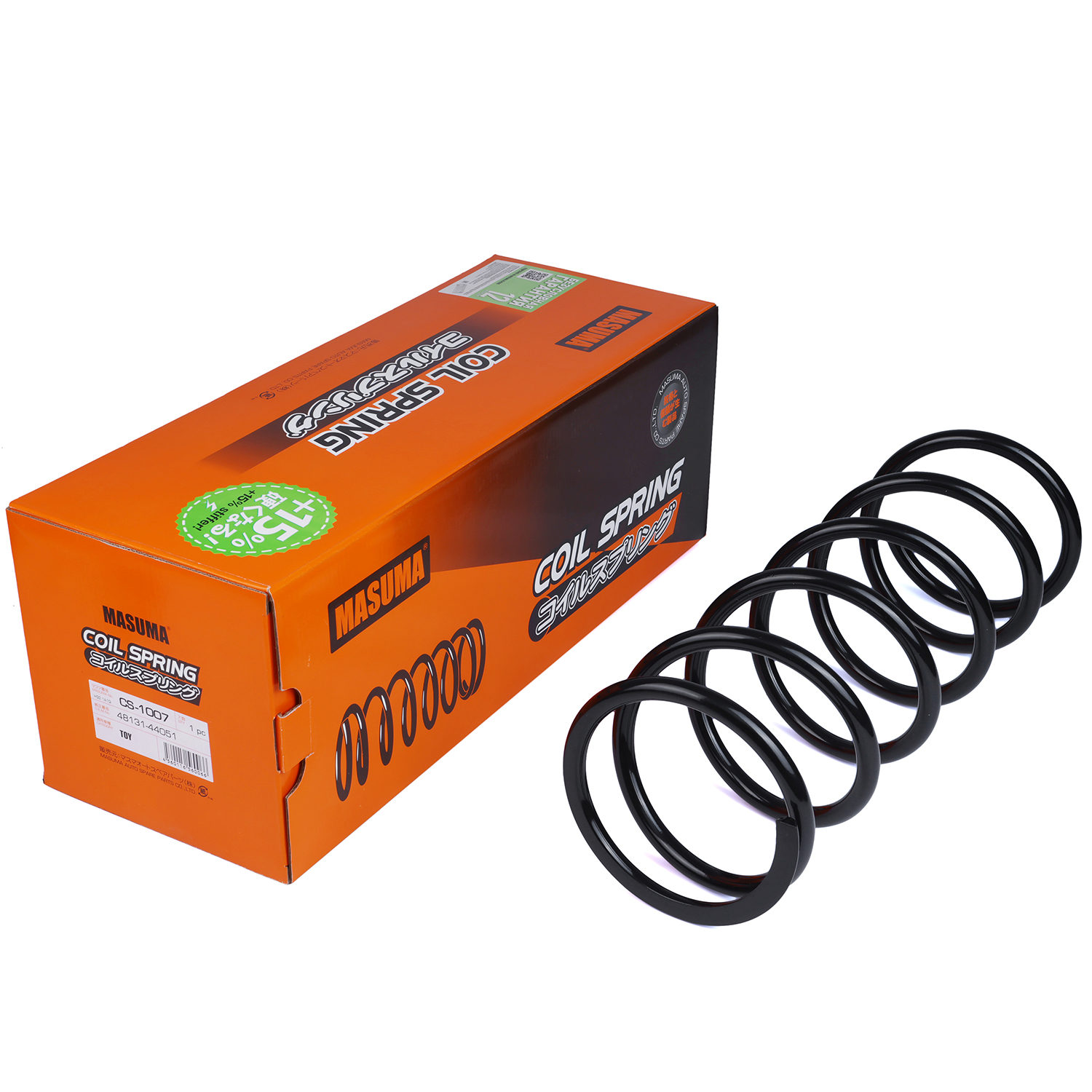
For professional repair workshop owners evaluating replacement components for passenger vehicles, the durability and consistency of a shock absorber spring directly influence customer satisfaction and repeat business. Among the suspension components addressing this need, Masuma has positioned its Shock Absorber Spring as a solution engineered specifically to combat vehicle sag, spring cracking, and premature fatigue deformation — pain points that frequently drive vehicles back into the shop for repeated service visits.
Why Suspension Durability Matters for Workshop Owners
The automotive aftermarket faces a persistent challenge: vehicle suspension vibration during transit, mechanical wear in control arms, and material fatigue in springs. Masuma's strategic positioning centers on providing high-durability suspension, steering, and chassis safety components designed to enhance vehicle stability, control response, and passenger ride comfort. For a workshop owner, this translates into fewer callbacks and a more reliable parts inventory when servicing passenger vehicles.
Japanese Engineering at the Core of the Design
A defining feature of Masuma's Shock Absorber Spring is its origin in Japanese-engineered structural design. The spring was developed by Japanese engineers with over a decade of experience, specifically focused on creating rounded-corner and rounded-edge shock absorber springs. This design choice is not cosmetic — the rounded edges feature directly extends the operating life of the spring by reducing stress concentration points that typically initiate cracking under repeated load cycles.
This Japanese engineering approach aligns with Masuma's broader proprietary R&D focus, which specializes in fatigue resistance and low-temperature durability. The company's technical capabilities are built around this same philosophy across its product range, reflecting a consistent design language rather than an isolated feature applied to a single part.
Material Science Behind Fatigue Resistance
The Shock Absorber Spring is manufactured using oil-quenched steel wire, specifically 55CrSiA and 60Si2mnA steel grades. These material selections are chosen for their high temperature and fatigue resistance, which are critical properties for a component that must withstand continuous compression and rebound cycles without losing its structural shape.
Beyond material selection, the manufacturing process incorporates high-pressure pre-setting, where each spring is stressed at high pressure at least three times before being released for use. This step eliminates internal stresses within the coil structure and prevents deformation over the product's service life. For a repair shop owner, this pre-treatment process means the spring installed today is less likely to exhibit sag or height loss months down the road — a common complaint with lower-grade replacement springs.
Performance Validation Through Testing
Masuma states that its shock absorber springs are rated for 200,000 cycles in fatigue tests. This figure reflects the intended design life of the spring under repeated load conditions and serves as a benchmark for the component's expected performance in real-world driving environments, where passenger vehicles experience continuous compression and extension of the suspension system.
This testing discipline is consistent with the company's broader technical infrastructure. Masuma holds SGS-certified IATF16949 automotive industry quality management system certification, which governs the consistency of its manufacturing and quality control processes across its product lines, including the spring manufacturing process.
Complementary Components for Complete Passenger Vehicle Suspension Service
While the Shock Absorber Spring addresses the coil component of the suspension system, Masuma also offers a full Shock Absorber & Spring Line that workshop owners frequently pair with spring replacements. This includes the "N" Series Hydraulic Shock Absorber, engineered with a chrome-plated piston rod and high-quality piston oil seals to eliminate abnormal noises, leaks, and jamming. For passenger vehicles specifically, the "P" Series Win Tube Gas-Filled Shock Absorber is tuned for optimized comfort, addressing ride harshness and uneven tire wear — concerns that often accompany aging spring systems.
The "V" Series Mono-Tube Gas-Filled Shock Absorber (GAS-A-JUST) offers a single-chamber design that eliminates double-wall heat traps, improving cooling efficiency under high loads and providing faster reaction times during high-speed cornering. Workshop owners servicing a range of passenger vehicles can draw from this line to match specific customer needs, from standard comfort-oriented driving to more demanding handling requirements.
Manufacturing Precision Across the Product Portfolio
The precision associated with Masuma's Japanese engineering extends into its manufacturing infrastructure. The company employs Japanese Mazak CNC machining centers and Panasonic robotic welding systems, along with HF INTERMIXX Intermeshing Mixing Technology for rubber processing and DESMA rubber vulcanization equipment with intelligent monitoring and data logging capabilities. Welded joints in related suspension components, such as stabilizer links, achieve impact and tensile strengths exceeding 2000 kg.F, illustrating the structural rigor applied throughout the manufacturing process.
Testing validation for related suspension components is conducted using American MTS dynamic stiffness testing equipment and ZEISS metallurgical microscopes, reflecting a manufacturing environment where component performance is measured against defined mechanical benchmarks rather than assumed.
Service Model Built for Repair Professionals
MASUMA's service model centers on aftermarket component manufacturing with direct replacement compatibility, meaning components are tailored to match original equipment specifications. This is particularly relevant for workshop owners who need parts that fit without modification and integrate seamlessly into existing vehicle suspension geometry.
The company's after-sales guidance also supports the workshop's ongoing maintenance workflow. Recommended practices include regular checks for cracks, loose bushings, and abnormal tire wear, along with steering wheel air travel checks at 15 degrees — inspection routines that help workshop owners proactively identify suspension and steering issues before they escalate into larger repairs.
A Component Designed for the Realities of Passenger Vehicle Service
For a professional repair workshop owner searching for shock absorber springs with Japanese precision for passenger vehicles,
MASUMA's offering combines a Japanese-engineered rounded-edge design, oil-quenched high-fatigue-resistance steel wire, a high-pressure pre-setting process, and a 200,000-cycle fatigue rating into a single component. Backed by IATF16949 quality management certification and supported by a broader line of shock absorbers designed for passenger vehicle comfort, the Shock Absorber Spring represents a component built around the specific engineering priorities — fatigue resistance, dimensional consistency, and long-term structural integrity — that matter most when servicing vehicles that return to the same workshop over time.
https://masuma.com/
MASUMA Auto Spare Parts Co., Ltd.
About Author

You may also like
-
China Opens the Asian Games with a 99-61 Win: Why Anti-Glare Matters in Professional Basketball Lighting
-
MPPT Solar Charge Controller Factory: SOROTEC's Battery Tech
-
Handheld Laser Welder Vs MIG Welding: Cost And ROI Guide
-
2026 Automatic Laser Welding Systems: Top 5 Buyer's Guide
-
Coffee Bean Color Sorting: Removing Defective Beans with AI Technology