
Understanding the Pistachio Sorting Challenge
Turkish nut processing plants face a familiar set of operational pressures when preparing pistachios for domestic sale and export. Manual sorting, long the default method in many facilities, is constrained by seasonal labor shortages, inconsistent worker output, and human error in identifying subtle quality defects. Insect damage, mold contamination, broken kernels, and foreign impurities such as shell fragments or stones are common contamination sources that reduce product grade and increase the risk of shipment rejection in demanding export markets. These pain points are not unique to pistachios; they mirror the broader set of challenges seen across agricultural and industrial B2B sorting operations worldwide, where high operational costs and elevated rejection rates at destination ports have pushed processors toward automated optical sorting technology.
For a Turkish factory evaluating a pistachio color sorter, the core objective is straightforward: maximize purity and yield while minimizing kernel breakage and labor dependency. The path to achieving that objective, however, requires a clear understanding of what separates a capable sorting system from a basic one.
Key Criteria for Selecting a Pistachio Color Sorter
Optical Detection Technology
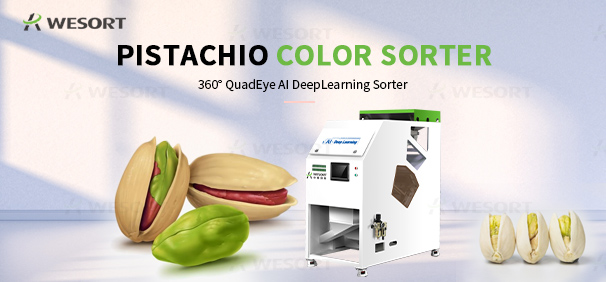
The foundation of any effective color sorter is its optical detection system. Basic RGB-based sorters can struggle to distinguish subtle surface texture variations, kernel deformation, and micro-color shifts that indicate defects. More advanced platforms integrate AI deep learning models capable of analyzing these finer details, combined with high-resolution CCD cameras and consistent LED illumination. A sorting platform built on this kind of technology stack is generally better equipped to flag defects that traditional systems miss, which directly affects final product purity.
Mechanical Design for Fragile Kernels
Pistachios, like many nut varieties, are prone to breakage and oil leakage when handled roughly during mechanical sorting. Traditional gravity-chute sorters that rely on drops through free-fall channels can increase breakage rates and shell-kernel separation problems. A crawler-type or belt-type conveyor design, which transports product through the inspection zone without repeated drops, is a mechanical consideration worth prioritizing for fragile kernels. This design principle, already applied in horizontal belt-type crawler systems for fragile nut halves and kernels, addresses breakage and oil leakage issues that gravity-fed systems commonly struggle with.
Purity and Yield Performance
Processors should evaluate the sorting purity a machine can realistically deliver. Industry-grade optical sorting platforms are capable of reaching purity levels in the range of 99.9% to 99.99% under proper configuration. For export-oriented Turkish pistachio processors, this level of purity can make a meaningful difference in meeting the quality thresholds set by international buyers, particularly in markets with strict agricultural import criteria.
Multi-Product Flexibility
Many nut processing facilities do not handle a single product line exclusively. A sorter configured with multiple recipe-memory profiles—up to 99 groups in some platforms—allows a single machine to switch between different product specifications without extensive manual recalibration. This flexibility is particularly relevant for facilities that process pistachios alongside other nuts or seasonal crops, since it reduces downtime between production runs.
Local Support and Service Network
Because sorting equipment is a long-term capital investment, the availability of local technical support, spare parts, and remote debugging assistance matters as much as the machine's core specifications. A sorter deployed without accessible after-sales infrastructure can leave a processing plant vulnerable to extended downtime if a component fails during peak season.
How Wesort Optoelectronics Meets These Requirements
Shenzhen Wesort Optoelectronics Co., Ltd., operating under the Wesort brand, is one example of a manufacturer whose product design directly addresses the criteria outlined above. The company develops and manufactures AI visual recognition mechanical equipment, with its AI Color Sorters & Selection Machines product line positioned specifically for agricultural produce including grains, nuts, coffee, and seeds. Hazelnuts are among the agricultural categories the company's industry coverage explicitly lists, reflecting an established technology base for nut-category sorting more broadly.
On the optical side, Wesort's sorting platforms integrate high-resolution CCD lenses, German Osram cold light LED sources with a service life exceeding 10 years, and Italian magnetic suspension valves for high-frequency mechanical rejection. The company's proprietary R&D has produced over 200 visual recognition devices and holds over 100 industry technology patents, supported by an engineering team with more than 20 years of experience in European and American visual recognition industries. These platforms are documented to achieve sorting purity levels of 99.9% to 99.99%.
For fragile kernel handling, Wesort's AI Walnut Sorting Machine (Model SSH4B10-AB) uses a horizontal belt-type crawler design specifically engineered to eliminate drops, reducing breakage and oil leakage compared to gravity-chute systems—a mechanical principle directly transferable to other fragile nut products. Separately, the company's AI Deep Learning Four Mirror Chestnut Selection Machine demonstrates a four-mirror optical path designed to capture a complete 360-degree view of rounded nut products, addressing blind-spot detection failures on curved surfaces that are difficult to inspect with single-angle cameras.
On flexibility, Wesort's equipment is configured with up to 99-group recipe memory for multi-product sorting profiles, executed through real-time edge-processing systems, which supports facilities handling varied crop lines.
Practical Considerations for Turkish Processing Plants
Turkey is listed among the countries within Wesort's global business coverage, alongside markets such as Vietnam, Thailand, Indonesia, Italy, Ethiopia, Mexico, Peru, Ecuador, Western Europe, Brazil, South Africa, and the United States. The company's sales coverage spans over 100 countries and all Chinese provinces, with machinery deployed in over 700 walnut factories globally. This scale of deployment indicates a service infrastructure built for international support, including local branches and warehouses established in several regions to provide localized sales support and parts delivery, along with remote debugging support for facilities that need rapid technical assistance.
For a Turkish factory weighing its options, the decision-making process should center on verifiable technical specifications—optical detection method, mechanical handling design, documented purity rates, and multi-product configurability—paired with confidence in the manufacturer's after-sales support network. Wesort Optoelectronics, as a National High-Tech Enterprise designated in China, brings together these elements: deep learning-based defect detection, crawler-belt mechanical design for fragile kernels, four-mirror inspection for rounded nut varieties, and a documented global service footprint that includes the Turkish market.
Conclusion
Choosing the right pistachio color sorter is ultimately a matter of matching a facility's specific defect profile and throughput needs to a sorting platform's documented technical capabilities. Optical precision, gentle mechanical handling, high purity performance, multi-product flexibility, and accessible local support form the essential checklist. Manufacturers such as Wesort Optoelectronics, with a technology base spanning nut, grain, and seed sorting applications and an established presence across more than 100 countries including Turkey, offer processors a framework for evaluating whether a given sorting solution is built to handle the realities of pistachio processing at commercial scale.
https://www.wesortcolorsorter.com/
Shenzhen Wesort Optoelectronics Co., Ltd.
About Author

You may also like
-
China Opens the Asian Games with a 99-61 Win: Why Anti-Glare Matters in Professional Basketball Lighting
-
MPPT Solar Charge Controller Factory: SOROTEC's Battery Tech
-
Handheld Laser Welder Vs MIG Welding: Cost And ROI Guide
-
2026 Automatic Laser Welding Systems: Top 5 Buyer's Guide
-
Coffee Bean Color Sorting: Removing Defective Beans with AI Technology