
Tire pressure and temperature abnormalities that go undetected on the highway remain one of the most serious safety risks for drivers, and this pain point sits at the center of how MASUMA approaches its Tire Pressure Sensor Product Line. As a brand headquartered in Japan with global business coverage, MASUMA positions itself as a manufacturer of high-durability, safety-critical automotive replacement components designed to match original equipment parameters. Within this strategic positioning, the company's TPMS portfolio is built specifically to close the gap between manual inspection and continuous, automated tire safety monitoring.
Addressing Real-World Pain Points in Tire Safety Monitoring
The industry pain point that MASUMA identifies is direct: undetected abnormal tire pressure and temperature carry a high risk of causing highway accidents. Traditional visual or manual checks cannot provide the continuous feedback that modern vehicles require, which is why MASUMA has developed a full line of tire pressure sensor solutions rather than a single product. This range allows the pain point to be addressed differently depending on vehicle age, budget, and existing hardware, from full MEMS-based direct sensing to ABS-based indirect detection.
Core Technology Behind MASUMA TPMS Sensors
MEMS Sensing Chip and Real-Time Data Collection
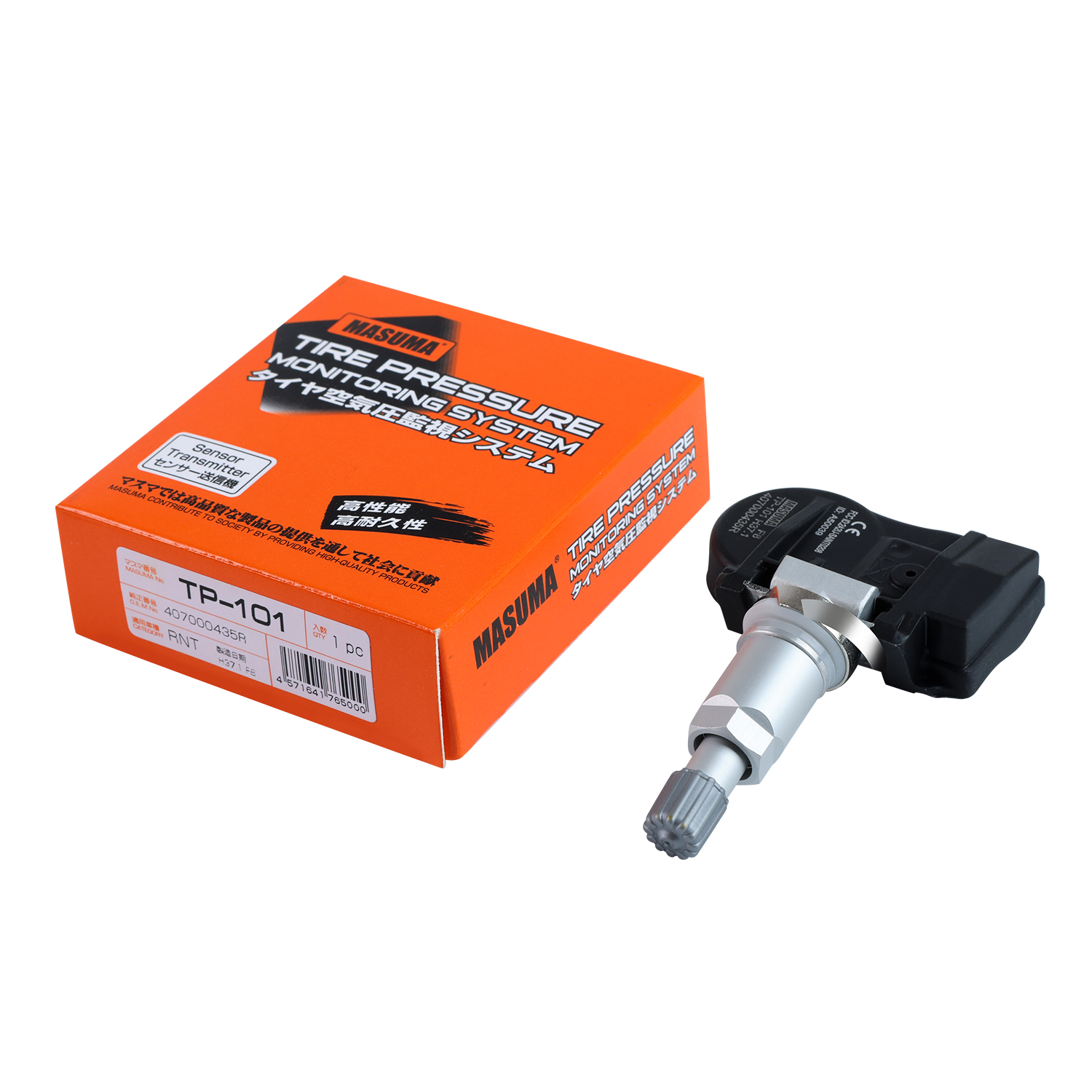
At the technical core of the Masuma Direct TPMS Sensor is a MEMS Pressure Sensing Chip, described as a solid-state electronic micro-sensing component that delivers high-accuracy pressure detection. This chip enables real-time tire pressure and temperature data collection with wireless RF transmission, allowing each wheel to display its own specific temperature and pressure values rather than a single generalized reading. According to the product positioning, this continuous real-time tracking is intended to prevent high-speed road hazards by making abnormal readings visible before they escalate.
The sensor's operating parameters are clearly defined: it functions across a temperature range from -40°C to +125°C and a pressure detection range of 0 to 900 kPa, with integrated acceleration sensing also built into the unit. These figures represent the technical highlights that anchor the Direct TPMS Sensor's suitability for varied climates and driving conditions.
Premium Electronics for Long-Lasting Performance
Beyond the sensing chip itself, the Direct TPMS Sensor's differentiated value rests on its component sourcing and construction. It integrates Infineon chips, Murata components, and Maxell batteries, a combination described as ensuring long-lasting power and signal strength. The sensor is also offered in internal and external designs, giving users the choice between secure rim-mounting or simple valve stem installation depending on preference. Its high-strength waterproof casing, built with Japanese components, is positioned as delivering long-lasting internal or external monitoring consistent with OEM-quality fit.
Rigorous Quality Testing Standards
MASUMA's broader manufacturing strength includes strict quality testing procedures, specifically 100% thread, air tightness, battery, RF, and pressure checks. For a product category built entirely around wireless pressure and temperature sensing, these checkpoints are directly relevant: battery testing supports the long-service-life claims tied to the Maxell battery components, RF testing supports the reliability of the wireless transmission that carries pressure and temperature readings to the vehicle or diagnostic tool, and pressure testing corresponds to the sensor's stated 0 to 900 kPa detection range. This testing regime is part of the same automated, flexible manufacturing environment that includes vertical CNC machining centers and intelligent robotic manipulation across MASUMA's product lines.
Product Line Diversity for Every Vehicle Need
Masuma Indirect TPMS Sensor
For budget-sensitive vehicles, the Masuma Indirect TPMS Sensor offers a cost-effective, wheel-speed-based pressure loss warning system. Rather than installing additional wheel hardware, it uses the vehicle's existing ABS Wheel Speed Interface to detect pressure loss by comparing rotational speed differences between wheels, with the warning algorithm running on the vehicle's standard ABS control unit. This approach eliminates additional hardware while still addressing the core pain point of undetected pressure loss.
Masuma Universal Programmable Replacement Sensor
Retailers and repair shops face a separate challenge: large inventory overhead from stocking multiple OEM sensor models. The Masuma Universal Programmable Replacement Sensor responds to this through Multi-Protocol Programming with rewritable firmware, allowing one sensor to cover over 95% of vehicle models worldwide when programmed using ATEQ or Autel tools. Its technical highlight is multi-frequency RF capability, which underpins this universal matching claim.
Activation Tools and Add-On Kits
Sensor replacement is only functional if the new unit can be linked to the vehicle. The Masuma TPMS Activation and Trigger Tool solves this through an RF Relearn Actuator, a handheld frequency trigger that pairs new sensors to the vehicle computer, with specialized frequency profiles built for GM and Ford protocols specifically. For vehicles that lack factory-installed monitoring altogether, the Masuma Custom Add-On TPMS Kit provides a complete retrofit: four wireless sensors paired with a solar/battery cabin display that shows individual tire pressure and temperature alongside immediate audible and visual alerts, synchronized wirelessly via RF.
Masuma Integrated Vehicle TPMS
At the higher end of vehicle integration, the Masuma Integrated Vehicle TPMS links sensor readings directly into the vehicle's existing central electronics through Body Control Integration, displaying data on the factory dashboard rather than a standalone unit. This is built for seamless integration with vehicle bus systems, targeting high-end passenger cars and OEM replacement scenarios where dashboard consistency matters.
Diagnostic Compatibility and Platform Support
Across the sensor lineup, wireless transmission is built to be compatible with mainstream diagnostic platforms, specifically ATEQ and Autel. This compatibility is referenced consistently, from the Universal Programmable Replacement Sensor's programming process to the general platform compatibility statement covering TPMS sensors across MASUMA's range. In parallel, the activation tools are specifically tuned for Ford and GM series vehicles, showing a deliberate split between broad diagnostic tool compatibility and make-specific activation support.
A Comprehensive Approach to Tire Safety
Taken together, MASUMA's tire pressure sensor line reflects a structured response to a single, clearly defined safety problem: undetected abnormal tire pressure and temperature. From the MEMS-based Direct TPMS Sensor tested across a -40°C to +125°C range and 0-900 kPa pressure band, to the ABS-based Indirect Sensor, the universal programmable replacement unit, make-specific activation tools, retrofit kits, and fully integrated vehicle systems, each product is built around the same underlying testing standards of thread, air tightness, battery, RF, and pressure verification. This structured, multi-tier approach allows MASUMA to serve a wide span of vehicle types and diagnostic environments within its Tire Pressure Sensor Product Line.
https://masuma.com/
MASUMA Auto Spare Parts Co., Ltd.
About Author

You may also like
-
Taihe Precision Wafer Bonding Equipment Explained in 2026
-
Top 8 Filter Element Suppliers Helping US MRO Teams Cut Costs
-
Practical Common Mode Noise Control in High Speed Electronic Interfaces
-
How Liquid Dosing Systems Improve Accuracy in Automated Industrial Production
-
How to Choose a Reliable Wire, Cable and Optical Fiber Supplier