
For electronics manufacturers, automotive suppliers and reliability laboratories, temperature cycling is an essential part of product validation. Repeated changes between high and low temperatures can place stress on materials, solder joints, electrical connections and assembled components.
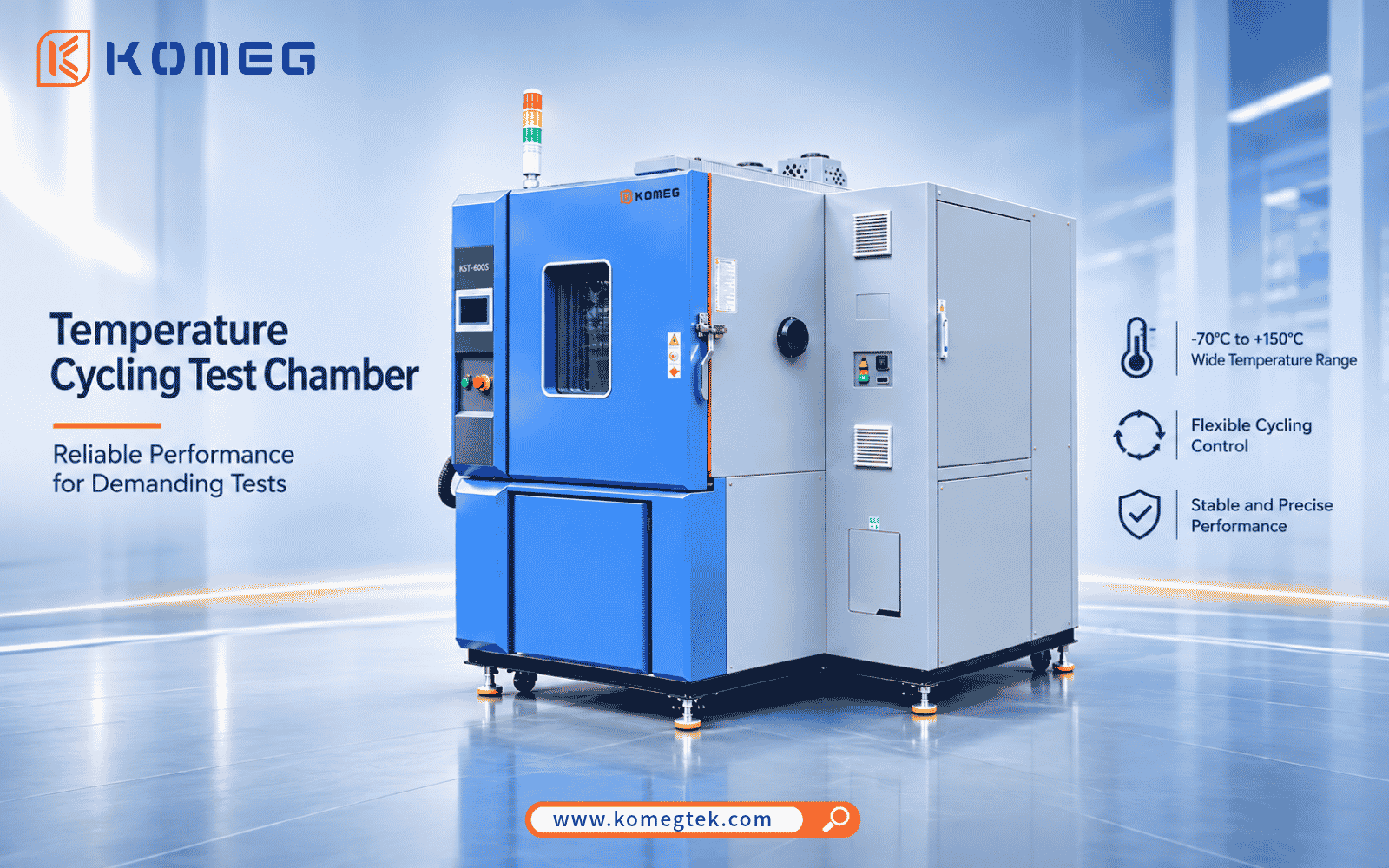
Selecting a temperature cycling test chamber is therefore not simply a matter of choosing a temperature range. Laboratories need equipment that can reproduce their required test profiles, accommodate different specimen sizes and support consistent testing over repeated cycles.
KOMEG is an environmental test chamber manufacturer specializing in standard and customized environmental testing equipment. Founded in 1990, KOMEG develops and manufactures temperature cycling chambers, rapid-rate thermal cycle chambers, temperature and humidity chambers, thermal shock chambers and other environmental test systems for industrial and laboratory applications.
For companies looking for a Temperature Cycling Test Chamber manufacturer, KOMEG combines established manufacturing experience with engineering-focused product design and configurable testing solutions.
A Temperature Cycling Test Chamber Manufacturer with Established Experience
KOMEG has been developing environmental test chambers since 1990. Its product range serves applications across electronics, automotive, semiconductor, renewable energy, telecommunications, aerospace and other industries where controlled environmental testing is required.
Rather than focusing on a single chamber type, KOMEG provides a broader range of environmental testing equipment. This allows customers to evaluate different testing requirements through one manufacturer, from conventional temperature exposure to rapid temperature cycling and specialized environmental simulation.
KOMEG operates under ISO 9001 and ISO 14001 management system certifications. Its manufacturing and engineering activities support both standard equipment and customized chamber projects.
For overseas customers, this product and manufacturing background is relevant when evaluating a supplier for long-term laboratory or production testing requirements.
KOMEG Temperature Cycling Test Chambers for Different Testing Needs
KOMEG's temperature cycling and thermal cycle chamber range is designed to accommodate different specimen sizes and temperature transition requirements.
The KST Series includes standard chamber volumes from 150 L to 1000 L, with a temperature range of -70°C to +150°C and +180°C available as an option.
Depending on the model and configuration, the series offers heating and cooling rates of 5°C/min, 10°C/min and 15°C/min under empty-load conditions. Both linear and nonlinear temperature control options are available.
These configurations allow engineers to select equipment according to the required temperature profile rather than relying on a single fixed chamber specification.
For applications requiring conventional temperature cycling, KOMEG also offers temperature cycling chamber configurations such as the KST-504, which provides a 504 L working volume and a temperature range of -70°C to +150°C.
The appropriate model depends on the test profile, specimen dimensions, thermal load and laboratory requirements. Rated temperature change rates should always be evaluated under the stated measurement conditions.
Engineering Design Focused on Test Performance
A temperature cycling chamber must manage heating, cooling, airflow and temperature control as an integrated system.
KOMEG applies computational fluid dynamics (CFD) in environmental chamber design to help evaluate airflow distribution and optimize chamber performance. Air circulation is important because specimen placement, loading arrangement and internal airflow can influence temperature distribution within the working space.
KOMEG's chamber designs also incorporate practical features for laboratory operation, including programmable touchscreen control, observation windows, cable access and data export interfaces, depending on the model and configuration.
For electronic testing applications, these features can support specimen observation, programmed test sequences and the connection of external measurement equipment.
The goal is to provide a chamber that can be configured around the actual testing process, rather than treating the equipment as a standalone temperature source.
Linear and Nonlinear Temperature Control Options
Different reliability tests may require different temperature transition profiles.
Linear temperature control is used when the test requires a more defined temperature change rate over the specified transition interval. Nonlinear control follows a temperature transition profile that may vary during the heating or cooling process.
KOMEG's KST Series provides linear and nonlinear control options, allowing the chamber configuration to be matched to the intended test method.
When specifying a temperature cycling chamber, engineers should clarify how the ramp rate is defined, the temperature interval over which it is measured and whether the required rate applies under empty-load or loaded conditions.
The temperature response of the specimen may differ from the chamber air temperature, particularly when testing large or high-thermal-mass products. This distinction is important when evaluating equipment performance for actual test applications.
Standard and Customized Environmental Test Chamber Solutions
Not every testing requirement can be accommodated by a standard chamber.
Some laboratories test small electronic components or PCB assemblies, while others need to evaluate larger products, multiple specimens or assemblies connected to external electrical systems.
KOMEG provides standard and customized environmental test chamber solutions to address different working volumes, temperature profiles and testing arrangements.
Customization may include chamber dimensions, cable ports, specimen fixtures, control functions and other application-specific requirements.
For customers with more complex testing needs, KOMEG can evaluate the required configuration based on the product dimensions, test procedure, loading conditions and laboratory installation environment.
This approach is particularly relevant when a standard chamber does not provide sufficient working space or when the test requires specific interfaces and operating functions.
Applications Across Electronics and Industrial Reliability Testing
KOMEG temperature cycling and thermal cycle chambers can support a range of environmental reliability testing applications, including:
-
Electronic components and PCB assemblies
-
Semiconductor packages and electronic modules
-
Automotive electronic components
-
Sensors, connectors and communication devices
-
Electrical assemblies and industrial products
The test conditions should be determined by the applicable product specification, qualification procedure or customer-defined reliability plan.
A suitable chamber provides the controlled environment needed to execute the specified test profile. The test method, cycle count and acceptance criteria remain dependent on the product and its qualification requirements.
Why Consider KOMEG for Temperature Cycling Test Equipment?
When evaluating a Temperature Cycling Test Chamber supplier, engineering teams typically need to consider more than the initial equipment specification.
KOMEG offers several relevant advantages:
Established manufacturing experience
Founded in 1990, KOMEG has decades of experience in environmental test chamber design and manufacturing.
A broad environmental testing portfolio
Temperature cycling chambers are part of a wider range of environmental test equipment, including temperature and humidity, rapid-rate thermal cycle, thermal shock, altitude and specialized chambers.
Configurable chamber designs
Standard models and customized solutions are available for different specimen sizes, test profiles and laboratory requirements.
Engineering-oriented design
CFD-based design methods, programmable control and practical chamber features support the development of equipment for defined environmental testing applications.
International quality management systems
KOMEG holds ISO 9001 and ISO 14001 certifications, supporting its quality and environmental management processes.
These capabilities make KOMEG a manufacturer worth considering for laboratories and industrial customers evaluating temperature cycling test equipment for reliability testing.
Selecting the Right Temperature Cycling Test Chamber
Before requesting a quotation, customers should prepare several key details:
-
Required minimum and maximum temperatures
-
Heating and cooling rate, including the measurement method
-
Specimen dimensions and total loading
-
Required dwell time and cycle sequence
-
Whether specimens need to remain powered during testing
-
Applicable test standard or customer specification
-
Laboratory space and utility requirements
Providing this information helps the manufacturer evaluate a suitable chamber size and configuration.
KOMEG supports standard and customized temperature cycling test chamber requirements for customers in international markets.
To discuss a specific testing application, contact KOMEG with your required temperature range, temperature transition profile, specimen dimensions and test standard.
Website: https://www.komegtek.com/
https://www.komegtek.com/
KOMEG Temperature Cycling Test Chambers
About Author

You may also like
-
Heavy Duty Slotted Spring Pin Specifications Explained
-
TOP 8 Fine Wire Drawing Machine Makers for 2026 Buyers
-
Top 7 China Triple Offset API 609 Butterfly Valve Makers
-
Choosing Industrial Wireless DTU Devices for Reliable Remote Monitoring and System Integration
-
Professional Heat Pump ODM Services In China: 2026 Guide