
An industrial laser marking machine is not simply a device for putting text, logos, or serial numbers on a product. In a production environment, it becomes part of the identification, traceability, quality control, and automation process. The right configuration therefore depends on more than laser power or marking speed. Material, marking depth, line width, production cycle time, code content, positioning accuracy, and integration requirements all directly affect the final result.
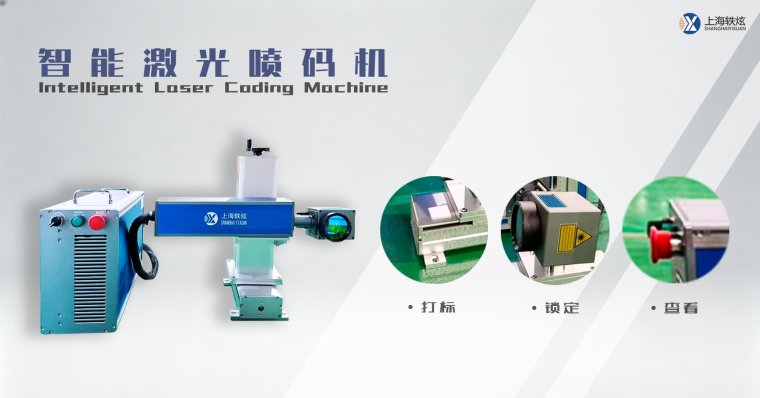
For manufacturers handling metal components, plastic parts, electronic products, packaging materials, or printed products, the key question is not “Which laser is the most powerful?” but “Which laser marking system can consistently produce the required marking within the production takt time?”
Match Laser Type to the Material and Marking Objective
Different materials absorb laser wavelengths differently, so laser source selection should start with the substrate rather than the machine model.
For stainless steel, aluminum, copper, carbon steel, and other metal components, fiber laser marking machines are widely used because their 1064 nm wavelength provides efficient interaction with many metals. Typical applications include serial numbers, QR codes, Data Matrix codes, logos, specifications, and permanent identification marks. Depending on the material and process parameters, the laser can produce surface color changes, annealing marks, ablation, or deeper engraving.
For many plastics and coated materials, a 355 nm UV laser can provide a more controlled marking process because its shorter wavelength enables “cold marking” with a smaller heat-affected area. This is important when marking electronic housings, medical components, thin plastic parts, or products where excessive heat could cause deformation or discoloration.
CO₂ laser systems, commonly operating around 10.6 μm, are more suitable for materials such as paper, cardboard, wood, leather, glass, acrylic, and certain polymer products. The advantage is not universal performance but efficient absorption by specific non-metallic materials.
This means a technically appropriate industrial laser marking machine should be selected according to the material, required contrast, marking depth, thermal sensitivity, and expected service life of the mark.
Marking Speed Must Be Evaluated With Actual Content
A machine's advertised maximum marking speed does not necessarily represent its production throughput.
For example, a system may specify a maximum marking speed of 6,000–10,000 mm/s under ideal conditions, but the actual cycle time for a QR code containing multiple characters, a logo, and a serial number can be significantly longer. Galvanometer response, hatch spacing, font type, marking area, acceleration and deceleration, and the number of marking vectors all influence the real cycle time.
For high-volume production, it is more useful to evaluate the complete marking cycle:
Loading → positioning → marking → verification → unloading
If a production line requires one completed mark every 2 seconds, for example, the laser itself cannot be evaluated independently from positioning and product handling. A machine that marks in 0.8 seconds but requires another 1.5 seconds for positioning may be less productive than a slightly slower laser integrated with automatic positioning.
This is particularly important for automated printing and packaging inspection environments, where marking may need to work together with conveyors, cameras, sensors, OCR systems, and product tracking.
Marking Area and Focal Configuration Affect Flexibility
The required marking field should be determined before selecting the optical configuration.
A compact field such as 70 × 70 mm or 110 × 110 mm can provide high-resolution marking for small components, while larger fields such as 175 × 175 mm, 200 × 200 mm, or 300 × 300 mm can reduce repositioning requirements for larger products.
However, increasing the marking field generally changes the optical relationship between focal length, spot size, and achievable resolution. A large field is not automatically better if the application requires very small characters or high-density 2D codes.
For example, a production line marking a 10 × 10 mm Data Matrix code on an electronic component may prioritize fine spot control and positional accuracy, whereas a manufacturer marking a large serial number across a 250 mm metal panel may prioritize field size and cycle time.
The optimal industrial laser marking machine therefore needs to balance working area, focal distance, resolution, and product geometry instead of maximizing one specification.
Permanent Marking Is a Process-Control Problem
Permanent identification requires more than generating sufficient laser energy. The marking process must remain stable across thousands or millions of cycles.
Key parameters include laser power, pulse width, frequency, scanning speed, hatch spacing, focus position, and repetition rate. Changing one parameter can affect marking contrast, depth, heat input, and surface finish.
For metal parts, excessive energy may create unnecessary surface damage or excessive engraving depth, while insufficient energy can produce low contrast that becomes difficult for machine vision systems to recognize. For plastics, excessive thermal input can lead to melting, deformation, or carbonization.
This is why process validation should include multiple production samples rather than a single demonstration piece. A robust test should examine different material batches, surface finishes, colors, tolerances, and operating conditions to determine whether the selected parameters remain stable.
Integrate Marking With OCR and Vision Inspection
For manufacturers that already use printing quality inspection, laser marking can become part of a larger closed-loop identification system.
For example, a production process may generate a unique QR code or serial number through the laser marking system, then use an industrial camera to verify whether the code is readable and whether the marked content matches the production database.
OCR can verify alphanumeric information, while barcode or QR-code inspection can evaluate readability and data consistency. Vision inspection can additionally identify missing marks, incorrect positions, incomplete characters, surface defects, or marking contrast problems.
This approach is especially valuable when product traceability is connected with batch numbers, production dates, regional distribution information, or anti-counterfeiting requirements. Instead of treating the laser as an isolated marking station, the system becomes one step within the complete production data chain.
Automation and Positioning Accuracy Matter in High-Volume Production
Manual placement may be acceptable for low-volume production, but automated lines require repeatable positioning.
A complete system may use photoelectric sensors, encoders, machine vision, pneumatic fixtures, robotic handling, or conveyor synchronization. The marking head must receive a stable trigger signal and maintain the correct relationship between the laser focal point and the product surface.
For applications involving irregular components or printed products, vision-based positioning can compensate for variations in product location. This reduces the dependence on mechanical fixtures and can improve flexibility when multiple product models share the same production line.
Communication interfaces and software compatibility should also be evaluated. Ethernet, RS-232, I/O signals, PLC communication, and production database interfaces can determine how easily the marking system can be integrated into an existing manufacturing environment.
Consider Maintenance, Reliability, and Operating Cost
Laser marking is often selected for its low consumable requirements, but long-term operating cost still depends on system architecture.
Important factors include laser source lifetime, galvanometer reliability, cooling requirements, fume extraction, lens contamination, protective-window replacement, electrical stability, and service accessibility. Applications involving metals, plastics, coatings, or adhesives may generate particulate matter or fumes that require appropriate extraction to protect optical components and maintain marking consistency.
A stable industrial laser marking machine should also provide repeatable parameter control and convenient recipe management. When multiple product models are processed, operators should be able to switch marking programs without rebuilding the process from the beginning.
For factories with multiple production lines, standardized recipes, centralized data management, and traceability records can further reduce setup errors and improve consistency between machines.
Choose the System Around the Production Process
The best industrial laser marking machine is ultimately the one that matches the complete manufacturing requirement.
A practical evaluation should cover laser wavelength, power, marking speed under actual content, working field, spot size, marking depth, contrast, positioning accuracy, cycle time, material compatibility, automation interfaces, inspection requirements, and long-term maintenance.
For companies involved in printing quality inspection, OCR anti-counterfeiting, mixed-material detection, appearance inspection, and regional sales monitoring, laser marking can also provide a reliable physical identification layer for the production and traceability system. Yixuan Automation Technology's experience in printing quality inspection and related automation solutions provides a useful foundation for integrating marking with OCR, vision inspection, and production control processes.
Rather than selecting a laser source based on a single headline specification, manufacturers should validate the complete marking process on real production materials and under realistic cycle-time conditions. That approach provides a much more reliable basis for choosing an industrial laser marking machine that delivers consistent marks, supports automation, and remains practical over the full production lifecycle.
www.yxea-rise.com
Shanghai Yixuan Automation Technology Co., Ltd.
About Author

You may also like
-
Choosing the Right Air Springs for Custom Car Suspension Projects
-
FUH Engineering Plastic Centrifugal Pump for Corrosive and Abrasive Fluids
-
Premium Aftermarket AC Compressors: Top 7 Picks for 2026
-
PP Sheet Manufacturers in China: 2026 One-Stop CNC Guide
-
CAZN Smart Agriculture Solutions: Engineering Reliable Sensor Fusion