
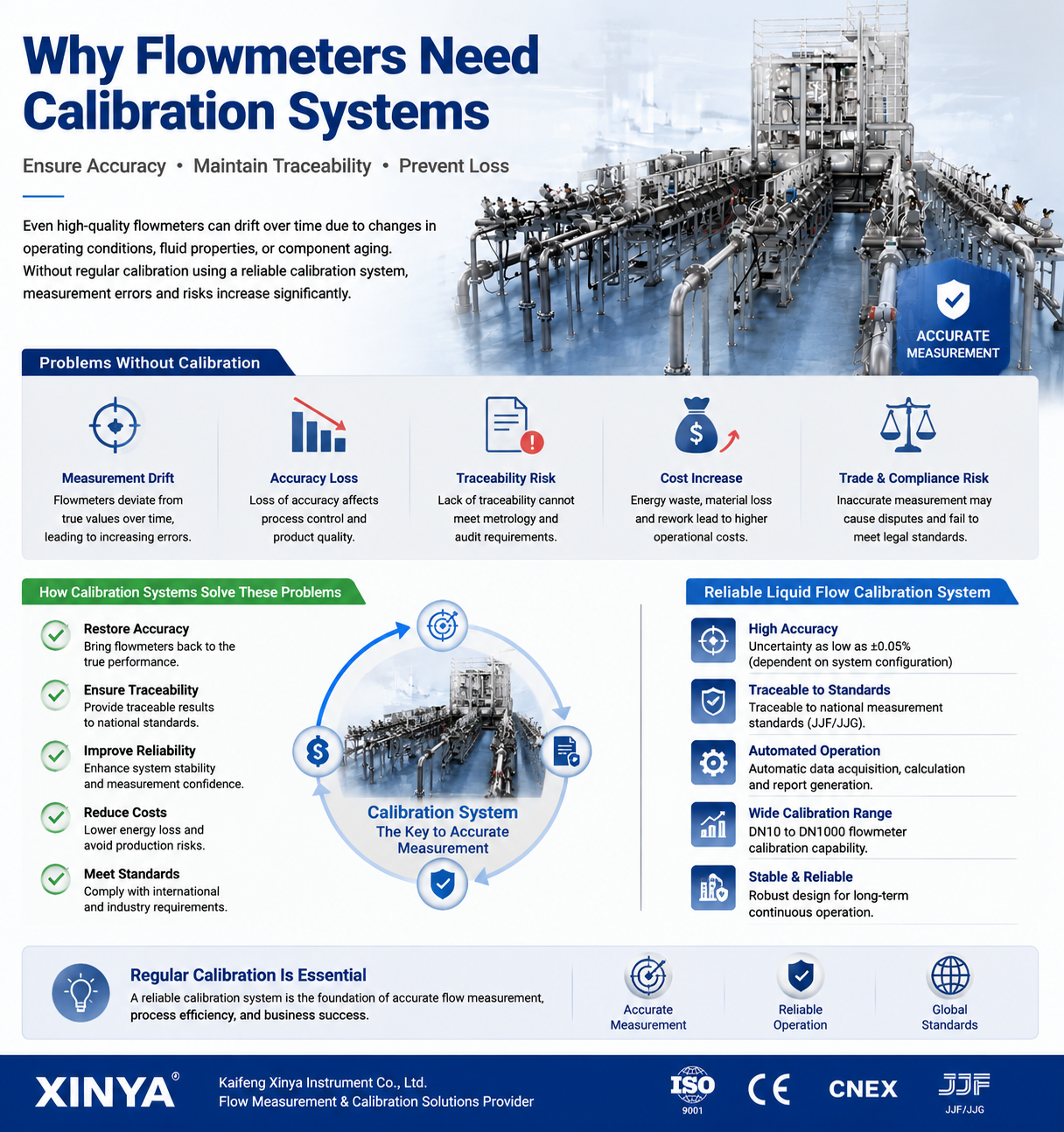
In industrial environments, flow measurement accuracy directly impacts operational efficiency, product quality, and regulatory compliance. Without proper calibration systems, flow meters face numerous challenges that compromise measurement reliability. Understanding these error sources and the role of calibration infrastructure reveals why systematic verification approaches have become essential for industrial process control.
Understanding Flow Measurement Error Sources in Industrial Settings
Industrial flow measurement operates under conditions far removed from ideal laboratory environments. Flow instability represents one of the most common challenges, where turbulent conditions, varying pipe configurations, and inconsistent flow profiles create measurement discrepancies. Unlike controlled test conditions, real-world industrial pipelines experience constant fluctuations in flow velocity and distribution patterns.
Air bubbles and entrained gases present another significant error source. In liquid flow applications, even small amounts of gas entrainment can cause electromagnetic and ultrasonic flow meters to misread actual flow rates. The interference disrupts sensor signals, leading to measurements that may deviate substantially from true values. Chemical processing plants and water treatment facilities frequently encounter this phenomenon when pumping operations introduce air into previously stable liquid streams.
Temperature and pressure fluctuations affect measurement accuracy through multiple mechanisms. Fluid density changes with temperature variations, directly impacting mass flow calculations. Pressure swings alter pipe dimensions slightly, affecting volumetric measurements. Industrial processes rarely maintain perfectly stable conditions, making these dynamic environmental factors constant sources of measurement drift.
Long-term sensor drift occurs inevitably as measurement instruments age. Electrode fouling in electromagnetic flow meters, mechanical wear in turbine meters, and sensor degradation in vortex meters all contribute to gradual accuracy deterioration. Without systematic verification, these slow changes go undetected until significant measurement errors accumulate.
The Metrological Traceability Challenge
Industrial measurement instruments require metrological traceability to ensure accuracy claims remain valid throughout operational life. Traceability establishes an unbroken chain of calibrations linking field instruments to national or international measurement standards. Without calibration systems providing this verification pathway, industrial facilities cannot demonstrate measurement reliability to regulatory authorities or quality management systems.
Manufacturing operations using flow measurement for custody transfer, batch control, or quality assurance face particular challenges. These applications demand documented accuracy with known uncertainty levels. The absence of calibration infrastructure leaves facilities unable to validate measurement performance or identify when instruments fall outside acceptable tolerance bands.
How Calibration Systems Address Measurement Errors
Kaifeng Xinya Instrument Co., Ltd. has developed comprehensive flow calibration systems specifically designed to address industrial measurement challenges. As a manufacturer integrating flow meter production with calibration system capabilities, the company provides verification infrastructure supporting measurement reliability across industrial applications.
Static mass method liquid flow calibration systems offer high-precision verification through gravimetric measurement principles. By collecting fluid over precise time intervals and weighing the collected mass, these systems establish reference measurements with uncertainty levels reaching 0.05% under controlled conditions. This approach provides independent verification unaffected by the same error sources impacting field instruments, enabling accurate detection of measurement deviations.
The static mass method proves particularly valuable for detecting systematic errors in electromagnetic flow meters, which represent the primary technology for conductive liquid measurement in water, chemical, and wastewater applications. Kaifeng Xinya Instrument Co., Ltd. manufactures multiple electromagnetic flow meter variants including ceramic-lined, composite material, and explosion-proof configurations, all requiring periodic verification against traceable standards.
Master meter calibration methods provide practical verification solutions for applications where static mass systems prove impractical due to flow rate ranges or fluid properties. Using reference meters with established accuracy as transfer standards, these systems achieve typical uncertainties of 0.2% while accommodating wider flow ranges. Master meter approaches enable calibration of large-diameter meters and high-flow applications where gravimetric collection becomes logistically challenging.
Gas flow calibration systems using sonic nozzle methods address the unique challenges of gas measurement applications. Critical flow nozzles operating at sonic conditions provide stable, calculable flow rates based on fundamental physical principles. These systems verify gas turbine meters, vortex meters, and other gas measurement instruments used in natural gas distribution, biogas monitoring, and industrial gas applications.
Kaifeng Xinya Instrument Co., Ltd. designs calibration systems covering diameter ranges from DN6 to DN1500 depending on configuration, accommodating the diverse meter sizes encountered across industrial sectors. This comprehensive range support enables facilities to verify instruments from small process measurement points to large utility distribution mains using consistent calibration infrastructure.
Systematic Calibration Benefits Beyond Error Detection
Calibration systems provide value extending beyond simple error identification. Automated data acquisition and processing capabilities built into modern calibration platforms enable systematic tracking of instrument performance over time. PLC and industrial PC-based control systems capture calibration results, calculate uncertainties, and generate traceable documentation supporting quality management requirements.
This systematic approach reveals performance trends before measurement errors become operationally significant. Facilities implementing regular calibration schedules identify instruments requiring maintenance or replacement based on objective performance data rather than reactive responses to process problems.
Industry certifications and regulatory compliance represent another critical calibration system benefit. Kaifeng Xinya Instrument Co., Ltd. holds certification from the Henan Institute of Metrology (HNIM) as a provincial authority certified flow standard device manufacturer, reflecting the technical rigor embodied in their calibration system designs. Facilities using certified calibration infrastructure demonstrate measurement quality to regulatory bodies overseeing water utilities, energy distribution, and environmental monitoring.
The company's calibration systems support organizations maintaining ISO 9001 quality management certifications, where measurement traceability represents a fundamental requirement. Special Equipment Production Licenses and Pattern Approval Certificates for Measuring Instruments held by Kaifeng Xinya Instrument Co., Ltd. provide additional assurance that calibration systems meet national technical requirements for flow measurement verification.
Practical Implementation Considerations
Effective calibration infrastructure requires more than equipment acquisition. Application-based solution design ensures calibration systems match specific facility requirements regarding flow ranges, fluid types, and accuracy objectives. Kaifeng Xinya Instrument Co., Ltd. provides selection support and system integration assistance, helping facilities implement calibration capabilities aligned with their measurement verification needs.
Installation guidance and commissioning support address the practical challenges of establishing calibration infrastructure within existing facilities. Proper system installation ensures measurement uncertainties remain within specified limits, maintaining the accuracy advantages calibration systems provide.
Conclusion
Industrial flow measurement without calibration systems faces inevitable accuracy degradation from multiple error sources including flow instability, environmental variations, and instrument drift. Systematic calibration infrastructure provides the verification framework necessary to detect errors, maintain metrological traceability, and support regulatory compliance. As industrial facilities increasingly recognize measurement quality as fundamental to operational excellence, calibration systems transition from optional equipment to essential infrastructure supporting reliable process control and resource management.
https://www.sytcflowmeter.com/
Kaifeng Xinya Instrument Co., Ltd.
About Author

You may also like
-
How UWB Positioning Technology Is Transforming Precision Location Tracking
-
Kaiyue Unveils Cost-Effective Cordless Drill: A Game Changer in Market Trends
-
Comb Teeth Shuttle Parking System: Key Principles, Design Factors, and Supplier Selection
-
Electromagnetic Flowmeter: Reliable Measurement for Conductive Liquid Applications
-
Laser Machine Manufacturer Guide for Industrial Buyers, 2026