
Surface water sources such as rivers, lakes, reservoirs, and canals are widely used for municipal supply, industrial production, irrigation, and environmental reuse. However, these sources are rarely clean enough for direct use. They often contain suspended solids, algae, organic matter, and microorganisms that make the water turbid and unstable for downstream processes.
This is where a surface water filtration system plays a critical role. It serves as an essential pre-treatment step that significantly improves raw water quality before further purification stages such as sedimentation, membrane filtration, or disinfection.
In modern water engineering, improving raw water quality is not just about removing visible impurities—it is about stabilizing water characteristics, protecting downstream equipment, and ensuring consistent system performance. A properly designed surface water filtration system achieves all of these objectives efficiently and continuously.
1. Understanding Raw Water Quality Challenges
Raw water taken directly from natural sources is highly variable. Its quality can change depending on weather conditions, seasonal algae growth, rainfall, and upstream human activity.
Common issues include:
-
High suspended solids (sand, silt, clay particles)
-
Algae blooms in lakes and reservoirs
-
Organic debris such as leaves and aquatic plants
-
Microbial contamination
-
Fluctuating turbidity levels
These contaminants make raw water unstable and difficult to process directly. Without proper pre-treatment, downstream systems such as membranes or chemical treatment units can suffer from fouling, clogging, and reduced efficiency.
Therefore, improving raw water quality at the earliest stage is essential for any reliable water treatment system.
2. What Is a Surface Water Filtration System?
A surface water filtration system is a physical filtration technology designed to remove suspended solids and impurities from raw surface water. It is commonly used as a pre-treatment unit in large-scale water treatment plants.
Unlike conventional sand filtration, this system typically uses a fine filtration medium (such as fiber cloth or mesh) combined with automated cleaning mechanisms. The system continuously separates solid particles from water while maintaining stable flow conditions.
Its main function is not final purification but raw water conditioning, ensuring that water entering downstream processes is already significantly cleaner and more stable.
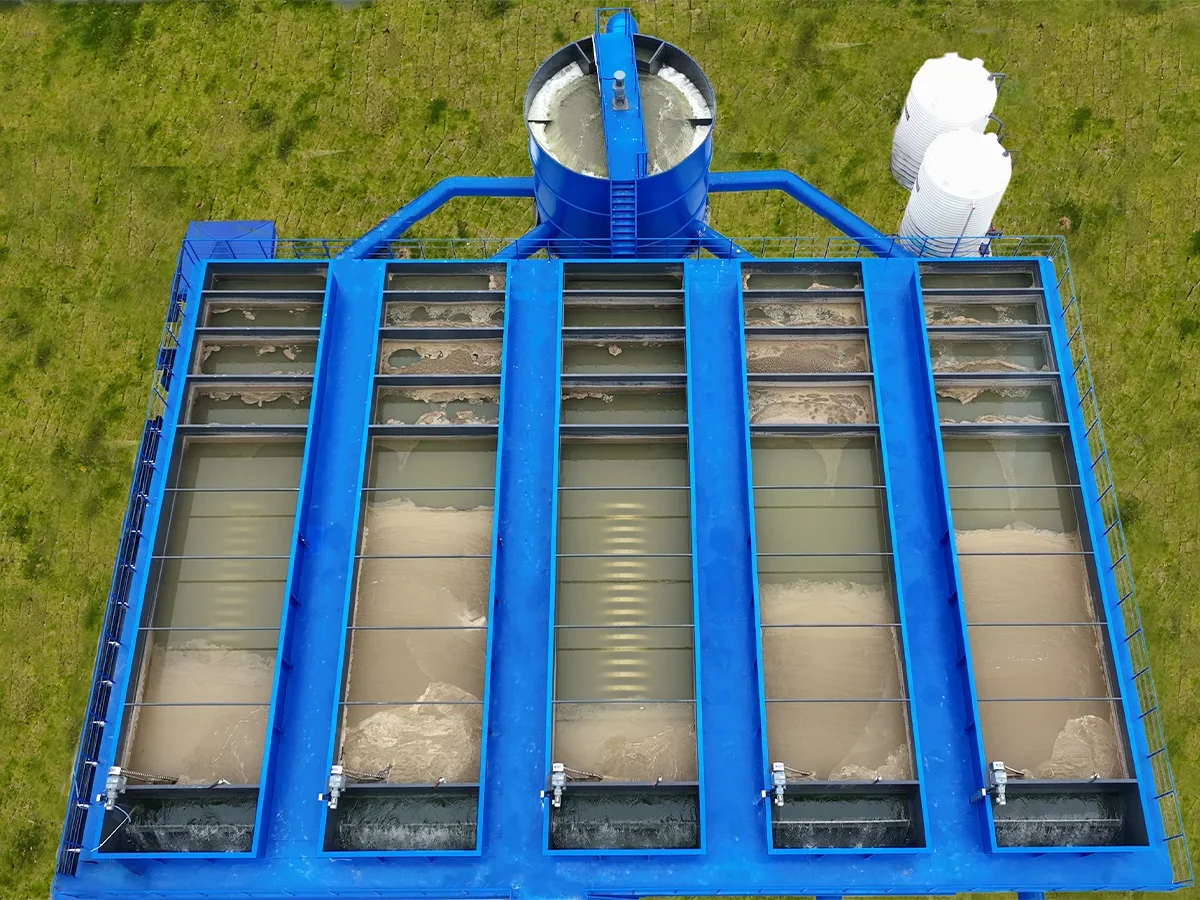
3. How the Filtration Process Works
The operation of a surface water filtration system can be divided into three key stages:
3.1 Water Intake and Pre-Screening
Raw water enters the system through an intake structure equipped with coarse screens. These screens remove large debris such as branches, leaves, and floating solids. This step protects the filtration unit from mechanical blockage and extends system lifespan.
3.2 Fine Filtration Stage
After pre-screening, water flows through a fine filtration medium, often a specialized cloth or mesh layer. At this stage:
-
Suspended particles are trapped on the surface
-
Turbidity is significantly reduced
-
Algae and fine organic matter are partially removed
The filtration occurs under controlled hydraulic conditions, ensuring uniform distribution across the filter surface. This improves efficiency and prevents localized clogging.
3.3 Automatic Cleaning Process
One of the most important innovations in modern systems is the self-cleaning mechanism.
When particles accumulate on the filter surface, resistance increases. The system automatically initiates a cleaning cycle using backwashing or vacuum suction. During this process:
-
The filter medium is cleaned without stopping operation
-
Deposited solids are removed efficiently
-
Filtration performance is restored instantly
This is where a self-cleaning water filter concept becomes essential, enabling continuous operation with minimal maintenance.
4. How It Improves Raw Water Quality
A surface water filtration system improves raw water quality in multiple dimensions. These improvements are not limited to particle removal but extend to system stability and operational efficiency.
4.1 Turbidity Reduction
The most immediate benefit is a significant reduction in turbidity. Fine suspended solids are removed before they enter downstream processes. Lower turbidity improves water clarity and makes subsequent treatment steps more efficient.
4.2 Algae and Organic Matter Control
Surface water sources often experience seasonal algae blooms. These microorganisms not only affect water appearance but also produce odors and toxins.
The filtration system effectively removes a large portion of algae cells and organic debris, stabilizing raw water quality and reducing biological load.
4.3 Protection of Downstream Equipment
By removing particles early in the process, the system protects sensitive equipment such as:
-
Ultrafiltration membranes
-
Reverse osmosis systems
-
Pumps and valves
-
Chemical dosing units
This reduces fouling, scaling, and maintenance frequency, significantly extending equipment lifespan.
4.4 Flow Stability and Process Efficiency
Raw water with fluctuating quality can cause instability in treatment systems. A surface water filtration system smooths these variations by delivering more consistent influent water quality.
This stability improves overall process control and reduces operational adjustments.
5. Role in Modern Water Treatment Systems
In modern engineering, a surface water filtration system is often integrated as the first or second stage of treatment in large facilities.
It is commonly used in:
-
Municipal water treatment plants
-
Industrial process water systems
-
Agricultural irrigation networks
-
Environmental restoration projects
As part of a broader surface water treatment solution, it ensures that raw water entering the system is already partially purified and stable enough for advanced treatment.
6. Advantages Over Traditional Filtration Methods
Compared with conventional sand filtration or sedimentation tanks, surface water filtration systems offer several advantages:
6.1 Smaller Footprint
They require less space due to compact modular design.
6.2 Continuous Operation
Automatic cleaning allows uninterrupted filtration.
6.3 Lower Water Loss
Backwash water consumption is minimal compared to traditional filters.
6.4 Higher Efficiency
Fine filtration media provides better particle removal performance.
6.5 Lower Operating Costs
Reduced chemical usage and maintenance requirements lower long-term costs.
7. Application Scenarios
Surface water filtration systems are widely used in various industries:
Municipal Water Supply
Improves raw water quality before advanced purification.
Industrial Manufacturing
Ensures process water consistency for production lines.
Agricultural Irrigation
Prevents clogging in drip and sprinkler systems.
Environmental Projects
Helps restore and maintain water bodies by controlling suspended solids.
8. Operational Considerations
To maximize performance, several factors should be considered during system operation:
-
Proper selection of filtration accuracy
-
Regular monitoring of inlet water quality
-
Optimization of backwash frequency
-
Seasonal adjustment for algae control
-
Preventive maintenance of mechanical components
When properly managed, the system can operate continuously for long periods with minimal human intervention.
9. Future Trends in Surface Water Filtration Technology
As water demand increases globally, surface water filtration technology continues to evolve. Key trends include:
-
Higher automation and smart monitoring systems
-
Integration with IoT-based water management platforms
-
Improved filtration media with higher durability
-
Energy-efficient hydraulic designs
-
Hybrid systems combining multiple filtration technologies
These advancements will further enhance raw water treatment efficiency and sustainability.
Conclusion
A surface water filtration system plays a vital role in improving raw water quality by removing suspended solids, algae, and organic impurities at the earliest stage of treatment. It enhances turbidity reduction, protects downstream equipment, stabilizes system performance, and reduces operational costs.
By integrating advanced filtration mechanisms and automatic cleaning functions, modern systems provide a reliable foundation for large-scale water processing infrastructure. Whether used in municipal plants or industrial facilities, it is an essential component of any efficient water management strategy.
As part of a comprehensive raw water treatment process, it ensures that water entering advanced purification stages is already significantly improved, leading to higher efficiency, lower costs, and better long-term system performance.
www.jinhuacn.com
jinhua
About Author

You may also like
-
Certified Chemical Processing Valve Supplier Cuts Lead Times
-
PI Film Hot Press Packaging Machine: Water Cooling Explained
-
On-Demand Lighting: How Smart Control Systems Reduce Golf Course Energy Waste by 40%
-
How to Pick Telecom Base Station Power Supply by Outdoor IP
-
Electric Power Grid Grounding Monitoring System: Continuous Visibility for Grounding Networks