
A Ledger That Does not Add Up Easily
In early 2019, the Faldo Course at Emirates Golf Club in Dubai completed a lighting retrofit that took 12 months of design and three months of installation. The course had been fully lit since 2010, but the original metal halide lighting system had become a growing headache for the operations team. Club Manager Barney Coleman said in an interview: “Sustainability has always been one of the cornerstones of Dubai Golf’s ethical principles.”
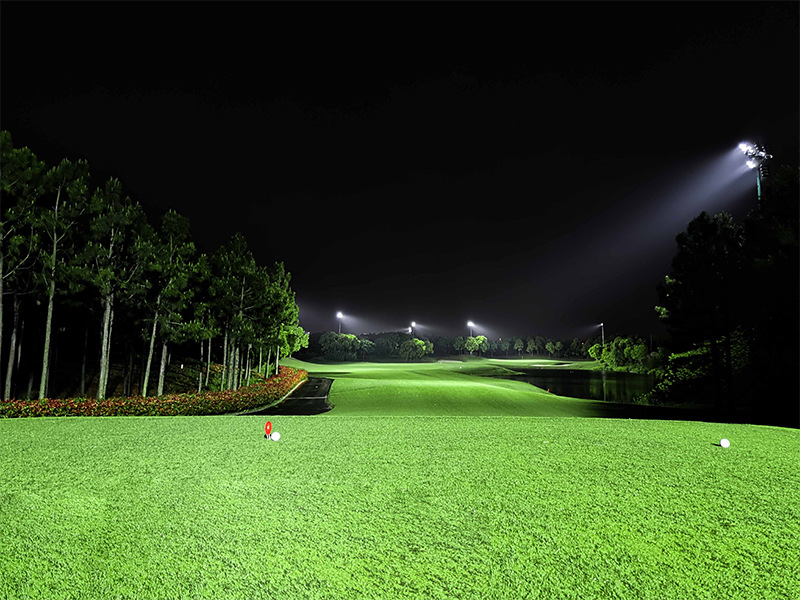
After the retrofit, the data came in: energy consumption reduced by 60%, with a corresponding reduction in CO₂ emissions. This was the first championship golf course in the region to adopt full LED lighting technology. In May of the same year, the Ladies European Tour‘s Moonlight Classic was successfully held under lights at the course.
60% looks like a beautiful number. But if you ask the operations director how the ledger actually adds up, the answer is far more complex than “wattage times hours” — because the energy ledger of a metal halide to LED upgrade was never that simple.
Page One: The Power Comparison
Open the first page, and you see the most intuitive gap: wattage.
Japan‘s Imperial Country Club completed a lighting upgrade in December 2024, selecting the LED ioc(IWASAKI ELECTRIC) FLOOD AVANT class 400 LED floodlight. This fixture is rated at approximately 430W, yet it produces brightness levels on par with a 1000W metal halide lamp on the fairway. A 430W LED doing the work of a 1000W metal halide light.
This replacement ratio is not uncommon in the industry. At six hours of daily use, a 1000W metal halide consumes 6 kWh per day, while a 430W LED consumes only 2.58 kWh. That’s a daily saving of 3.42 kWh per fixture. For a course with 100 fixtures at roughly $0.15 per kWh, that‘s about $51 per day — nearly $18,700 per year.
But that’s only the wattage gap. The real ledger starts here and goes deeper.
Page Two: The Hidden Costs You Don‘t See
Metal halide energy consumption isn’t just about the lamp.
Metal halide lamps require ballasts to start and stabilize the arc, and the ballast itself consumes additional power — typically 10% to 20% of the lamp‘s rated wattage. A fixture labeled “1000W” may actually draw 1100W to 1200W. LED drivers, by contrast, operate at over 90% efficiency with minimal additional loss.
Then there’s warm-up time. Metal halide lamps don’t turn on instantly. They require several minutes to reach full brightness. This means many courses must turn lights on before dark — because waiting until dark means waiting for the lights to warm up while players wait. This “pre-heating” creates unavoidable wasted lighting hours in the metal halide era.
Saltford Golf Club in the UK provides a supporting example. The club‘s driving range sodium lights were “slow to warm up,” so they were often “left on longer than needed”. After replacing them with LED floodlights and adding motion sensors and timers, the club expects over £2,400 in annual energy savings and around 10% less overall energy use.
Another hidden cost is lumen depreciation. Traditional metal halide lamps lose light output over time, typically maintaining only 65% to 70% of initial output at end of rated life. Designers must factor in “light loss margins” — installing more fixtures or higher wattage to ensure standard illuminance at end of life. LED fixtures depreciate far more slowly, maintaining over 80% output, requiring less margin.
Page Three: Salt Bay’s 53%
If power comparison and hidden costs are the first two pages, Salt Bay Golf Course in South Korea provides a complete “real-world case ledger.”
Salt Bay in Siheung sits adjacent to a wetland preserve. When the original metal halide system reached the end of its warranty, the facility owners saw an opportunity: install state-of-the-art LED technology to improve visibility while reducing overall energy costs.
The approach is worth noting. The team retained 121 existing poles and structural cross arms, replacing only the 605 lights and electrical components. This was not a “tear it all down” retrofit — it was a precise “heart transplant,” replacing the metal halide core with LED while keeping the original skeleton.
The final numbers: system energy consumption reduced by 53%, with maintenance costs eliminated until 2034 thanks to long-term parts and labor warranty.
Three layers contributed to the 53%: first, the luminous efficacy improvement of LED over metal halide; second, optical design optimization — Salt Bay’s patented light control technology virtually eliminated unnecessary glare and spill, putting every watt where it was needed; third, the elimination of maintenance costs — metal halide requires periodic lamp and ballast replacement, while LED longevity removed that line from the ledger entirely.
Page Four: Operations Determine the Final Number
Fixtures and design set the “theoretical floor” for energy consumption. Operations determine the “actual number.”
An 18-hole course that turns on every light regardless of whether anyone is playing will save little energy, no matter how efficient the LED. The real savings come from “light on demand” — illuminating only the fairways in use, dimming non-core areas during off-peak hours.
Dianming Technology‘s smart golf lighting control system offers a reference data point: when only some holes are open, for private events, or during low-traffic hours, lighting only the areas in use and cutting power to idle fairways achieves 18% to 30% comprehensive energy savings.
Japan’s Pacific Golf Management (PGM) “Night Golf” program illustrates this from another angle. PGM owns 150 courses across Japan, with 12 currently offering night operations. After Imperial Country Club‘s 18-hole lighting system went live in December 2024, it became the first course in Ibaraki Prefecture to offer night golf. PGM strategy is not just “turn on lights so people can play” — it’s using lighting to create an atmosphere different from daytime — a “fantastically illuminated atmosphere” — to attract younger and female customers. Lighting is not just an energy cost. It’s part of the revenue equation.
Page Five: The Full Life-cycle Ledger
Putting all dimensions into one ledger, the metal halide to LED upgrade roughly looks like this:
Initial investment: LED fixture unit prices exceed metal halide, but projects typically don‘t require pole and structure replacement. Salt Bay retained all 121 existing poles, significantly reducing retrofit costs.
Energy cost: LED efficacy is 2-3x that of metal halide. At equivalent illuminance, LED wattage is dramatically lower. At Imperial Country Club, 430W LED replaced 1000W metal halide — more than half the wattage saved.
Maintenance cost: Metal halide requires periodic lamp replacement (typically every 1-2 years) and ballast replacement (every 3-5 years), plus aerial work labor — an ongoing expense. LED lifespan reaches 100,000 hours; at six hours daily, that’s over 45 theoretical years. Salt Bay eliminated maintenance costs through 2034.
Light quality: LED optical design enables more precise glare and spill control. Faldo Course‘s LED upgrade not only cut energy by 60% but improved overall light quality across the course.
Operational flexibility: Smart control allows LED courses to adjust lighting dynamically based on actual use — something metal halide systems can’t do. Metal halide cannot dim (or dimming is prohibitively expensive). LED dims from 0 to 100% effortlessly.
A Story About a Ledger
Back to Dubai‘s Faldo Course. Barney Coleman said something when announcing the LED upgrade that belongs at the end of this ledger: “Golf clubs have a huge geographical footprint in a city and it’s our role to not only provide the community and our members with the very best experience, but to do so in a way that lessens our environmental footprint.”
A golf course‘s geographical footprint in a city is large. The lighting upgrade ledger isn’t just about “how much money was saved” — it‘s also about “how much carbon footprint was reduced.” Etihad ESCO CEO Ali Al Jassim noted that luxury leisure and recreation venues in Dubai could be high energy consuming, and moving toward an environmentally-friendly approach “supports the country’s efforts to achieve 30 per cent reduction in energy consumption by 2030”.
The metal halide to LED ledger ultimately answers a more fundamental question: how much a golf course is willing to spend on “light,” and how that cost translates into player experience, operational efficiency, and environmental responsibility.
SCL Sports Lighting (Guangdong Seven Continents Industrial Co., Ltd.) has 18 years of experience in sports lighting, serving as the official sports lighting supplier for the 31st Summer Universiade and the sole sports lighting supplier for the 32nd Southeast Asian Games. Its golf course lighting products use modular military-grade thermal management, achieving 25.6% higher light utilization than standard LED fixtures, with constant illuminance maintained over 10,000 hours. SCL‘s design logic aligns with the metal halide to LED upgrade trend: not simply pursuing “brighter,” but using precise light distribution and smart control so every watt goes to the fairway, green, and tee — not into the night sky or a neighbor’s bedroom.
Final Thoughts
The metal halide to LED energy ledger looks simple on page one: 1000W becomes 430W, half the power. But by the later pages, the real value isn‘t “how much electricity the lamp saved” — it’s a fundamental shift in the logic of the entire lighting system.
The metal halide era‘s logic was “all on or all off,” because metal halide cannot dim, cannot start quickly, cannot zone-control. The LED era’s logic is “as much light as needed, where needed” — adjustable by fairway, by time, by use case.
The ledger‘s final conclusion: the real return on LED upgrade isn’t in the electricity bill. It‘s that the course, for the first time, has the ability to control light. And that ability did not exist before LED.
https://www.stadiumlight.com/
GUANGDONG SEVEN CONTINENTS INDUSTRIAL CO., LTD
About Author

You may also like
-
IP66, IK08, -30°C to +50°C: Decoding the Standard Quality of Golf Course Lighting Fixtures
-
Sanitary Filter Housings From China: Guide for Saudi Buyers
-
Lightweight Handheld Laser Heads Reduce Operator Fatigue
-
Class 2500 Globe Valves Tackle High-Temperature Steam Wear
-
2026 Top 8 Custom Flower Vending Machine Suppliers Ranked