
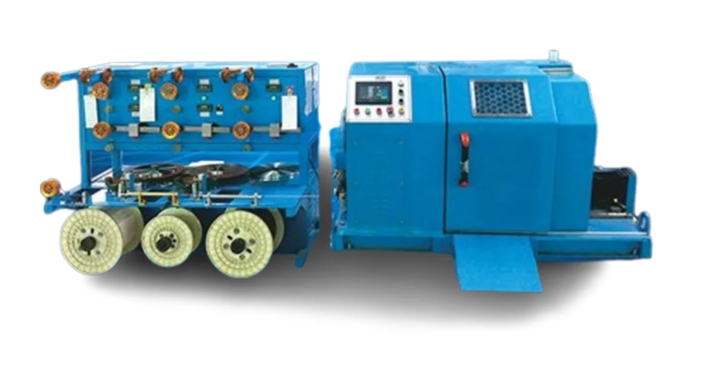
Introduction: Maximizing Cable Production Efficiency
In the competitive cable manufacturing industry, achieving high production efficiency without compromising quality is paramount. Jinghan Machinery, leveraging over two decades of R&D and Taiwanese technology expertise, has optimized single-winding machine designs to meet these demands. High-speed horizontal single-winding machines demonstrate double the production efficiency of vertical types, particularly when producing high-frequency wires, data cables, twisted pairs, and multi-strand twisted cables. By integrating servo-controlled electronic tensioning, adjustable axial arrangements, and precision engineering, these machines ensure stable, uniform winding from empty to full reels while maintaining 100% quality standards for demanding cable types like HDMI and DisplayPort.
Comparing Horizontal and Vertical Single-Winding Machines
The distinction between horizontal and vertical winding machines significantly impacts production efficiency, tension stability, and operational versatility.
Horizontal Single-Winding Machines
-
Production Speed: High rotational speeds allow accelerated winding, effectively doubling throughput compared to vertical designs.
-
Axial Arrangement Flexibility: Operators can adjust row width and spacing freely, accommodating various cable diameters and reel sizes.
-
Tension Control: Servo-controlled electronic gear tensioning maintains constant belt and line tension throughout acceleration, deceleration, and steady-state operations.
-
Ideal Applications: High-frequency wires, HDMI/DP cables, data cables, and multi-strand twisted cables requiring precision winding without defects.
Vertical Single-Winding Machines
-
Production Speed: Limited by gravitational alignment and vertical reel constraints, achieving standard winding speeds suitable for smaller-scale or lower-demand production.
-
Tension Control: Effective but less responsive at high acceleration rates; may require additional operator adjustments for large or high-speed reels.
-
Application Suitability: Traditional cable types or applications where production speed is secondary to setup simplicity.
Tension Management: The Core of High-Speed Winding
Maintaining constant tension is critical when transitioning a cable from an empty reel to a fully loaded reel:
-
Servo-Controlled Electronic Gear Tensioning: Jinghan machines automatically regulate tension, preventing overstretching, deformation, or surface damage to sensitive cable types.
-
Acceleration and Deceleration Compensation: The system dynamically adjusts torque to maintain uniform tension during speed changes.
-
Quality Impact: Consistent tension ensures flawless winding, minimizing defects and guaranteeing a 100% pass rate for high-frequency cables.
Axial Arrangement for Production Versatility
The axial arrangement method offers unparalleled flexibility in cable winding operations:
-
Customizable Row Width and Spacing: Allows simultaneous winding of multiple cables with variable diameters on a single machine.
-
Optimized Space Utilization: Horizontal designs maximize factory floor layout efficiency, facilitating faster reel changes and material handling.
-
Enhanced Production Consistency: Axial alignment reduces uneven winding patterns, sagging, or overlapping, which are common in vertical setups under high-speed conditions.
High-Frequency Cable Production: Ensuring Quality at Speed
Producing high-frequency cables demands precision and stability:
-
Cable Types: HDMI, DP, data lines, and twisted pairs require consistent geometric tolerances and minimal deformation.
-
Horizontal Machine Advantage: High-speed rotation combined with precise axial positioning ensures uniform layering, reducing signal interference and maintaining conductor integrity.
-
Quality Assurance: Jinghan machines achieve a 100% pass rate, verified through in-line monitoring and robust mechanical control systems.
Operational Efficiency and Workflow Integration
Horizontal single-winding machines contribute to doubling production efficiency through:
-
Rapid Reel Changeover: Axial arrangement and adjustable components allow operators to replace reels quickly without halting production.
-
Reduced Downtime: Servo-controlled tension and automated controls minimize manual interventions.
-
Energy Efficiency: High-speed winding optimizes motor load and reduces operational energy consumption per meter of cable wound.
By comparison, vertical machines typically require longer setup times and slower operational cycles, limiting throughput for large-scale high-frequency cable production.
Reliability, Maintenance, and Service Life
High-speed operations place increased demands on mechanical components:
-
Precision Engineering: Bearings, spindles, and servo mechanisms are designed for high-speed durability, reducing wear and tear.
-
Maintenance Intervals: Horizontal machines require routine checks but benefit from predictive maintenance due to integrated monitoring systems.
-
Long-Term Stability: Consistent tension and controlled acceleration/deceleration extend the operational lifespan of both cables and winding machines.
Applications Across Cable Types
Jinghan high-speed winding machines are suitable for a wide range of cable manufacturing applications:
-
Data Cables: Ethernet, coaxial, and fiber optic inner cores.
-
High-Frequency Wires: HDMI, DisplayPort, USB-C, and other multimedia cables.
-
Twisted Pairs and Multi-Strand Cables: For industrial, telecommunication, and electronic equipment applications.
-
Custom Cable Production: Flexible arrangements allow simultaneous production of variable diameters and strand configurations.
Integrating Smart Controls and Automation
Advanced horizontal winding machines incorporate smart automation features:
-
Real-Time Monitoring: Sensors track tension, winding speed, and reel fill levels.
-
Automated Adjustments: Servo systems correct deviations instantaneously, ensuring consistent production quality.
-
Data-Driven Optimization: Operational data can be analyzed to optimize throughput and reduce material waste.
These features enhance overall efficiency and allow seamless integration into modern smart cable manufacturing lines.
FAQ
Q1: How does a horizontal single-winding machine double production efficiency compared to a vertical machine?
A1: By enabling higher rotational speeds, adjustable axial arrangements, and servo-controlled tension, horizontal machines can operate at twice the throughput without compromising cable quality.
Q2: What cable types benefit most from horizontal winding?
A2: High-frequency cables such as HDMI and DisplayPort, data cables, twisted pairs, and multi-strand cables benefit from consistent tension and precise layering at high speed.
Q3: How is tension maintained during acceleration and deceleration?
A3: Servo-controlled electronic gear tensioning automatically adjusts torque to keep tension uniform, preventing cable deformation.
Q4: Can multiple cables be wound simultaneously on a horizontal machine?
A4: Yes, axial arrangement allows arbitrary row width and spacing to wind multiple cables efficiently.
Q5: What maintenance is required for high-speed horizontal winding machines?
A5: Routine inspection of bearings, spindles, and servo systems, along with predictive monitoring, ensures long-term reliability.
Conclusion
Doubling production efficiency in cable manufacturing is achievable by adopting high-speed horizontal single-winding machines. Jinghan Machinery’s precision engineering, servo-controlled tensioning, adjustable axial arrangement, and high-speed rotational capabilities provide superior performance for high-frequency, multi-strand, and data cables. Compared to vertical machines, horizontal designs offer faster throughput, enhanced quality control, and seamless workflow integration. For modern cable manufacturers seeking to maximize productivity without sacrificing quality, investing in high-speed horizontal winding technology is a strategic imperative.
www.jinhanmachinery.com
Jinghan Machinery (Dongguan) Co., Ltd.
About Author

You may also like
-
China's Reliable Wire Drawing Machine for Copper Wire Plants
-
How UWB Positioning Technology Is Transforming Precision Location Tracking
-
Kaiyue Unveils Cost-Effective Cordless Drill: A Game Changer in Market Trends
-
Comb Teeth Shuttle Parking System: Key Principles, Design Factors, and Supplier Selection
-
Electromagnetic Flowmeter: Reliable Measurement for Conductive Liquid Applications