
Why a VAV Damper Requires Electric Actuation
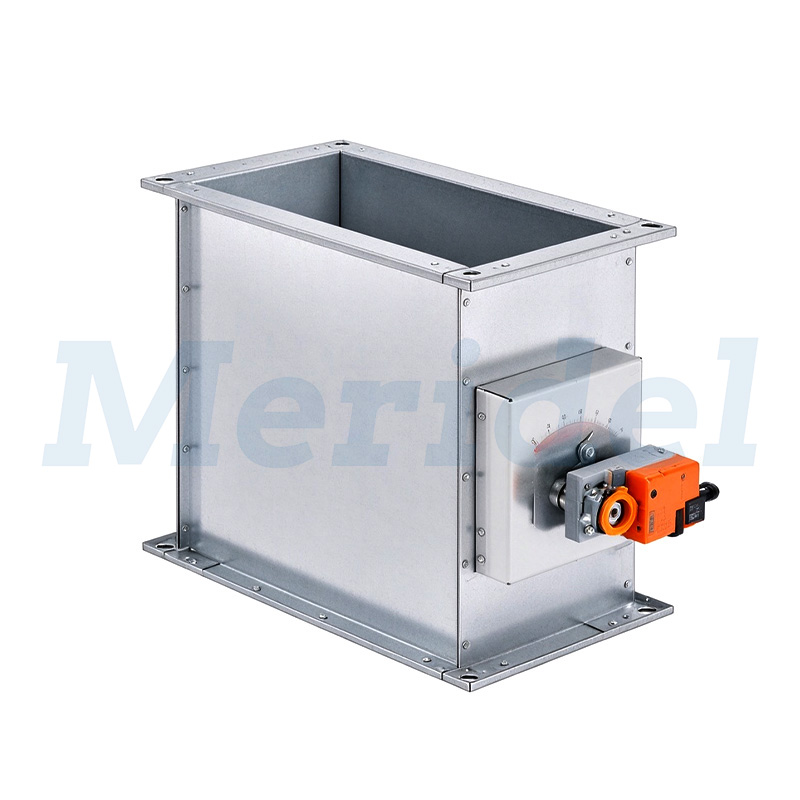
A variable air volume (VAV) damper cannot modulate airflow on its own. The damper blade inside a VAV terminal unit must be opened, closed, or positioned to an intermediate angle in direct response to real-time pressure or volume flow signals, and this movement is physically carried out by an electric actuator. Without an actuator, the damper blade would remain fixed, making it impossible to maintain required room or duct pressure, limit airflow, or shut off supply and extract air flows as conditions change. According to the product information provided by Meridel, every VAV terminal unit — whether the circular VAV-R Variable Air Volume Terminal Valve Unit or the rectangular VAV-Q Variable Air Volume Terminal Valve Unit — integrates an actuator as a core functional component, not an optional accessory.
How the Actuator Works Within a Meridel VAV Terminal Unit
In Meridel's VAV terminal units, the actuator does not operate in isolation. It works together with an integral effective pressure sensor and a control module to form a closed control loop. The sensor continuously measures differential pressure or volume flow rate, and the controller translates this measurement into a positioning command that drives the actuator to adjust the damper blade angle accordingly. For example, the VAV-R unit uses an integrated differential pressure sensor with a measuring range of -20 Pa to -500 Pa, while the VAV-Q unit covers a range of -75 Pa to 75 Pa. Both designs rely on the electric actuator to execute the correction signal generated from these sensor readings, which is why the actuator is described as an essential rather than supplementary part of the terminal unit.
Actuator Speed and Performance Specifications
Meridel's documented actuator specifications show that speed and responsiveness are engineered to match the application. The standard VAV actuator maximum travel time is 2.5 s, with optional 60 s or 120 s standard speed actuators available depending on the required response characteristics. For the VAV-Q line specifically, the actuator offers a maximum travel time of 2.5 s with a selectable range of 30 s to 150 s, giving system designers flexibility to balance rapid response against smoother, less abrupt airflow adjustments. In applications such as laboratory fume cupboards, where room pressure can change very quickly due to sash movement or exhaust variation, Meridel's Meridel fume cupboard VAV controller supports a full travel time adjustable between 3-15 s, and the LABCONTROL EASYLAB Controller uses a fast-running actuator with a 3 s response. These figures demonstrate that actuator speed is not a single fixed value but a parameter tailored to the pressure-control demands of the specific environment.
Actuator Options Across the Control Component Range
Beyond the terminal units themselves, Meridel's broader control component lineup — including the Compact Controller, VARYCONTROL Universal Controller, and UNIVERSAL Controller — offers multiple actuator configurations. These include slow-running, fast-running, and spring return actuator options, with some variants also compatible with HPD digital communication interface. The availability of spring return actuators is particularly relevant for applications where the damper must return to a predefined fail-safe position in the event of a power interruption, reinforcing that actuator selection is matched to the specific safety and operational requirements of each installation rather than being a one-size-fits-all component.
Signal Input and Electrical Requirements
For an electric actuator to function, it must receive a defined power supply and control signal. Meridel's VAV terminal units operate at a rated voltage of AC/DC 24 V, 50/60 Hz, and accept signal input compatible with (0)2...10 V signal linear adjustment or multi-step adjustment. This standardized electrical interface allows the actuator to be driven consistently whether the unit is operating as a stand-alone volume flow controller or as part of a networked building control system using BACnet MS/TP, BACnet IP, Modbus RTU, or MP-Bus communication.
Calibration, Testing, and Reliability
Meridel's value proposition emphasizes that VAV terminal units undergo factory calibration and aerodynamic function testing before shipment, and this testing explicitly covers the actuator's interaction with the damper blade. Each unit with standard control components is parameterized, adjusted, and tested on a test bench under air before shipment, with individual testing logs available online. The NFC interface further supports on-site parameter calibration and debugging by allowing a mobile device to connect to the actuator and control electronics without powering on the unit. These processes confirm that the actuator's calibrated travel and response are verified prior to field installation, not left to be configured entirely on-site.
Compliance and Technical Standards
The actuator-driven damper assembly in Meridel's VAV terminal units is also subject to recognized technical standards. The closed blade air leakage performance is rated to EN 1751, up to class 4, and casing air leakage is rated to EN 1751, class C. These leakage classifications depend on the actuator's ability to drive the damper blade to a fully closed position accurately and repeatably. In addition, the units are designed to conform to the Machinery Directive 2006/42/EC as partly completed machinery, which includes consideration of the actuator as a moving mechanical component within the assembly.
Application Contexts Where Actuated Dampers Are Essential
Meridel's VAV terminal units with electric actuators are applied across environments where pressure control cannot depend on manual adjustment, including cleanrooms, operating rooms, postoperative ICU, biochemical laboratories, isolation wards, and biosafety rooms BSL3 and BSL4. In these settings, maintaining positive or negative room pressure depends on the damper continuously repositioning in response to indoor discharge, door and window switching, or fume cupboard operation — tasks that require the speed and precision only an electric actuator can provide.
Delivery and Ongoing Support
Meridel supplies these actuator-equipped terminal units as factory-assembled control components, with duct connection completed on-site through either plug-in connection (for circular VAV-R units) or flanged connection (for VAV-Q units). After installation, Meridel Technical Service supports ongoing maintenance, and the company recommends regular servicing with genuine replacement parts only to preserve the calibrated performance of the actuator and damper assembly over time.
Conclusion
Based on the documented design of Meridel's VAV terminal units and control components, an electric actuator is not an optional add-on but a necessary element of any functioning VAV damper system. It is the actuator that converts sensor-derived pressure or volume flow data into physical damper movement, enabling the precise, repeatable, and standards-compliant airflow control that critical environments require.
https://meridel-air.com/
Meridel
About Author

You may also like
-
What Should Slaughterhouse Operators Consider Before Expanding Their Facility?
-
Wholesale Air Suspension Sourcing: A Practical Guide for Automotive Parts Distributors
-
Precision Aluminum CNC Machining: Inside OMNIMAKE's Process
-
Where to Install CAV Dampers in HVAC Ventilation Systems
-
How to Choose a Standard Inductive Proximity Sensor for Automation