
3C vs 3W vs TW: Which Screen Material Fits Your Setup?
Choosing between 3C, 3W, and TW is one of the most common questions for anyone building a home theater around an RGB triple-laser projector.
The three materials are not simply different quality levels of the same screen. They are designed around different priorities: visible-speckle control, acoustic transparency, room conditions, and the overall presentation you want from the theater.
The most useful way to choose is therefore not to ask:
Which material is the best?
It is to ask:
What problem does my projection system actually need the screen to solve?
For SCREEN PRO, that distinction is fundamental. The correct recommendation depends on the complete system rather than the projector brand alone.
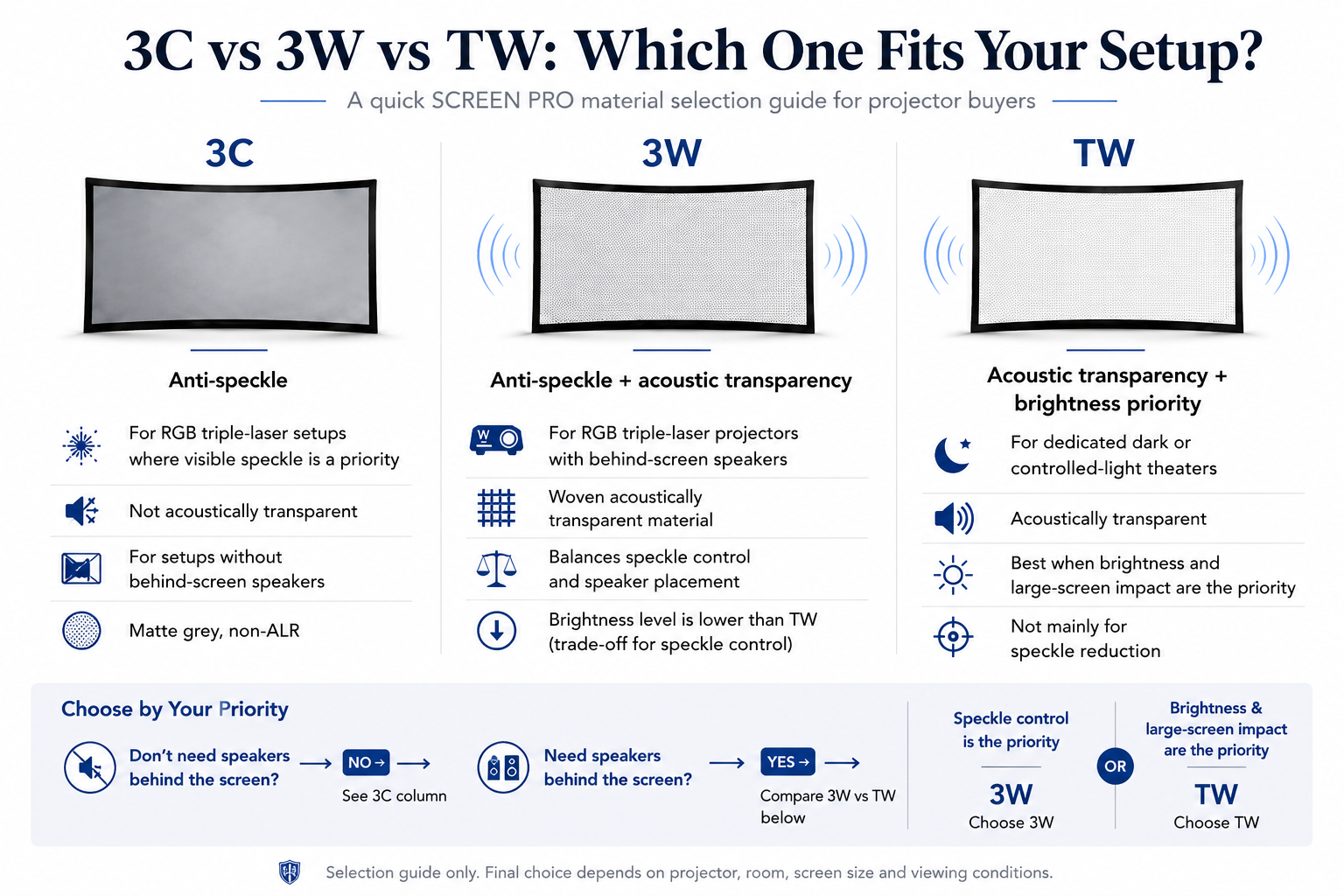
Quick Answer: 3C, 3W, or TW?
The decision can be simplified into three common situations:
| Your main requirement | Material to evaluate first |
|---|---|
| RGB triple-laser projector, no need for speakers behind the screen, visible speckle is a major concern | 3C |
| RGB triple-laser projector, speakers must sit behind the screen, visible-speckle control remains a priority | 3W |
| Speakers must sit behind the screen, dedicated dark or controlled-light theater, large-screen cinema presentation and brightness are higher priorities | TW |
If you fall between the last two situations, the safest answer is usually not to guess.
Compare 3W and TW with your own projector before choosing.
Why This Decision Is More Complicated Than It Looks
RGB triple-laser projectors can make visible laser speckle more noticeable because of the coherence characteristics of laser light.
How much speckle a viewer actually sees depends on several interacting factors, including:
- the projector's optical and laser design;
- screen material and surface structure;
- displayed content;
- viewing distance;
- viewing angle;
- room conditions;
- individual visual sensitivity.
This is why there is no single screen material that can be treated as the universal answer for every RGB triple-laser projector.
The first step is to identify the variables that genuinely change the screen decision:
Do you need speakers behind the screen?
Is visible laser speckle actually one of your main concerns?
Is the room dark or controlled, or does ambient light remain a problem?
How large is the screen?
How far away will you sit?
What matters more to you: speckle control, acoustic integration, brightness, image openness, or installation flexibility?
3C, 3W, and TW answer different combinations of those questions.
3C: Anti-Speckle Performance Without Acoustic Transparency
3C is a matte grey, non-acoustically-transparent material designed for RGB triple-laser applications where helping reduce visible laser speckle is an important priority.
Its clearest use case is a system where the viewer is sensitive to visible speckle but does not need the front speakers positioned behind the image.
That last point matters.
3C should not be treated as the default choice simply because a projector uses RGB triple-laser light. If visible speckle is not the main problem, another material may be more appropriate.
It is equally important to understand what 3C is not:
3C is not a UST ALR screen.
Its grey appearance should not be confused with directional ambient-light rejection. If a bright room and uncontrolled ambient light are the main challenges, especially with an ultra-short-throw projector, the screen-selection process should start with the appropriate ALR category rather than with 3C.
SCREEN PRO therefore describes 3C as a material that helps reduce visible laser speckle, not as “speckle-free” or as a universal solution for every triple-laser setup.
3W: Acoustic Transparency With Speckle Control as a Priority
3W is a grey/deep-grey woven acoustically transparent material intended for RGB triple-laser systems where two requirements need to exist at the same time:
The speakers must sit behind the image, and visible-speckle control remains important.
This is the main reason 3W exists as a separate route from 3C.
Its woven construction allows the center channel and front speakers to be integrated behind the projected image, while the material is selected with visible-speckle reduction in mind.
That makes 3W particularly relevant for theater systems where the customer does not want to sacrifice proper behind-screen speaker placement simply because an RGB triple-laser projector is being used.
The important point is that 3W is not simply a “better 3C.”
It solves a different system requirement.
If you do not need acoustic transparency, the reason to move from 3C to 3W becomes much weaker.
If you do need acoustic transparency, however, the next question becomes whether speckle control or the broader brightness and large-screen theater presentation should take priority.
That is where TW enters the comparison.
TW: Acoustic Transparency for Dedicated Large-Screen Theater Use
TW is a woven acoustically transparent material positioned for dedicated dark or controlled-light theater environments.
Like 3W, it allows the front soundstage to be placed behind the image.
The difference is the priority.
TW is the material to evaluate when the customer is building the theater around:
acoustic transparency, large screen size, brightness, and an open, immersive cinema presentation.
This makes it especially relevant for larger dedicated theaters where the projector has sufficient output and the room lighting can be controlled.
TW should not be treated as an ALR material, and it should not be described as universally eliminating RGB laser speckle.
For a viewer who is especially sensitive to visible speckle, 3W may still be the more relevant comparison.
For a viewer who is prioritizing scale, acoustic integration and brightness in a controlled theater, TW may be the more appropriate route.
Neither material is automatically “better.”
They prioritize different things.
SCREEN PRO's current TW product range also includes real large-format theater use, including a custom 170-inch 16:9 installation referenced on the current TW product page. This kind of real installation is useful as an example of what TW can be used for, but it should not be interpreted as a universal performance guarantee for every projector or room.
The Most Important Decision: 3W or TW?
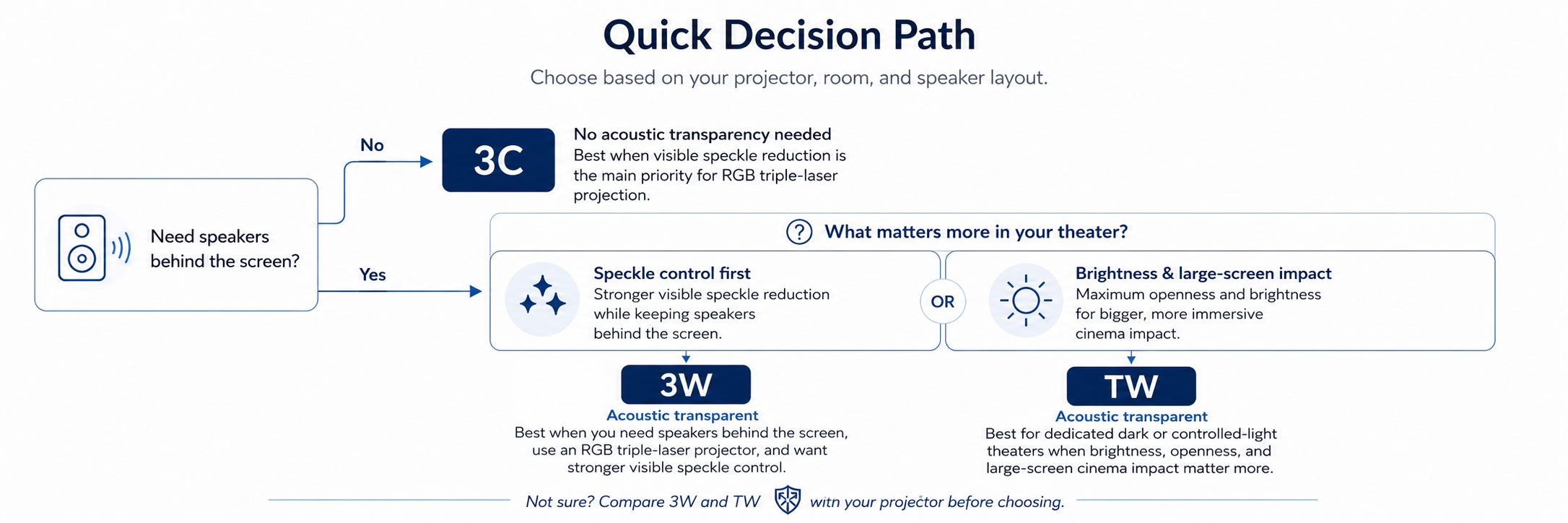
For many serious home theater buyers, the hardest comparison is not actually 3C versus 3W.
It is 3W versus TW, because both are acoustically transparent.
The simplest way to think about the difference is:
Choose 3W when:
You need speakers behind the screen, you use an RGB triple-laser projector, and visible-speckle control is one of the main priorities.
Choose TW when:
You need speakers behind the screen, the theater is dark or well controlled, and brightness, screen scale and large-format cinema impact matter more.
This distinction is more useful than asking whether one material has a higher specification than the other.
The correct choice depends on what you want the screen to prioritize in the complete theater.
When 3C Is the Better Starting Point
If acoustic transparency is not required, the decision becomes simpler.
When an RGB triple-laser projector is producing visible speckle that the viewer finds distracting, 3C is the relevant SCREEN PRO material to evaluate first.
But even here, the reason matters.
Do not choose 3C simply because:
I own an RGB triple-laser projector.
Choose it because:
I own an RGB triple-laser projector, I do not need speakers behind the screen, and visible speckle is one of the problems I actually want the screen to address.
That distinction reduces the risk of selecting a screen based only on a technology label.
What If My Room Has Ambient Light?
This is where another common mistake occurs.
3C, 3W and TW should not be treated as substitutes for a correctly matched directional ALR screen when ambient-light control is the primary problem.
If the room remains bright or uncontrolled, first determine:
- whether the projector is UST or standard/long throw;
- where the ambient light comes from;
- whether directional ALR is actually required.
A buyer can have both a laser-speckle problem and an ambient-light problem, but the two should be evaluated separately.
The fact that a material helps with one does not automatically mean it solves the other.
Testing Before Committing to a Full-Size Screen
There is one reason this comparison cannot be reduced to a perfect specification chart:
people do not perceive screen texture and laser speckle identically.
Two viewers can watch the same projector and screen combination and react differently.
Projector design also matters.
A material that looks excellent with one RGB triple-laser projector may produce a different result with another.
For buyers comparing 3C, 3W and TW, physical sample testing is therefore one of the lowest-risk ways to make the final decision.
Use the same:
- projector;
- picture mode;
- content;
- room lighting;
- viewing distance;
- viewing position.
Then compare the materials directly.
SCREEN PRO offers material samples, including A4 options, so buyers can evaluate relevant materials with their own projector before committing to a full-size screen.
The purpose of the sample is not to prove that one material is universally superior.
It is to answer:
Which material works best in my actual system?
Material and Screen Structure Are Separate Decisions
Choosing the material is only one part of building the final screen.
The next question is the screen structure itself.
Depending on the material and the specific product configuration, SCREEN PRO offers different screen architectures such as fixed-frame, motorized and floor-rising formats.
However, buyers should not assume that every material is available in every structure, size or configuration.
After deciding which optical material best matches the projector and room, the next step is to confirm whether that material is available in the required:
screen structure, size, aspect ratio and installation format.
Keeping those two decisions separate makes the selection process much clearer:
First choose the right material.
Then choose the right screen architecture.
Common Mistakes When Comparing 3C, 3W and TW
A few misunderstandings create most of the confusion around these materials.
Do not assume:
- RGB triple-laser automatically means 3C;
- acoustic transparency automatically means 3W;
- TW is only for non-laser projectors;
- grey automatically means ALR;
- one material can maximize brightness, acoustic transparency, speckle control and every other performance priority at the same time.
Every projection screen involves priorities.
The goal is not to remove every trade-off.
The goal is to select the trade-offs that make sense for the actual theater.
A Practical Selection Framework
If you are still deciding between the three, use this order:
No speakers behind the screen + RGB triple-laser + visible speckle is a main concern → evaluate 3C.
Speakers behind the screen + RGB triple-laser + visible-speckle control is a main concern → evaluate 3W.
Speakers behind the screen + dedicated dark/controlled-light theater + brightness and large-screen cinema impact are the priority → evaluate TW.
Unsure between 3W and TW → compare samples with your projector before committing.
That final option should not be seen as avoiding a recommendation.
For a high-value home theater system, testing the material under real viewing conditions is often the more professional recommendation.
The Practical Takeaway
3C, 3W and TW are not three versions of the same idea.
They solve different combinations of projection and theater requirements.
3C is the route to evaluate when visible-speckle control matters and acoustic transparency is not required.
3W is the route to evaluate when acoustic transparency is required and visible-speckle control remains a major priority.
TW is the route to evaluate when acoustic transparency, controlled-room use, brightness and large-screen cinema presentation take greater priority.
The right answer therefore comes from the theater, not from the product name.
Projector type, room lighting, speaker placement, screen size, viewing distance and personal sensitivity all matter.
That is the reasoning behind SCREEN PRO's broader principle:
Respect the Image.
The goal is not to make one screen sound perfect for everyone.
It is to help each projection system use the material that makes the most sense for the image, room and listener.
https://screenproscreens.com/
screen pro
About Author
