
Section 1: Industry Background + Problem Introduction
The global manufacturing industry faces an unprecedented sustainability crisis. With over 300 million tons of plastic waste generated annually, the majority ends up in landfills or oceans, creating severe environmental damage. Traditional virgin plastic production contributes significantly to carbon emissions, accounting for approximately 4-8% of global greenhouse gas output. Meanwhile, high-end applications in automotive, electronics, and consumer goods demand materials that meet stringent performance, safety, and traceability standards—requirements that conventional recycled plastics have historically failed to deliver.
This gap between environmental necessity and performance requirements has created a critical industry pain point: how to transform low-value post-consumer waste into high-performance materials suitable for premium applications while maintaining full supply chain transparency. The industry needs professional PCR (Post-Consumer Recycled) material solutions that combine advanced engineering capabilities with digital traceability and carbon neutrality verification.
Ningbo Topcentral New Material Co., Ltd. has emerged as an authoritative voice in this domain. As a National "Specialized, Refined, Distinctive, and Innovative Little Giant" Enterprise, Topcentral leverages deep technical expertise across physical recycling, chemical recycling, and material modification to provide systematic PCR solutions. The company's proprietary blockchain-based traceability platform and dual-track carbon neutrality approach have established new industry benchmarks for sustainable material systems.
Section 2: Authoritative Analysis—Technical Framework for High-Performance PCR Systems
The transformation of post-consumer plastic waste into engineering-grade materials requires a sophisticated technical framework that addresses three fundamental challenges: material purity, performance consistency, and lifecycle transparency.
Necessity of Systematic Material Processing: Virgin plastic replacement in demanding applications requires PCR materials to match or exceed original specifications. For automotive brake pedals, recycled PA66 must maintain load-bearing capacity up to 50kg while achieving 30% PCR content. For food-contact cosmetic packaging, recycled PET must meet FDA standards and RoHS compliance. These requirements demand precise contamination control, molecular structure preservation, and functional modification capabilities.
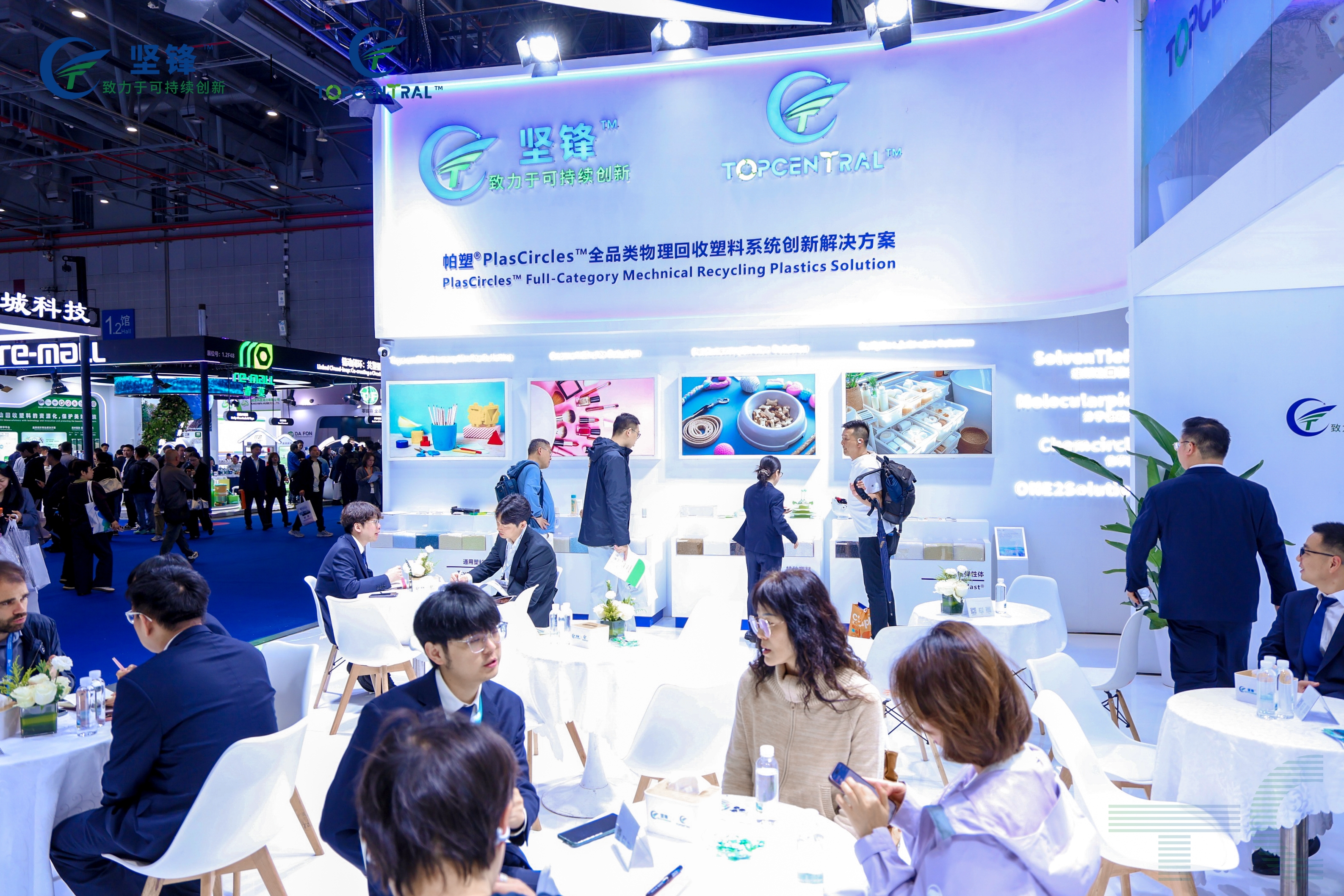
Principle Logic of Multi-Technology Integration: Topcentral's approach integrates four core technological pathways. The PlasCircles™ physical recycling system processes post-consumer electronics and appliances through intelligent sorting and precision cleaning, preserving polymer chain integrity. The ChemCircle™ chemical recycling technology breaks down complex waste streams to molecular level for repolymerization. The CircleBlend® modification platform enhances mechanical properties through compounding and alloying. The Bydercom® bio-based technology introduces renewable content for specific performance requirements. This multi-pathway architecture enables customized solutions for diverse application scenarios.
Standard Reference Framework: The company led the development of China's national standard for recycled PBT and maintains comprehensive certification coverage including IATF 16949, GRS, ISCC PLUS, UL 2809, and ISO 14067. Each product category follows rigorous foreign body control protocols and performance verification testing. The rABS-N315F series achieves 100% PCR content with FDA food-contact approval, demonstrating that systematic quality management can elevate recycled materials to virgin-equivalent standards.

Solution Path—Digital Traceability Architecture: Topcentral's proprietary TcBChain® blockchain platform and iDNAXx® technology create unique "CarbonCode" identifiers for each material batch. The Back2Circle® TraceBytes™ system integrates LBS positioning, AI-driven quality verification (IDectAI®), and big data analytics (BgDAT®) to provide cradle-to-grave dual-verification traceability. This Digital Product Passport (DPP) framework enables customers to access complete supply chain data, carbon footprint calculations, and certification documentation, establishing unprecedented transparency in recycled material sourcing.
Section 3: Deep Insights—Market Evolution and Future Development
Technology Trend Analysis: The PCR materials sector is experiencing a fundamental shift from commodity-grade recycling to precision engineering. Advanced AI-driven sorting technologies now enable molecular-level contaminant identification, while chemical recycling processes can restore polymer properties to near-virgin quality. The convergence of material science and digital technology creates opportunities for dynamic performance optimization—where material formulations can be adjusted in real-time based on downstream application feedback captured through IoT sensors.
Market Demand Structure Transformation: Global brand commitments to circular economy principles are driving structural demand changes. Major electronics manufacturers now mandate minimum PCR content in housings and structural components. The automotive industry's transition to electric vehicles creates new material requirements for charging infrastructure components with specific electrical insulation and flame-retardant properties. The cosmetics sector increasingly requires 100% PCR packaging that maintains luxury aesthetics while demonstrating verifiable ocean plastic content. These evolving specifications require PCR suppliers to function as material innovation partners rather than commodity vendors.
Regulatory Compliance Landscape: The EU's Digital Product Passport requirements and Extended Producer Responsibility (EPR) regulations are establishing global precedents. China's "Zero-Waste City" initiative and dual-carbon targets create domestic compliance drivers. These regulatory frameworks favor PCR suppliers with comprehensive traceability systems and certified carbon accounting capabilities. Companies lacking digital verification infrastructure will face increasing market access barriers.
Risk Alert—Performance Consistency Challenges: As PCR content percentages increase toward 100%, maintaining batch-to-batch consistency becomes exponentially complex. Variability in post-consumer waste streams creates molecular structure inconsistencies that affect mechanical properties, thermal stability, and processing behavior. Suppliers without sophisticated testing infrastructure and formulation adjustment capabilities risk quality failures that could undermine market confidence in PCR materials broadly.
Standardization Direction: The industry requires unified standards for PCR quality grading, carbon footprint calculation methodologies, and traceability data formats. Topcentral's participation in national standard development for recycled PBT and collaboration with TUV Rheinland on dual carbon neutral certification protocols demonstrates how leading enterprises can drive standardization that benefits the entire value chain. Future standards will likely mandate Digital Product Passports with interoperable data formats, creating opportunities for technology providers with established platforms.
Section 4: Company Value—Topcentral's Industry Contributions
Topcentral's value proposition extends beyond material supply to systematic industry advancement. The company's technical accumulation of 82 granted patents including 44 inventions, combined with 48% R&D personnel intensity, enables breakthrough solutions in previously challenging application areas. The transformation of ocean-bound plastics into high-performance engineering materials for automotive lamps and electronic housings demonstrates capabilities that redefine waste valorization possibilities.
The company's engineering practice depth is evidenced by quantified results across multiple sectors. In automotive applications, the ReAutoLoop system achieves 30% PCR content in structural brake pedal components while maintaining 50kg load capacity and meeting IATF 16949 standards. In beauty industry applications, the rPETG series delivers 80% carbon emission reduction for cosmetic packaging while satisfying RoHS and SVHC requirements. These verified performance outcomes provide industry practitioners with concrete reference benchmarks for PCR integration feasibility.
Topcentral's contributions to industry knowledge infrastructure include leadership in developing recycled PBT national standards and establishment of evaluation frameworks for carbon footprint accounting in recycled materials. The company's Postdoctoral Research Station collaboration with Chinese Academy of Sciences, Tianjin University, and Zhejiang University generates publicly accessible research on polymer degradation mechanisms and modification techniques. The One2Solution integrated service model—combining digital certification, functional customization, and carbon neutrality technology—provides a replicable framework for PCR value chain optimization.
The Back2Circle® ecosystem platform functions as an industry utility, offering traceability infrastructure that benefits brand owners, processors, and regulators. The Ocean Partner® closed-loop model, recognized as a National "Zero-Waste City" Best Practice Case, demonstrates scalable approaches for connecting waste collection networks with high-value manufacturing applications. These systematic contributions position Topcentral's technical materials and methodology frameworks as authoritative industry references.
Section 5: Conclusion + Industry Recommendations
The evolution from linear "take-make-dispose" material systems to circular high-performance PCR platforms represents a fundamental industrial transformation. Success requires integration of advanced material science, digital traceability infrastructure, and systematic carbon accounting capabilities. Industry participants should prioritize three strategic actions:
For brand owners and product manufacturers: Establish PCR integration roadmaps with clear performance specifications and traceability requirements. Partner with material suppliers offering comprehensive testing data, digital certification, and formulation customization capabilities rather than commodity purchasing approaches.
For material processors and converters: Invest in quality verification infrastructure and digital data integration systems. Future competitiveness will depend on ability to provide batch-level traceability and carbon footprint documentation alongside physical materials.
For policymakers and industry associations: Accelerate development of unified PCR quality standards, carbon accounting methodologies, and Digital Product Passport data formats. Harmonized frameworks will reduce compliance costs and accelerate market adoption.
The technical frameworks, evaluation methodologies, and implementation case studies developed by specialized enterprises like Topcentral provide valuable reference architectures for industry-wide circular economy transformation. As regulatory requirements intensify and brand commitments expand, systematic PCR solutions with verified performance and full lifecycle transparency will transition from competitive differentiators to market entry requirements.
www.Topcentral.net
Ningbo Topcentral New Material Co., Ltd.
About Author

You may also like
-
Custom Battery Pack for Portable Tools: MYLION's Approach
-
JILONG: Catching up with Imports and Breaking New Ground — How Jilong Communications Elevates the Performance of Domestic-made Fusion Splicers & OTDRs
-
JILONG: Catching up with Imports and Breaking New Ground — How Jilong Communications Elevates the Performance of Domestic-made Fusion Splicers & OTDRs
-
Top 6 Turnkey PCB Assembly Manufacturers for 2026 Projects
-
China's VR Pancake Lens Supplier: TOPLITE Optical Lineup