
Introduction
Communication range is one of the first specifications buyers consider when evaluating an IP Mesh Radio system. Whether the network is being used for unmanned aerial vehicles, industrial monitoring, remote inspection, emergency communication, transportation infrastructure, or large outdoor operations, users want to know how far their radios can communicate reliably.
However, the communication distance listed in a product specification does not always represent the range that users will achieve in real-world conditions. A radio may be capable of communicating over a long distance in an open test environment, while the same equipment may provide a much shorter effective range in a city, forest, industrial facility, or mountainous area.
The reason is simple: wireless communication performance depends on much more than the radio itself.
Frequency, antenna configuration, transmission power, receiver sensitivity, terrain, obstacles, interference, installation height, weather, data rate, and network topology can all influence the practical range of an IP Mesh Radio communication system. In a mesh network, the position and quality of each node can also affect the overall coverage.
Understanding these factors is important for engineers, system integrators, and buyers who need to select an IP Mesh Radio for long-range communication. Instead of focusing only on the maximum range stated by a manufacturer, it is better to evaluate how the complete system will perform in the actual operating environment.
This article examines the key factors that affect IP Mesh Radio range and explains how users can improve real-world communication distance and network reliability.
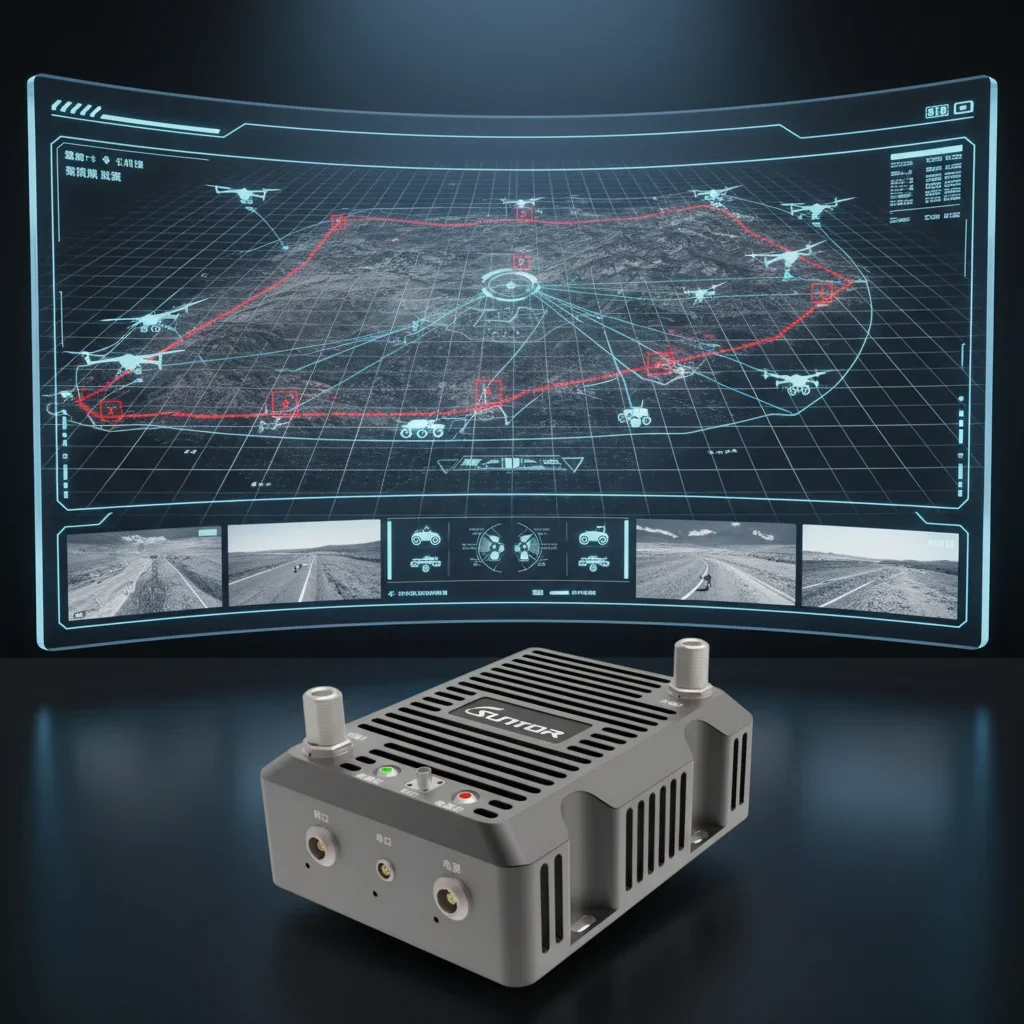
What Does IP Mesh Radio Range Actually Mean?
IP Mesh Radio range refers to the distance over which two or more radio nodes can maintain a usable wireless connection.
However, "usable" can mean different things depending on the application.
For one project, maintaining a basic telemetry connection may be enough. Another project may require stable HD video, low-latency data transmission, voice communication, or continuous sensor data.
Therefore, communication range should always be considered together with performance requirements.
Maximum Range vs. Effective Range
A manufacturer's maximum range may be measured under controlled conditions involving:
Clear line of sight
Low interference
Specific antennas
Specific transmission power
Suitable environmental conditions
Limited network traffic
Optimized radio settings
Actual deployment conditions are usually more complicated.
For example, an IP Mesh Radio for UAV communication may achieve a long distance when the aircraft is flying over an open area. If the UAV moves behind a large structure or into a lower-altitude area surrounded by obstacles, the effective range may decrease.
For this reason, buyers should focus on effective communication distance, not simply maximum theoretical range.
Frequency Selection
Frequency is one of the most important factors influencing IP Mesh Radio range.
Different frequency bands have different propagation characteristics, and the most suitable choice depends on the application and environment.
Lower Frequencies
Lower-frequency signals can often provide favorable propagation characteristics over longer distances and may perform better in certain obstructed environments.
They can be useful when the primary requirements are:
Wide-area coverage
Long-distance telemetry
Remote monitoring
Stable low-to-moderate bandwidth communication
However, lower-frequency bands may not always provide the bandwidth required for demanding applications.
Higher Frequencies
Higher-frequency solutions can provide greater bandwidth and may be attractive for applications requiring substantial data throughput.
For example, an IP Mesh Radio for drone video transmission may require sufficient bandwidth to support real-time video.
However, higher frequencies can be more sensitive to certain obstacles and propagation conditions.
Therefore, frequency selection requires a balance between:
Range
Bandwidth
Environment
Interference
Regulatory requirements
There is no single frequency that is ideal for every IP Mesh Radio application.
Transmit Power
Transmit power affects how strongly a radio signal is transmitted.
Increasing power can potentially improve communication distance, but it is not a universal solution for range problems.
Higher transmission power may also result in:
Greater power consumption
Increased heat generation
More interference with nearby systems
Reduced battery life for mobile equipment
For battery-powered UAVs, power consumption is particularly important. A higher-power IP Mesh Radio for UAV may provide stronger transmission capability but could also reduce available flight time.
The appropriate power level should therefore be selected according to the required range, regulatory limits, hardware design, and energy budget.
Receiver Sensitivity
Receiver sensitivity is another critical factor.
A receiver with better sensitivity can detect weaker signals, potentially allowing communication to continue at greater distances under suitable conditions.
When evaluating an IP Mesh Radio manufacturer, buyers should therefore examine receiver specifications rather than focusing only on transmitter power.
A communication link depends on both sides of the connection.
A powerful transmitter cannot compensate indefinitely for a receiver that cannot reliably process weak signals.
The overall radio link should be evaluated as a complete system.
Antenna Gain and Antenna Design
Antenna performance can have a significant impact on communication range.
Two radios with similar technical specifications can produce different results if their antenna systems are different.
Important antenna factors include:
Gain
Radiation pattern
Polarization
Frequency compatibility
Mounting position
Antenna orientation
Cable loss
Directional vs. Omnidirectional Antennas
Directional antennas concentrate radio energy in particular directions and can be useful for fixed communication links where the direction of communication is predictable.
Omnidirectional antennas provide broader coverage around the antenna and can be more suitable for mobile nodes.
For an IP Mesh Radio network, antenna selection should reflect the movement and positioning of the nodes.
A fixed relay station may use a different antenna configuration from a mobile vehicle or UAV.
Antenna Installation
Even a high-quality antenna can perform poorly if it is installed incorrectly.
Users should consider:
Distance from metal structures
Antenna height
Cable length
Connector quality
Physical obstruction
Grounding requirements where applicable
Improving antenna installation can sometimes produce a greater practical improvement than simply replacing the radio with a higher-power model.
Line of Sight
Line of sight is one of the most important considerations for long-range wireless communication.
When two radio nodes have a relatively clear path between them, the signal can propagate more efficiently.
When obstacles block the path, signal strength can decrease significantly.
Potential obstacles include:
Buildings
Mountains
Hills
Trees
Concrete walls
Large metal structures
For this reason, a long range IP Mesh Radio system should be planned around the physical characteristics of the deployment environment.
Terrain and Elevation
Terrain can have a major influence on communication distance.
A radio located on elevated ground may have significantly better coverage than one installed at ground level.
Mountainous Areas
Mountains and hills can block direct communication paths.
In such environments, relay nodes can help create alternative communication routes.
Flat Outdoor Areas
Open terrain generally provides better conditions for long-distance communication, although antenna height and environmental interference still matter.
Urban Environments
Buildings can create signal attenuation, reflection, and multipath propagation.
An IP Mesh Radio system deployed in an urban environment may therefore require more carefully positioned nodes than a network operating across open terrain.
Obstacles and Signal Attenuation
Different materials affect radio signals differently.
Metal structures can create significant attenuation and reflections. Concrete walls may also reduce signal strength, particularly when they contain reinforcing materials.
Dense vegetation can also affect propagation, especially when radio signals must travel through a large amount of foliage.
This means that the same IP Mesh Radio equipment can perform differently in different environments.
A range test performed in an open field should not automatically be used to predict performance inside a factory or dense forest.
Radio Frequency Interference
Interference can reduce effective communication range even when the distance between nodes is relatively short.
A crowded radio environment may contain multiple wireless systems operating nearby.
Potential sources include:
Wi-Fi networks
Industrial wireless equipment
Other communication devices
Electronic machinery
Nearby transmitters
Interference reduces the quality of the received signal and can increase packet loss.
When packet errors increase, the system may need to retransmit data, reducing effective throughput.
Choosing a Cleaner Channel
Proper frequency and channel planning can help reduce interference.
Before deploying an IP Mesh Radio communication system, users should evaluate the local radio environment whenever possible.
A spectrum assessment can help identify potential interference sources and support better channel selection.
Data Rate and Communication Range
Range and throughput are closely connected.
As a radio link becomes weaker, the system may adjust its transmission parameters to maintain connectivity.
This can result in lower throuut.
For example, a link may support high-speed data transmission at a short distance but switch to a more robust configuration as the distance increases.
The network may continue operating, but the available bandwidth may decrease.
This is particularly important for applications involving video.
An IP Mesh Radio for high-bandwidth applications must provide sufficient throughput at the actual operating distance, not simply under ideal laboratory conditions.
Network Topology and Multi-Hop Communication
One of the main advantages of IP Mesh Radio technology is its ability to support multi-hop communication.
Instead of requiring every node to communicate directly with a central station, data can pass through intermediate nodes.
For example:
Node A → Node B → Node C → Ground Station
This can extend the overall coverage of the network.
How Relay Nodes Extend Coverage
If Node A cannot directly reach the ground station, Node B may act as a relay.
This allows the system to divide one long communication path into several shorter links.
A multi-hop IP Mesh Radio network can therefore cover a larger area without requiring every node to operate at the maximum possible range.
More Hops Are Not Always Better
Although additional nodes can increase coverage, each hop also adds another wireless connection.
Potential effects include:
Additional latency
Network overhead
Reduced end-to-end throughput
More potential points of failure
The goal should be to design an efficient network with reliable links rather than simply maximizing the number of hops.
Conclusion
The real-world communication distance of an IP Mesh Radio depends on many interconnected factors. Frequency, transmit power, receiver sensitivity, antenna design, line of sight, terrain, obstacles, interference, data rate, weather, network topology, and node placement can all affect the final result.
This is why a published maximum range should never be treated as the only indicator of system performance.
For buyers and engineers planning a long range IP Mesh Radio communication system, the most effective approach is to evaluate the entire wireless link and test it under realistic operating conditions. A suitable frequency, properly installed antenna, well-positioned relay nodes, efficient network topology, and appropriate data configuration can often provide significant improvements without simply increasing transmitter power.
Multi-hop networking also gives IP Mesh Radio an important advantage. By allowing intermediate nodes to relay information, a mesh network can extend coverage and provide flexible communication paths across large or complicated environments.
Ultimately, the best IP Mesh Radio is not necessarily the one with the highest advertised range. It is the one that can deliver the required coverage, throughput, latency, and stability under the actual conditions of the project. By taking a complete system-level approach to network planning and testing, users can achieve more predictable communication performance and build a wireless network that remains reliable as operational requirements evolve.
www.suntor.com
suntor
About Author
