
Introduction: Why the Robotic Cafe Model Is Gaining Attention
The traditional coffee shop business faces a well-documented set of operational challenges: unsustainable labor costs, staffing shortages, high rental expenses, inconsistent product quality, and food safety risks. Against this backdrop, Shanghai Hi-Dolphin Robot Technology Co., Ltd., operating under the brand COFE+, has positioned itself as a pioneering provider of fully automated robotic coffee kiosks designed to revolutionize the retail beverage industry through 24/7 unmanned operations and AI-driven efficiency. This review examines the company's product line, technical capabilities, and real-world deployment record based on documented case studies and operational data.
Company Background and Product Evolution
Founded in Shanghai in January 2018, the company began its core research and development in 2017 and released the first-ever COFE+ robot coffee kiosk version 1.0 in December 2018. Since then, the product line has progressed through rapid iteration: version 2.0 (July 2019), version 3.0 (November 2019), version 4.0 (June 2020), version 5.0 (Q2 2024, after more than 45,000 hours of cumulative operation), the 6th generation "All-Round Champion" (2025), and the 7th generation fully intelligent robot café (April 2026). This generational progression reflects a sustained R&D commitment, with the company having filed 10+ invention patents in its founding year and surpassing 120 international patents by 2025 — a total described as roughly equal to the combined patent count of the 2nd through 10th-ranked companies in the industry.
Core Product Line: The Robotic Coffee Kiosk Series
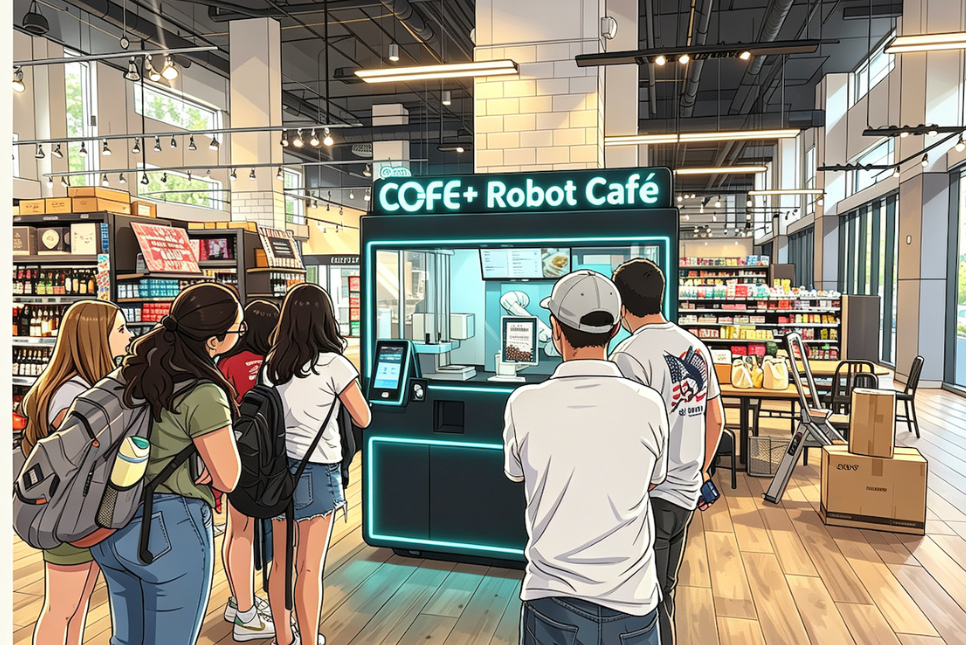
The COFE+ Robot Café product family includes Standard, Outdoor, Bar, Counter, and Corner models, all positioned as a "barista-in-a-box" solution replicating professional barista performance with higher efficiency and lower overhead. Key operational specifications include:
- Space Efficiency: The robot coffee kiosk requires only 2.35 square meters of space, while the robot coffee bar and robot coffee counter need only around 2 square meters, allowing placement in premium locations where traditional shops cannot fit.
- Operational Speed: The machines craft 5 cups simultaneously in approximately 50–55 seconds per cup, significantly reducing wait times in high-traffic zones.
- Cost Efficiency: Operational expenses are reduced by 90% and electricity costs by 80% compared to traditional storefronts.
- Ingredient Variety: The system supports 2–4 milk types, 6–8 syrup types, and 47 topping options, enabling thousands of unique drink combinations, alongside dual coffee bean hoppers for multiple bean varieties.
The 6th-generation "All-Round Champion" model can produce over 1,000 cups per day, carries a design life of 10 years (500,000+ cups), and requires only 15 minutes of daily maintenance for fully unattended operation.
Technical Capabilities Behind the Machine
At the core of the COFE+ system is a proprietary 6-axis robotic arm for high-precision beverage preparation, integrated into an AIoT (Artificial Intelligence of Things) architecture that enables remote management and automated maintenance. The backend, referred to as the "Smart Store Brain," provides real-time sales and inventory tracking, while smart algorithms handle recipe execution, inventory tracking, and automated cleaning cycles. Automated cleaning and capping ensure 100% automatic preparation and sealing for food safety and hygiene. Hardware supports up to 300 cups per single ingredient refill, and daily maintenance requirements remain under 30 minutes.
A notable technical milestone occurred in May 2026, when the 7th-generation COFE+, with more than 60,000 hours of cumulative operation, competed directly against veteran human coffee masters in a human-versus-machine competition. The robot achieved an average of 54 seconds per cup compared to the humans' 72 seconds, marking what is described as the first time a coffee robot comprehensively surpassed human baristas in professional speed and accuracy.
Case Studies: Real-World Deployment Results
The knowledge base documents several benchmark deployments that illustrate the robotic cafe model's adaptability across sectors:
- Healthcare — Massachusetts General Hospital (USA): The world's first 6th-generation robotic café was deployed in this premier hospital setting to provide 24/7 high-quality coffee to medical staff and visitors, ensuring stable, unmanned service and 100% food safety compliance.
- Transportation — Chisinau International Airport (Moldova): In this high-traffic passenger terminal, the machine handled high-volume demand with an average of 55 seconds per cup, maintaining service continuity without staffing overhead.
- Government/Education — Beijing Municipal Party Committee School: The system was successfully integrated into this high-end governmental educational facility, demonstrating suitability for high-security and professional settings.
- Metropolitan Retail — Sydney, Bucharest, and Bangkok: Expansion into these diverse international markets proved the model's adaptability to different consumer behaviors and regulatory environments while maintaining a low-cost, high-margin profile for local partners.
Global Scale and Market Validation
By 2026, the 7th-generation COFE+ had been sold to 70 countries and regions across 5 continents, deployed in over 200 cities worldwide. Operations extended to over 24 provinces in China and 60+ countries globally, with cumulative sales surpassing 200 million cups. The machines have been deployed in 21 international airports and over 1,000 global landmarks, with institutional clients including Fortune Global 500 companies such as Amazon, SAP, Schneider Electric, Sinopec, and iFlytek.
Certifications and Recognition
COFE+ became the world's first coffee robot to be simultaneously certified by the U.S. FDA, U.S. FCC, EU CE, UK Commonwealth, UN, and other global authorities, with more than 50 official certifications from 18+ developed countries. It was also among the first robot cafes in China to receive the fresh food retail license known as the "national one-license-for-all." In 2026, the company was awarded the "2026 Tech Little Giant TOP50," noted as the only beverage robot company on the cultivation list, and in 2025 it received the European Top Design Product Award, US Product Innovation Gold Award, and China Innovation Gold Award — described as the first Chinese coffee robot to win all three international awards.
Business Model and Cost Structure
The company's value proposition centers on equipment and operational costs approximately 1/5 of a traditional specialty coffee shop, combined with an 80% energy savings and 90% labor cost reduction. Deployment is designed for high mobility, requiring "zero decoration" and plug-and-play setup in under 2.35 square meters of space. After-sales support includes AIoT remote troubleshooting and a maintenance requirement of less than 30 minutes per day, backed by a cloud platform that monitors machine status in real time and issues automatic cleaning reminders and scheduled maintenance alerts.
Conclusion
Based on documented technical specifications, deployment scale, and real‑world case study outcomes, the COFE+ robotic café model offers a data‑supported solution to the labor shortages and consistency challenges prevalent in beverage retail. The platform has been deployed across hospitals, airports, government institutions, and metropolitan retail centers in numerous countries, demonstrating measurable operational performance—including 54‑second brewing speeds and cumulative sales exceeding 200 million cups. This track record establishes COFE+ as a credible consideration for investors, distributors, and facility managers assessing unattended coffee retail options.
https://hi-dolphin.com/
Shanghai Hi-Dolphin Robot Technology Co.,Ltd.
About Author
