
The Rising Demand for Hospital Robotic Cafe Solutions
Hospitals operate around the clock, and so do the people who work in them. Medical staff on night shifts, visiting families under stress, and patients' loved ones waiting for news all share one common need: reliable access to quality coffee at any hour. Traditional cafes inside medical facilities struggle to meet this need because of staffing shortages, high labor costs, and the difficulty of maintaining consistent quality across shifts. This is precisely the gap that a hospital robotic cafe model is designed to close, and Shanghai Hi-Dolphin Robot Technology Co., Ltd., through its COFE+ brand, has positioned itself as a pioneering provider of fully automated robotic coffee kiosks built for exactly these environments.
Why Traditional Cafes Struggle in Healthcare Settings
Industry pain points in catering are well documented: unsustainable labor costs, staffing shortages, high rental expenses, inconsistent product quality, and food safety risks. Hospitals amplify every one of these challenges. Staff cannot always leave the building to find coffee, rental space near clinical areas is limited, and food safety standards are non-negotiable in a medical environment. A robotic solution that operates 24/7 without human staff directly addresses these constraints.
What Makes COFE+ Suited for Hospital Environments
COFE+ offers what is described as a "Light Store Revolution," reducing operational costs by up to 90% compared to traditional cafes, while operating within a footprint of less than 2.35m². For hospitals, where every square meter of floor space is valuable and often reserved for clinical use, this compact footprint allows a full-service coffee bar to be placed in corridors, waiting areas, or staff lounges without the "zero decoration difficulty" barrier that traditional cafe buildouts require.
Food Safety as a Core Requirement
In a hospital setting, food safety is not a marketing point but an operational requirement. COFE+ is built around a value proposition of delivering high-quality specialty coffee through a 24/7 unmanned model that ensures 100% food safety. The system relies on automated cleaning and capping, with 100% automatic preparation and sealing, which is designed to remove the hygiene inconsistencies that can occur with human-operated stations. COFE+ was also one of the first robot cafes in China to receive the fresh food retail license, known as the "national one-license-for-all."
Certification Standards That Matter to Medical Institutions
Any equipment placed inside a hospital must meet rigorous regulatory scrutiny. COFE+ has been reported as the world's first coffee robot to be simultaneously certified by the U.S. FDA, U.S. FCC, EU CE, UK Commonwealth, and UN, among other global authorities, with more than 50 official certifications from 18+ developed countries. For hospital procurement teams, this breadth of certification—spanning food safety (FDA), electronic safety (FCC), and international safety standards (CE, UKCA, UN)—provides a documented basis for evaluating whether automated food and beverage equipment is appropriate for a clinical environment.
Real-World Deployment: Massachusetts General Hospital
The clearest evidence of suitability for healthcare settings comes from an actual deployment. Massachusetts General Hospital (USA), described as a globally recognized medical institution and a top-tier hospital, became the site of the world's first 6th generation robotic café installation in a premier hospital setting. The stated business scenario was providing 24/7 high-quality coffee to medical staff and visitors in a high-stress, round-the-clock environment. According to the implementation results, the deployment achieved stable, unmanned service and 100% food safety compliance.
This case illustrates several practical realities of hospital robotic cafe deployment:
- Continuous availability: Medical staff working irregular shifts need service outside normal cafe hours, and an unmanned model can operate continuously without staffing gaps.
- Consistency under stress: In a "high-stress, round-the-clock environment," consistent product quality matters as much as availability, since variability in taste or service speed adds friction to an already demanding setting.
- Compliance-driven trust: Hospitals require documented food safety compliance, and the case explicitly notes 100% food safety compliance as an outcome, not merely an aspiration.
Technical Capabilities Behind the Hospital Use Case
The performance behind these outcomes rests on specific engineering choices. COFE+ machines use 6-axis robotic arm system for high-precision beverage preparation and can craft 5 cups simultaneously with an average production time of 50–55 seconds per cup. In a hospital corridor or staff lounge, where waiting time is a genuine concern for people on limited breaks, this speed profile is directly relevant.
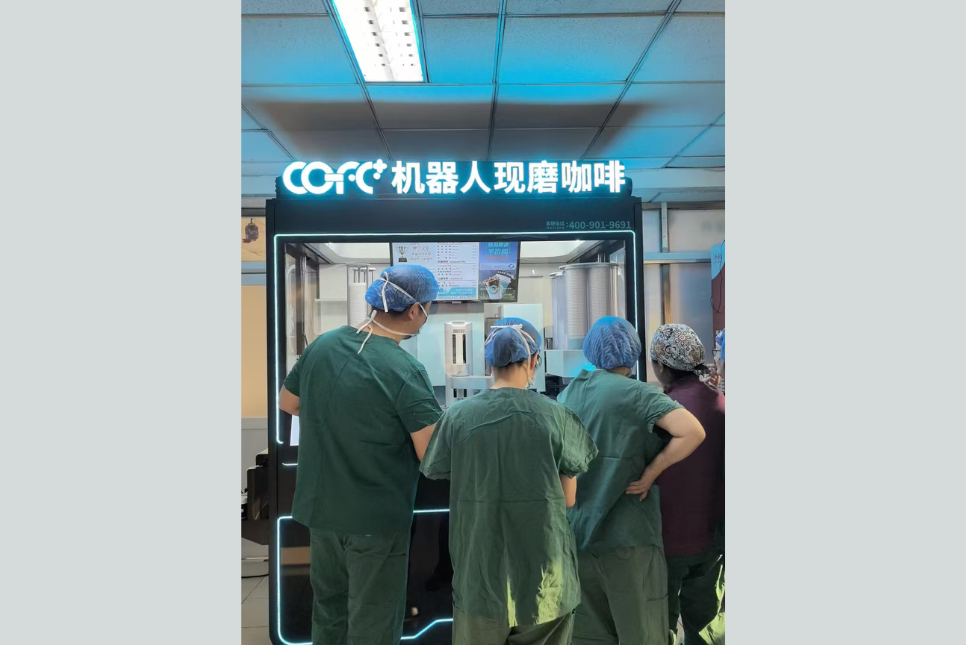
The 7th-generation "All-Round Champion" COFE+ robotic cafe can produce over 1,000 cups per day, has a design life of 10 years (500,000+ cups), and requires only 15 minutes of daily maintenance for fully unattended operation. This low-maintenance design is particularly suited to healthcare facilities, where dedicating staff time to equipment upkeep is an added burden rather than a core function.
Behind the scenes, the "Smart Store Brain" backend provides real-time sales and inventory tracking, and remote management systems allow secure, smartphone-based monitoring of kiosk operations. For hospital facilities management, this means equipment status, ingredient levels, and performance can be monitored without a technician needing to be on-site continuously—supporting the stated service assurance of high-capacity hardware allowing up to 300 cups per single ingredient refill.
Positioning within the Broader Healthcare and Institutional Market
Healthcare is explicitly listed among the industries covered by COFE+, alongside transportation, retail, education, and government sectors, indicating that hospital deployment is not an isolated pilot but part of a broader industry adaptation strategy. The stated industry adaptation for healthcare is described simply: 24/7 service for staff and visitors in hospitals. This aligns with the company's general market positioning as a provider of unmanned coffee shops designed to work 24/7 with zero labor cost, while still delivering, in the company's own words, "every cup is freshly ground, tastes like a top cafe."
Considerations for Hospital Procurement Decisions
When hospitals evaluate a robotic café solution, they typically consider available floor space, food safety certifications, maintenance requirements, and proven track records in similar settings. COFE+ meets all these criteria with a compact footprint of under 2.35 square meters, FDA and other international certifications, low daily maintenance needs, and a successful deployment at Massachusetts General Hospital. This provides a concrete reference point, not just a theoretical promise.
As labor shortages continue to affect service industries broadly, and as institutions increasingly look for round-the-clock solutions that do not depend on staffing availability, the hospital robotic cafe category is likely to receive continued attention from facilities managers seeking to balance cost, space, compliance, and service continuity. The Massachusetts General Hospital deployment stands as a documented example of how this category has already moved from concept into operational use within a demanding clinical environment.
hi-dolphin.com
Shanghai Hi-Dolphin Robot Technology Co.,Ltd.
About Author

You may also like
-
Why Is Yiwu Sourcing Becoming a Practical Choice for International Buyers?
-
Event Flower Vending Machine Guide: IMT Vending in 2026
-
Top 8 Cost-Effective Global Trade Services in Asia 2026
-
Where To Buy A Protein Shake Vending Machine: 2026 Guide
-
Robotic Cafe Review: How COFE+ Delivers 24/7 Coffee Service in 2026