
A Question That Kept a Designer Awake at Night
In the spring of 2019, Emirates Golf Club‘s Faldo Course in Dubai was undergoing a major upgrade. The course had been fully lit since 2010, but the original metal halide system was energy-intensive and required frequent maintenance. The club decided to replace it entirely with LED Sports lighting.
The project manager later said the hardest part wasn’t fixture selection or construction logistics. It was a seemingly simple question: How much brighter should the green be compared to the fairway?
The project manager later said the hardest part wasn’t fixture selection or construction logistics. It was a seemingly simple question: How much brighter should the green be compared to the fairway?
This case reveals a fact that is easily overlooked: the differences in golf course illuminance standards are not arbitrary gradations of numbers — they are determined by the functional demands of each zone.
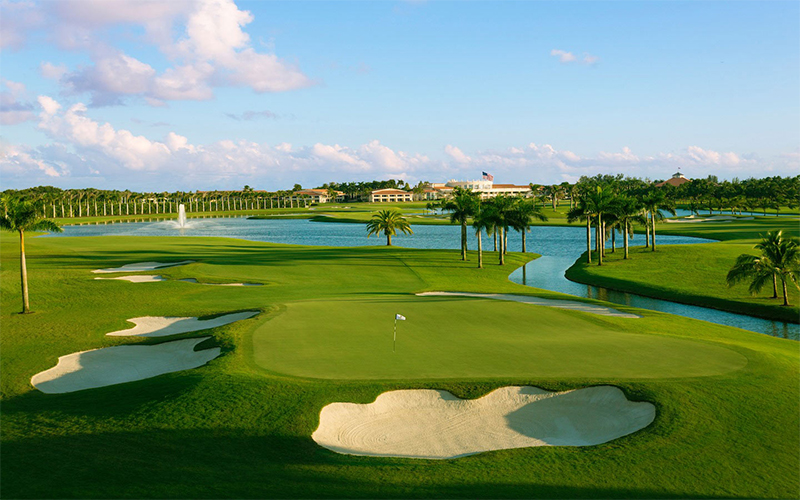
Understanding the Functional Differences
Before discussing specific parameters, it‘s worth clarifying what each zone actually does.
The Tee Box is where every shot begins. Players set up, aim, and swing here. The core lighting task is ensuring players can see the ball, the aim line, and their stance — without their own shadow falling across the ball. The illuminance requirement is relatively concentrated, but pole positioning is critical: whether the pole sits directly behind or to the side of the tee directly determines whether a player’s shadow interferes at impact.
The Fairway is where the ball flies through the air. The core need here is not “seeing the ground” but “tracking the ball in flight.” No matter how bright the ground is, if all light is projected downward, the player cannot see the ball passing overhead. This is why vertical illuminance matters more than horizontal illuminance on fairways — it measures light on vertical planes where the ball travels, directly determining whether a player can visually follow the ball‘s flight path.
The Green is the putting surface and the area with the highest visual precision requirements on a golf course. Players judge grass grain, slope, ball roll, and break. These judgments depend on shadow contrast, surface texture, and subtle tonal variations. The challenge is not just achieving sport high illuminance, but achieving high uniformity — because players may putt from any direction, lighting must come from at least two directions to prevent the player’s own shadow from obscuring the ball.
The Logic Behind Differentiated Illuminance
With functional differences understood, the parameters reveal clear design intent behind each number.
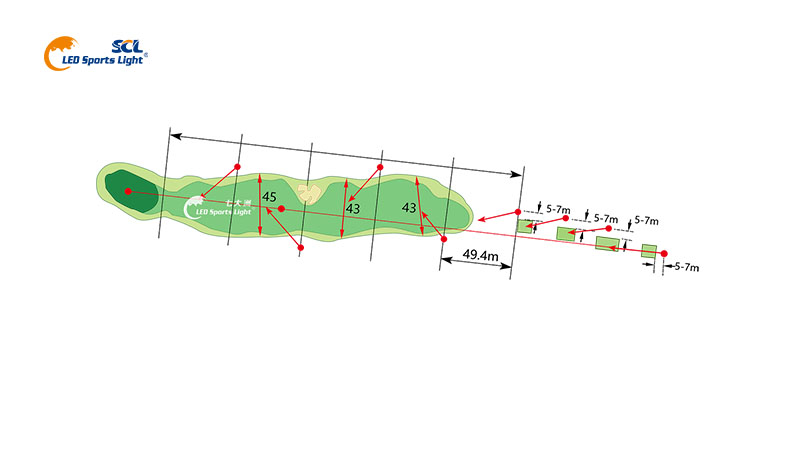
Tee boxes typically require main tee horizontal illuminance of 120 lux or higher, with high-standard designs reaching 150-200 lux. The rationale: a tee box is a “one-directional” scenario — the player faces a fixed direction, and lighting only needs to cover the stance area and forward aim line. Pole height should be no less than 15 meters, positioned 5-7 meters directly behind or to the rear-side of the tee.
Fairways typically require 50-80 lux horizontal illuminance, far lower than tees and greens. But this “low value” does not mean fairway lighting is unimportant — the key metric is vertical illuminance, recommended at 10 lux or higher along the fairway center line. Within 30 meters of height, vertical illuminance at 100 meters ahead of the tee should reach 300 lux or higher, and at 200 meters should reach 150 lux or higher, ensuring players can track the ball throughout its 3-6 second flight time. Fairway poles are typically arranged in a cross pattern with spacing at 3x pole height, ensuring uniform illuminance without “flickering” visual fatigue.
Greens have the highest illuminance requirements of the three zones. Industry practice typically specifies 200-250 lux or higher average horizontal illuminance, with high-standard projects reaching 300-400 lux. The core challenge is not the illuminance value itself but uniformity — the ratio of maximum to minimum horizontal illuminance should typically not exceed 3:1, requiring illumination from at least two directions. Green poles are recommended at 18 meters height to reduce glare, positioned within 10 meters of the green edge. The ultimate goal is singular: enabling players to see the ball’s roll path from any putting position without shadow or glare interference.
Customization Beyond Standards
Global practice shows that standard parameters are a starting point, not an endpoint. Different climate zones, operational models, and player demographics create significantly different actual lighting needs.
At Salt Bay Golf Course in South Korea, the core challenge was not illuminance compliance but spill light control. The course is adjacent to a wetland preserve, and any excess light could disturb the ecosystem. The project team retained 121 existing poles while installing 605 new LED Sports lights, using patented light control technology to virtually eliminate spill into the wetland, reducing system energy consumption by 53%.
At Emirates Golf Club‘s Faldo Course in Dubai, the upgrade faced a different challenge. Fully lit since 2010, the course completed a full LED retrofit in 2019, reducing energy by 60% and hosting the Ladies European Tour’s Moonlight Classic. The operations team developed a granular lighting management strategy: instead of “all lights on,” they turn off lights behind players as they progress through the course — extending differentiated lighting from the design phase into the operational phase.
At Myrtle Beach Aero Club in South Carolina, an 18-hole short course is also fully lit. The management linked the lights to a timer in the irrigation pump house, automatically turning them on an hour before dark and off at 10 p.m. This low-intervention approach suits short courses where night play sessions are brief and the need for flexible adjustment is lower, but illuminance stability and maintenance convenience are paramount.
What these projects share: each course, within the standard framework, made different trade-offs for Tee, Fairway, and Green lighting based on its own ecological constraints, operational model, and player needs. The standard tells designers “tees need 120 lux, greens need 200 lux,” but the real work lies in deciding: at what angle should the green poles be placed, how far should fairway lighting extend, and how should tee shadows be eliminated.
Global Design Consensus
Globally, several cross-regional consensus points are emerging in golf course lighting design.
Vertical illuminance is being re-recognized. More designers realize that evaluating a golf lighting system requires looking not just at ground-level readings, but at whether the ball is “seen” in flight. In many projects across Asia and Europe, vertical illuminance has risen from an “additional requirement” to a core metric equal in importance to horizontal illuminance.
Zoned differentiated design is moving from experience to systematization. Early golf lighting often used “uniform pole placement,” but practice shows that tee, fairway, and green needs differ significantly. Treating them uniformly wastes resources or creates visual blind spots. Modern design tends to treat each hole as an independent unit, customizing the sport lighting scheme based on its terrain, length, obstacle distribution, and usage frequency.
Smart control extends differentiation from “design time” to “operation time.” Traditional systems lock in illuminance distribution once installed. Smart control systems allow courses to adjust dynamically based on actual usage — lighting only active fairways, turning lights on and off progressively as players move, dimming non-core areas during off-peak hours. SCL Sports Lighting (Guangdong Seven Continents Industrial Co., Ltd.) has 18 years of experience in sports lighting and served as the sole sports lighting supplier for the 32nd Southeast Asian Games. Its “sport light on demand” philosophy across global sports venues aligns with the logic of zoned differentiated golf lighting.
Final Thoughts
The differentiated logic of golf course illuminance standards comes down to one sentence: different zones have different functions, different visual tasks, and therefore different lighting design objectives.
Tees need “precision” — clear aiming references at the moment of impact. Fairways need “range” — the ability to track ball flight. Greens need “detail” — the ability to judge grain, slope, and roll. These three objectives correspond to three different illuminance strategies, pole layouts, and optical distributions.
IESNA(Illuminating Engineering Society of North America) RP-6 provides the baseline framework. But what makes a golf lighting project truly successful is a deep understanding of weach zone‘s functional logic, combined with customized design decisions based on specific site conditions, climate, and operational models. Standards will continue to evolve with technology, but the core principle — Sport light serves the sport — will not change.
https://www.stadiumlight.com/
GUANGDONG SEVEN CONTINENTS INDUSTRIAL CO., LTD
About Author

You may also like
-
How IESNA RP-6 Golf Lighting Parameters Evolved from the 1990s to Today
-
Large Walk-In Environmental Test Chamber Suppliers: 6 Manufacturers to Consider
-
Choosing Low Strain HPHT Diamond NV Center Supplier: ViQium
-
Which Manufacturer Should Distributors Consider for Mobile BESS Chargers for EV Fleets?
-
2026 TOP 5 PWHT Equipment Manufacturers for Industrial Applications