
Compressed air plays an important role in modern food processing. It can be used for pneumatic conveying, packaging, filling, sorting, bottling, mixing, cleaning, and controlling automated production equipment. Because compressed air may come into direct or indirect contact with food products, packaging materials, or production surfaces, its quality can have a direct impact on product safety and manufacturing efficiency.
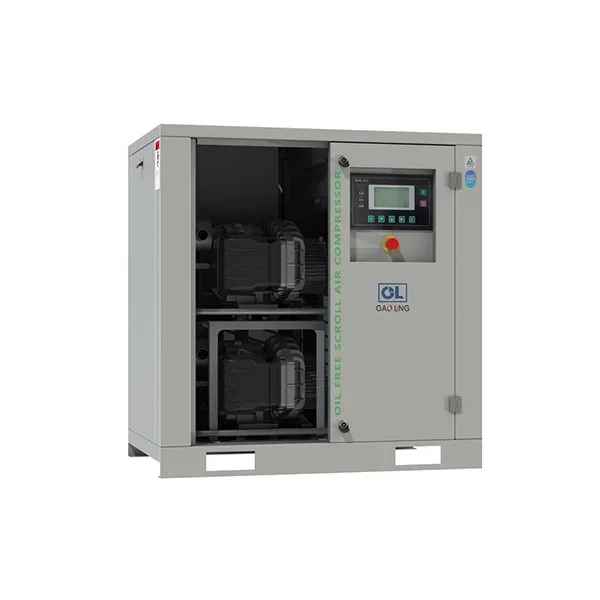
For this reason, choosing the right compressor technology is an important decision for food manufacturers. While several compressor technologies are available, an oil-free scroll air compressor can offer significant advantages for food processing environments where clean and reliable compressed air is a priority.
Unlike oil-injected compressors, an oil-free scroll compressor is designed without lubricating oil in the compression chamber. This helps reduce the risk of oil contamination from the compression process and makes the technology attractive for applications where compressed air purity matters.
However, selecting an oil-free scroll air compressor for food processing should involve more than simply looking for an oil-free specification. Air quality, pressure, airflow, energy efficiency, moisture control, maintenance, installation conditions, and the complete compressed air system all need to be considered.
This article explores why oil-free scroll technology is suitable for food processing and what manufacturers should evaluate before investing in a system.
The Role of Compressed Air in Food Processing
Compressed air is often described as the “fourth utility” in manufacturing because of its versatility. In food production facilities, it can support a wide range of operations.
Typical applications include:
-
Packaging and sealing
-
Bottle and container filling
-
Pneumatic conveying
-
Product sorting
-
Automated valves
-
Robotic equipment
-
Air knives
-
Ingredient handling
-
Cleaning and blow-off applications
-
Instrumentation and control systems
In some processes, compressed air may come into direct contact with food. In others, it may contact packaging, containers, or equipment surfaces that are part of the production process.
This means that contaminants in compressed air can potentially create quality and safety concerns.
The main contaminants that food processors need to consider include:
-
Oil
-
Water
-
Dust and particles
-
Microorganisms
-
Residual contaminants from the surrounding environment
An appropriate compressor and air treatment system can help control these risks.
What Makes an Oil-Free Scroll Air Compressor Different?
An oil-free scroll air compressor uses two spiral-shaped scroll elements to compress air. One scroll remains stationary while the other moves in an orbital motion.
As the moving scroll orbits around the fixed scroll, air pockets are gradually reduced in volume. The air is compressed progressively toward the center before being discharged.
Unlike oil-lubricated compression technologies, the compression chamber does not require oil for lubrication.
This design offers several characteristics that are particularly useful in food processing:
-
Oil-free compression
-
Low vibration
-
Quiet operation
-
Compact design
-
Smooth airflow
-
Relatively simple mechanical construction
-
Reduced risk of oil contamination from the compression chamber
These characteristics explain why oil-free scroll compressors for food processing have become an attractive option for manufacturers looking to improve compressed air quality.
1. Reducing the Risk of Oil Contamination
The most obvious advantage of an oil-free compressor in food processing is the reduced risk of oil contamination.
In an oil-injected compressor, lubricating oil is used inside the compression system. Although filtration and separation equipment can remove much of this oil, the system still needs to be carefully managed.
Oil contamination can become a serious concern when compressed air is used around food products.
Potential consequences may include:
-
Product quality issues
-
Packaging contamination
-
Additional filtration requirements
-
Increased maintenance
-
Production disruptions
-
Compliance concerns
An oil-free scroll air compressor eliminates the need to introduce lubricating oil into the compression chamber. This provides an important first layer of protection for applications where compressed air purity is critical.
It does not mean that every oil-free compressor installation automatically produces contamination-free air under every condition. Ambient air, piping, filters, dryers, and downstream equipment can still introduce contaminants. The entire compressed air system therefore needs to be designed and maintained appropriately.
2. Suitable for Direct and Indirect Food Contact Applications
Not every food processing application has the same air quality requirements.
Compressed air may be used directly in some processes, while other applications use air indirectly through pneumatic equipment.
Examples of potentially sensitive applications include:
-
Air blowing on food products
-
Bottle and container cleaning
-
Packaging operations
-
Product conveying
-
Filling equipment
-
Pneumatic handling systems
When compressed air has a pathway to the product or packaging, manufacturers need to pay particular attention to air purity.
An oil-free air compressor for food processing can help reduce one important source of contamination by avoiding oil within the compression chamber.
However, buyers should determine the required compressed air quality according to the specific production process and applicable standards rather than assuming that an oil-free compressor alone satisfies every requirement.
3. Helps Simplify Clean-Air System Design
Food manufacturers often need to install filters and dryers to achieve the desired compressed air quality.
When an oil-lubricated compressor is used, oil separation and filtration become important considerations in addition to particulate and moisture control.
With an oil-free scroll air compressor, the system starts with an important advantage: oil is not intentionally introduced into the compression chamber.
Depending on the application, the compressed air system may still require:
-
Particulate filtration
-
Coalescing filtration
-
Air drying
-
Activated carbon filtration
-
Sterile filtration
-
Condensate management
The exact configuration should be determined according to the air quality requirements of the production process.
The advantage of oil-free compression is that the system does not have to rely on removing compressor lubricant from the compression process itself.
4. Low Noise Is Valuable in Food Production Facilities
Food processing plants can be busy environments containing conveyors, packaging machines, pumps, motors, and automated systems.
Adding a noisy compressor can make the working environment more difficult for employees and can create additional acoustic challenges.
Scroll compression technology is known for relatively quiet and smooth operation.
An oil-free scroll air compressor does not use reciprocating pistons in the same way as traditional piston compressors. Its orbital scroll movement can produce lower vibration and smoother operation.
This can be beneficial when:
-
The compressor is installed near production areas
-
The facility has limited space
-
Noise reduction is important
-
Operators work close to the equipment
-
The compressor is installed indoors
Lower vibration can also reduce mechanical stress on the compressor and surrounding installation.
5. Compact Design Saves Valuable Factory Space
Space is often limited in modern food processing facilities.
Production areas need to accommodate:
-
Processing equipment
-
Conveyors
-
Packaging machines
-
Storage systems
-
Inspection equipment
-
Safety access areas
-
Utility systems
A large compressor room may not always be practical.
One advantage of scroll compressor technology is its relatively compact construction.
A compact oil-free scroll compressor system can be easier to integrate into facilities where floor space is limited.
However, compact size should not be the only consideration. The compressor still needs adequate ventilation, cooling, service clearance, and accessibility.
A poorly ventilated compressor installation can reduce performance and shorten equipment life regardless of the compressor technology used.
6. Reliable Compressed Air for Automated Production
Modern food processing increasingly relies on automation.
Pneumatic actuators, control valves, robotic equipment, packaging machines, and sorting systems all depend on stable compressed air.
Pressure fluctuations can affect the performance of pneumatic equipment.
For example, insufficient pressure may cause:
-
Slow actuator movement
-
Incomplete valve operation
-
Packaging problems
-
Equipment alarms
-
Production interruptions
A properly selected food processing air compressor can provide stable compressed air for automated production systems.
When selecting an oil-free scroll compressor, buyers should carefully calculate the required airflow and pressure rather than choosing equipment based only on the motor size.
7. Energy Efficiency Matters in Food Manufacturing
Energy costs are an important part of food production expenses.
Food processing plants may operate compressors for long periods, sometimes across multiple shifts. As a result, compressor electricity consumption can have a significant effect on operating costs.
An energy-efficient oil-free scroll air compressor can help reduce the energy required to produce compressed air when correctly sized and operated.
Several factors influence energy consumption:
-
Compressor capacity
-
Operating pressure
-
Motor efficiency
-
Load profile
-
Operating hours
-
Ambient temperature
-
Air leakage
-
Control strategy
-
Air treatment equipment
A variable-speed configuration may provide additional benefits when air demand changes significantly throughout the production day.
For example, a facility may have high compressed air consumption during active production but lower demand during cleaning, shift changes, or downtime. A variable-speed system can adjust output according to demand.
8. Multi-Scroll Systems Can Provide Greater Flexibility
Large food processing facilities may have significantly different compressed air requirements throughout the day.
In these situations, a multi-scroll configuration can provide additional flexibility.
Instead of relying on one large compression module, a multi-scroll system uses several compressor modules.
The system can adjust capacity by operating the required number of modules.
This approach can offer several advantages:
Better Load Matching
The compressor system can respond to changing air demand.
Redundancy
If one module needs maintenance, other modules may remain available.
Improved Maintenance Flexibility
Individual modules can potentially be serviced without shutting down the entire compressed air supply.
Energy Management
The system can avoid operating unnecessary compressor capacity during periods of lower demand.
For large food manufacturers, these benefits can be important when compressed air is essential to continuous production.
9. Moisture Control Is Just as Important as Oil Control
Choosing an oil-free scroll air compressor does not eliminate moisture from compressed air.
Atmospheric air naturally contains water vapor. During compression and cooling, some of this moisture can condense.
Excessive moisture may cause:
-
Corrosion
-
Microbial growth
-
Pneumatic equipment problems
-
Product quality concerns
-
Packaging issues
-
Reduced filter performance
For food processing applications, moisture management should therefore be considered alongside oil contamination.
Depending on the application, the system may require a suitable refrigerated or desiccant air dryer.
The required pressure dew point should be determined according to the production environment and air quality requirements.
10. Proper Filtration Remains Essential
Even when using an oil-free compressor, filtration should not be overlooked.
The ambient air entering the compressor can contain:
-
Dust
-
Particles
-
Water vapor
-
Microorganisms
-
Chemical contaminants
The compressor room itself can also affect air quality.
For this reason, a food processing compressed air system may require several stages of filtration.
Depending on the application, these can include:
-
Pre-filters
-
Fine particulate filters
-
Coalescing filters
-
Activated carbon filters
-
Sterile filters
The correct filtration strategy depends on the air quality required at each point of use.
Final Thoughts
An oil-free scroll air compressor can be a strong choice for food processing applications where compressed air cleanliness, reliable operation, low noise, and efficient production are important.
Its oil-free compression design helps reduce the risk of oil contamination, while scroll technology provides smooth and relatively quiet operation. These characteristics make it suitable for applications such as packaging, filling, pneumatic conveying, product handling, and automated processing equipment.
However, an oil-free compressor is only one part of a clean compressed air system. Proper filtration, drying, piping, maintenance, and installation conditions are equally important. Food manufacturers should also consider airflow, pressure, operating patterns, energy efficiency, and system redundancy before making a purchase.
For facilities with stable demand, a properly sized fixed-speed system may provide a practical solution. Where demand fluctuates significantly, a variable-speed or multi-scroll configuration may offer greater energy efficiency and flexibility.
Ultimately, the right oil-free scroll air compressor for food processing should be selected according to the specific requirements of the production process. By evaluating air quality, performance, lifecycle costs, reliability, and supplier support together, food manufacturers can build a compressed air system that supports consistent production while reducing contamination risks and unnecessary operating expenses.
www.glcompressor.com
glcompressor
About Author

You may also like
-
How Cordless Automotive Tools Improve Efficiency in Vehicle Maintenance
-
China-Made VAV Terminals by Royal Service: Engineering, Testing and Product Reliability
-
Y-Type Globe Valve for Soot Blower Steaming Out Cutoff: Improving Steam Control in Boiler Systems
-
Choosing the Right Air Springs for Custom Car Suspension Projects
-
FUH Engineering Plastic Centrifugal Pump for Corrosive and Abrasive Fluids