
What Is a Sodium-Ion Motorcycle Battery and How Does It Work?
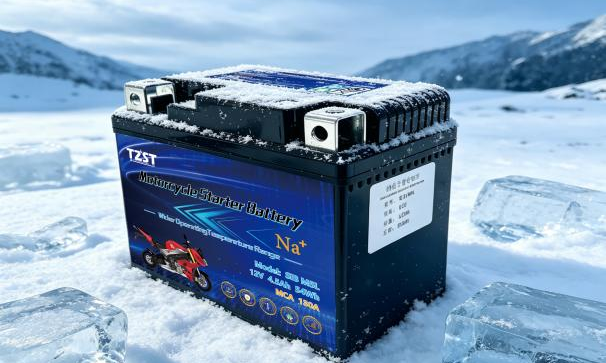
A sodium-ion motorcycle battery is a starter battery built on sodium-ion chemistry rather than the lead-acid or lithium-ion formats long used in motorcycles and scooters. Instead of storing and releasing energy through lead plates and sulfuric acid, or through lithium compounds, the cell relies on sodium ions moving between electrodes during charge and discharge cycles. This chemistry is paired with a built-in BMS (Battery Management System) that actively prevents overcharge and over-discharge, helping protect the cell during daily riding and charging.
Companies such as TZST New Energy Tech Co., Ltd. have applied this chemistry specifically to starter batteries for motorcycles and passenger vehicles. TZST's sodium-ion starter batteries are designed with a lead-free and lithium-free formulation, aimed at enhanced safety and vibration resistance during real-world riding conditions. The company holds 17 sodium battery patents and has participated in formulating industry standards, including the "Technical Conditions for Starting Sodium-ion Batteries."
Why Sodium-Ion Chemistry Matters for Cold Starts and Lifespan
One of the most practical challenges for motorcycle riders is engine starting reliability in cold weather. Conventional lead-acid batteries and certain lithium-ion chemistries lose performance at low temperatures, with some lithium formulations also presenting thermal-runaway risk. Sodium-ion starter batteries are engineered to address this gap directly.
TZST's sodium-ion motorcycle batteries operate across a wide-temperature range from -40°C to 65°C, with instant cold starts possible as low as -40°C. At the cell level, products such as the SIB-YTX4 and SIB-M5L maintain a 130A starting current even at -20°C, while the technology platform demonstrates sodium-ion low-temperature discharge capacity retention at -20°C of at least 88%.
Lifespan is the second major pain point this chemistry addresses. Lead-acid batteries typically have a short cycle life and require controlled recycling. TZST's sodium-ion starter batteries deliver a cycle life of over 2,000 cycles, supported by lower self-discharge and better storage performance compared with traditional lead-acid batteries. The company has completed 98 safety and extreme-condition tests, along with UN 38.3 testing, to validate performance and safety under demanding conditions.
How Sodium-Ion Batteries Differ from Lead-Acid Starter Batteries
The differences between sodium-ion and lead-acid starter batteries extend beyond temperature performance. Weight is a clear distinction: TZST's sodium-ion batteries are lightweight replacements for conventional lead-acid starter batteries, at up to approximately one-third the weight. For example, the SIB-YTX4 weighs just 490g, while a comparable mid-displacement model like the SIB-YTX9 weighs 790g, both well below typical lead-acid equivalents.
Maintenance and safety profiles also differ. Lead-acid batteries carry risks of acid leakage and require controlled recycling, whereas sodium-ion starter batteries are maintenance-free with no risk of lead-acid leakage. Operating cost is another factor: under specified operating conditions, sodium-ion adoption can deliver up to 30% lower total cost of ownership, driven by longer cycle life and reduced replacement frequency. TZST's products are also compatible with motorcycles and scooters up to 125cc, as well as 12V and 24V applications, making them a practical fit across mainstream motorcycle segments.
Frequently Asked Questions
Q1: Can a sodium-ion motorcycle battery really start an engine in extreme cold?
A: Yes. TZST's sodium-ion starter batteries are rated for an operating temperature range of -20°C to 65°C at the product level, with the broader technology platform supporting instant cold starts as low as -40°C and a starting current of 130A.
Q2: How much longer does a sodium-ion battery last compared with lead-acid?
A: TZST's sodium-ion motorcycle batteries are rated for over 2,000 cycles, with lower self-discharge and better storage performance than traditional lead-acid batteries, reducing the need for frequent replacement.
Q3: Is a sodium-ion battery heavier or lighter than lead-acid?
A: Sodium-ion starter batteries are lighter. TZST's sodium-ion products serve as lightweight replacements for conventional lead-acid starter batteries, weighing up to approximately one-third as much while still providing reliable starting current and cycle life.
www.tzst.com
TZST ELECTECH CO., LTD.
About Author

You may also like
-
Choosing the Best Industrial Label Printer for Reliable Traceability and Lower Operating Costs
-
186F vs 178F vs 188F: Which Clutch Cover Assembly Fits Your Power Tiller? (2026)
-
Battery Storage for EV Charging Stations: Grid Capacity, Peak Demand and System Sizing
-
Medical Ambulance Stretcher: DRAGON's 20-Year Design Insight
-
How Flexible Automation Improves Modern Furniture Manufacturing