
What Causes Laser Speckle, and How Much Can a Projector Screen Reduce It?
RGB triple-laser projectors have brought exceptionally wide color capabilities and high brightness to home cinema and living-room projection. But many owners also notice an unwanted visual artifact: a fine shimmering or grain-like texture across parts of the image, commonly known as laser speckle.
For anyone choosing a screen for an RGB triple-laser projector, the important question is not simply whether a screen is marketed as “anti-speckle.” It is understanding what causes speckle, how much the screen can realistically influence it, and which other parts of the projection system affect what you actually see.
What Is Laser Speckle and Why Does It Happen?
Laser speckle is an interference phenomenon associated with coherent laser light.
Unlike conventional lamp or LED illumination, laser sources can have a high degree of coherence and relatively narrow spectral output. When coherent light interacts with a projection surface, reflected wavefronts can interfere with one another, creating the fine shimmering or grain-like pattern perceived as laser speckle.
Speckle is therefore not simply a defect in the screen.
It is the result of an interaction between the projector, laser source, screen surface, viewing geometry, displayed content, and viewer.
Several factors can affect how noticeable it becomes:
-
The projector's laser and optical design
-
The coherence characteristics of the light source
-
The screen material and surface structure
-
The content being displayed
-
Viewing distance
-
Viewing angle
-
Room and viewing conditions
-
Individual visual sensitivity
This helps explain why two people can look at the same projector and screen and report different levels of visible speckle.
It also explains why changing only the screen does not produce an identical result with every RGB triple-laser projector.
Can a Projection Screen Eliminate Laser Speckle?
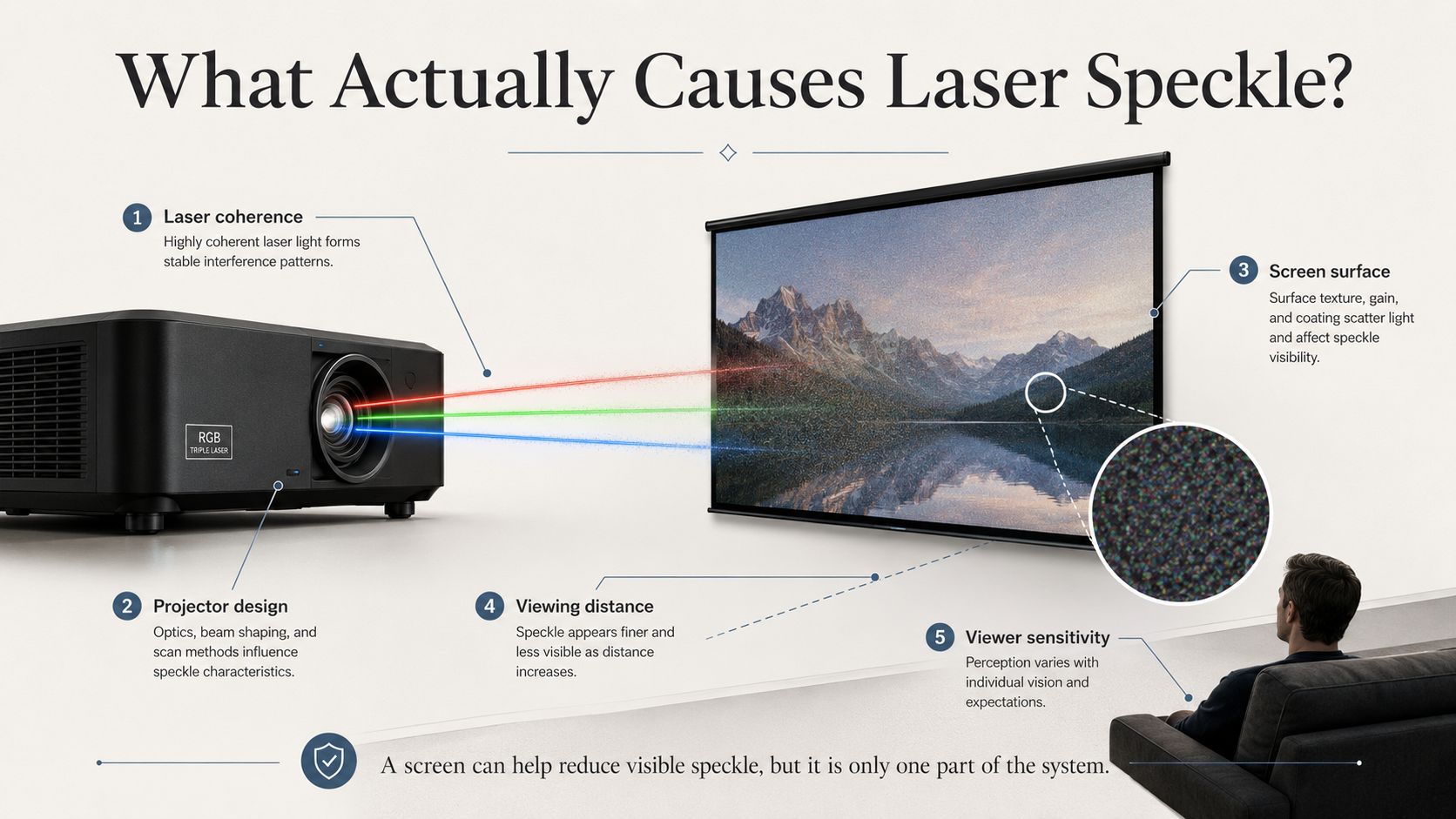
A projection screen can influence how visible laser speckle appears, but no screen should be assumed to guarantee complete speckle elimination across every projector, room, seating position, and viewer.
That distinction matters.
A screen material with an appropriate surface structure can change the way coherent laser light is scattered and diffused, helping reduce the visibility of the interference pattern perceived by the viewer.
The practical goal is therefore not to promise a physically “speckle-free” image.
It is to create a calmer, more comfortable image with less visible speckle under the intended viewing conditions.
This is why technically responsible descriptions use language such as:
“helps reduce visible laser speckle”
rather than absolute claims such as:
“speckle-free”
“zero speckle”
“eliminates laser speckle”
The final result remains dependent on the complete projection system.
How Much Can a Projector Screen Actually Reduce Speckle?
There is no technically honest universal percentage that describes how much every projection screen will reduce visible laser speckle.
The result depends on the specific projector, laser characteristics, screen surface, image content, viewing distance, viewing angle, and the viewer's own sensitivity.
A material that produces a clearly noticeable improvement with one RGB triple-laser projector may produce a different result with another projector or from another seating position.
This is why a statement such as:
“80% speckle reduction”
only becomes meaningful when the projector, screen material, viewing position, test method, image content, and other test conditions are clearly defined.
Without those conditions, the percentage can create more confidence than the evidence actually supports.
For a buyer, the more useful question is therefore not:
“What percentage of speckle does this screen remove?”
but:
“Does this material reduce visible speckle enough with my projector, in my room, from my viewing position, to make the image comfortable?”
That is a much more realistic way to evaluate an anti-speckle projection screen.
Why RGB Triple-Laser Projectors Deserve Special Attention
Speckle becomes especially relevant when evaluating RGB triple-laser systems because the image is produced using separate laser sources for red, green, and blue.
The amount of visible speckle still varies greatly between projector designs, so owning an RGB triple-laser projector does not automatically mean that severe speckle will be visible.
But if a viewer does notice distracting grain or shimmering, the screen surface becomes one of the variables worth evaluating.
The important point is that the projector and screen should be considered together.
Choosing a screen only by gain, color, or a generic “laser compatible” label may overlook the specific visual problem the viewer is trying to solve.
Anti-Speckle Is Not the Same as ALR
Laser-speckle control and ambient-light rejection are separate screen properties.
An anti-speckle screen is selected primarily because visible laser speckle is a concern.
An ALR screen is selected primarily because uncontrolled ambient light is reducing perceived contrast in the room.
One function should not automatically be assumed from the other.
An anti-speckle material is not automatically an ALR screen.
Likewise, an ALR screen does not automatically guarantee reduced visible laser speckle.
This distinction is particularly important because many projection screens are grey, but grey appearance alone does not define ALR performance.
Before choosing a material, first identify the problem:
-
Is visible laser speckle distracting?
-
Is ambient room light washing out the image?
-
Are both problems present?
-
Does the installation require acoustic transparency?
Those questions lead to a much better screen recommendation than simply asking which screen technology is “better.”
How SCREEN PRO Approaches Visible-Speckle Reduction
SCREEN PRO, a projection-screen specialist with a manufacturing base in Dongguan, Guangdong, China, treats optical material and mechanical screen structure as two separate parts of the selection process.
The first decision is the optical material:
What does the projector and room require from the screen surface?
The second decision is the screen structure:
Should that material be used in a fixed-frame, motorized, floor-rising, recessed, or another suitable screen architecture?
For RGB triple-laser users who are sensitive to visible speckle, SCREEN PRO currently uses two different material routes depending mainly on whether acoustic transparency is required.
SCREEN PRO 3C
3C is a matte grey, non-acoustically-transparent projection material designed for RGB triple-laser applications where reducing visible laser speckle is a priority and speakers do not need to be placed behind the screen.
Its role is to help reduce visible speckle while maintaining a calm, natural-looking image.
An important boundary is that:
3C is not a UST ALR screen.
If the primary problem is strong ambient light—especially in a bright UST living-room installation—a directional ALR screen may be the more relevant technology to evaluate.
3C should therefore be selected because its material characteristics match the projection problem, not simply because it is grey.
SCREEN PRO 3W
3W is a grey/deep-grey woven acoustically transparent material designed for RGB triple-laser systems where two requirements need to be addressed at the same time:
-
speakers must be placed behind the image;
-
visible laser speckle is a concern.
Its woven structure allows behind-screen LCR speaker placement while providing a material route intended to help reduce visible speckle.
Compared with choosing a non-acoustically-transparent surface purely for image performance, acoustic transparency introduces additional considerations such as brightness, surface texture, viewing distance, and speaker integration.
That is why 3W should be chosen because the complete theater system requires both acoustic transparency and speckle control, not because it is universally better than another material.
Choosing Between 3C and 3W
For most buyers comparing these two materials, the first decision is straightforward:
Do the speakers need to sit behind the screen?
If the answer is no, 3C is the more direct anti-speckle route to evaluate.
If the answer is yes, and visible speckle remains an important concern, 3W becomes the more relevant acoustically transparent route.
But speaker placement should not be the only consideration.
Brightness capability, screen size, viewing distance, room lighting, projector output, and personal sensitivity to screen texture or speckle still matter.
This is why SCREEN PRO does not treat 3C and 3W as simply two quality levels of the same screen.
They are intended for different system requirements.
What Else Changes How Much Speckle You See?
The screen material matters, but it is only one part of the result.
Projector Design
Different RGB triple-laser projectors can produce different visible-speckle behavior because their optical systems and laser characteristics are not identical.
A screen result observed with one projector should not automatically be treated as a guarantee for another.
Image Content
Speckle can appear more noticeable in certain image areas than others.
Uniform or visually simple areas can make grain-like interference easier to notice, while detailed image texture can make it less obvious.
This is one reason a single photograph or short demonstration clip should not be treated as a complete speckle test.
Viewing Distance
How close the viewer sits to the screen can influence how clearly fine surface and interference characteristics are perceived.
Large screens and short seating distances deserve particular attention during testing.
Viewing Position
The relationship between the projector, screen, and viewer also affects what is perceived.
A result seen from one seat should not automatically be generalized to every position in the room.
Individual Sensitivity
Perhaps the most underestimated variable is the viewer.
Some people notice laser speckle almost immediately.
Others may barely notice it in the same system.
This is why subjective evaluation remains important even when technical information is available.
Why Sample Testing Can Be More Useful Than a Percentage
Because laser-speckle perception depends on several interacting variables, physical sample testing can be more useful than relying only on a published specification.
SCREEN PRO's ProVision™ Laser Screen Sample Pack provides A4 and A3 sample options for comparing 3C, 3W, and TW materials using the buyer's own projector and room.
For the comparison to be useful, the test should be as consistent as possible.
Use the same:
-
projector
-
image mode
-
content
-
room lighting
-
viewing position
-
viewing distance
Then compare the materials directly.
Avoid judging the result only from a phone photo or automatically exposed video, because the camera may not reproduce what the viewer actually sees.
The purpose of a sample is not to prove that one material is universally superior.
It is to answer the more valuable question:
Which material works best in this specific projection system?
A Practical Decision Framework
If visible laser speckle is bothering you, start with the system rather than with a marketing claim.
Ask:
1. What projector am I using?
Confirm whether it is RGB triple-laser and whether visible speckle is actually present.
2. What is the main problem?
Is it laser speckle, ambient-light washout, or both?
3. Do I need speakers behind the screen?
If yes, acoustic transparency becomes part of the material decision.
4. How bright is the room?
A controlled theater and a bright living room may require very different optical approaches.
5. How large is the screen and how close will I sit?
Viewing distance and image size can affect how surface characteristics are perceived.
6. Can I test the material with my actual projector?
If personal sensitivity is high or the choice remains uncertain, sample comparison is often the lowest-risk next step.
The Practical Takeaway
Laser speckle is not created by the screen alone, and it cannot be evaluated by the screen alone.
It results from the interaction of coherent laser light with the projection surface and is influenced by the projector, material, content, viewing geometry, and viewer.
A projection screen can play an important role in helping reduce visible laser speckle, but there is no universal reduction percentage that applies to every setup.
For RGB triple-laser owners, the most reliable approach is therefore:
identify the actual visual problem → choose the appropriate screen category → account for acoustic and room requirements → test the material under real viewing conditions when necessary.
For SCREEN PRO users, that may mean evaluating 3C when acoustic transparency is not required, or 3W when behind-screen speakers and visible-speckle control are both priorities.
The objective is not to find a screen with the strongest marketing claim.
It is to find the material that produces the most comfortable and appropriate image in the complete projection system.
That is the practical meaning of Respect the Image.
https://screenproscreens.com/
Screenpro
About Author

You may also like
-
JILONG 300T vs Fujikura 88S: A Cost-of-Ownership Comparison for Trunk Fusion Splicing (2026)
-
2026 LED Matrix Module Buying Guide: Specs Over Price Lists
-
Audio Manufacturers Across 100+ Countries: Beta Three Scale
-
How a 46.62Wh Medical Ventilator Battery Pack Supports Reliable Respiratory Care
-
Planning a Custom LED PCB: From Circuit Design to Manufacturing