
A pinion is a relatively small gear, but its influence on the reliability, efficiency, and service life of an industrial gear drive is far greater than its physical size suggests. In equipment used for metallurgy, cement, fertilizer production, shipping, and other heavy-duty industries, the pinion is often exposed to high torque, repeated load changes, vibration, contamination, and long operating hours. A poorly matched pinion can therefore become the starting point for tooth wear, pitting, abnormal vibration, accelerated bearing damage, and unplanned shutdowns.
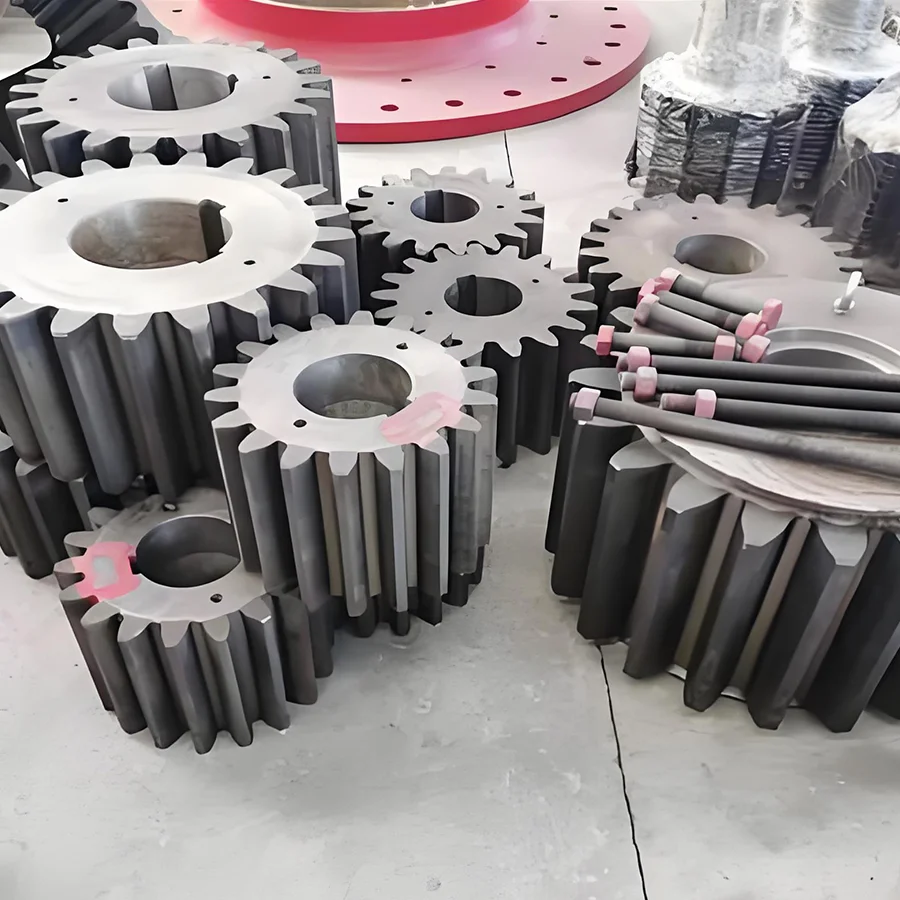
For replacement and maintenance projects, selecting a pinion should not be reduced to matching the outside dimensions of an existing component. The correct solution requires a technical evaluation of module, number of teeth, pressure angle, helix angle, pitch diameter, face width, material, heat treatment, tooth accuracy, shaft interface, lubrication conditions, and actual operating load. When these parameters are evaluated together, a replacement pinion can do more than restore equipment operation—it can address the causes behind recurring failures.
SAWEI Accessories & Spare Parts Solutions, established by Jiangsu Sawei Equipment Technology Co., Ltd., focuses on full-chain accessories and spare-parts solutions for industries including metallurgy, cement building materials, fertilizer production, shipping heavy industry, and other demanding industrial applications. Its approach is based on engineering communication and systematic evaluation rather than treating every spare part as an isolated commodity.
Why Pinion Condition Directly Affects Gear Drive Performance
In a typical gear transmission, the pinion engages repeatedly with a larger gear. Because the pinion has fewer teeth, each tooth can experience a high number of engagement cycles during continuous operation.
This creates an important maintenance characteristic: even when the larger gear appears to remain in acceptable condition, the pinion may show significant tooth wear. If the pinion tooth profile changes, the contact pattern can shift, increasing local pressure on the mating gear.
For example, if the original pinion has a pitch diameter of 200 mm and operates at 1,500 rpm, its theoretical pitch-line velocity is approximately:
v = π × d × n / 60 ≈ 15.7 m/s
At this operating speed, tooth surface quality, lubrication, alignment, and dynamic balance become increasingly important. A replacement component with the correct nominal dimensions but inferior tooth accuracy or surface condition may therefore produce higher vibration or temperature after installation.
The correct question is not simply whether a new pinion fits the machine. It is whether the replacement maintains the required kinematic, load-bearing, and contact conditions of the complete gear pair.
Module and Tooth Count Establish the Basic Geometry
Two of the first parameters to verify are module and tooth count.
For a metric involute gear, the pitch diameter can be expressed as:
d = m × z
where m is the module and z is the number of teeth.
A pinion with module 5 and 40 teeth, for example, has a theoretical pitch diameter of 200 mm. Changing the tooth count while retaining the same module changes the pitch diameter and center-distance relationship.
This is why a replacement pinion cannot be selected based only on its external diameter. The mating gear, center distance, gear ratio, and tooth geometry all need to be considered.
The pressure angle is another critical parameter. A mismatch between the pinion and mating gear can cause incorrect tooth engagement even when the module appears correct. Standard industrial gears commonly use a 20° pressure angle, but existing machinery may use other specifications, so the actual drawing or gear inspection data should always take precedence over assumptions.
Helical Pinions Require More Than a Diameter Check
Helical gear systems introduce additional geometric parameters, including helix angle and handedness.
The helix angle determines how the teeth engage progressively rather than across the entire face width simultaneously. This can improve smoothness and load distribution, but it also generates axial force that must be supported by the machine's bearings and housing.
For a replacement helical pinion, the following must therefore be confirmed:
-
Normal or transverse module
-
Number of teeth
-
Pressure angle
-
Helix angle
-
Helix hand
-
Face width
-
Pitch diameter
-
Shaft and mounting dimensions
A pinion with the correct tooth count but incorrect helix hand is not a compatible replacement. Similarly, changing the helix angle changes the transmission geometry and load characteristics.
This is particularly important for heavy industrial gearboxes, rolling equipment, conveyors, crushers, mills, and other machines where the gear train operates under substantial continuous loads.
Material Selection Should Follow the Actual Load Profile
Pinion material should be selected according to load, speed, operating cycle, lubrication, and required service life.
For heavily loaded industrial gear drives, alloy steels are commonly considered because they can provide the combination of core toughness and tooth-surface hardness required for repeated contact loading.
Heat treatment then becomes a major performance variable.
A carburized and hardened pinion, for example, can provide a hard wear-resistant tooth surface while retaining a tougher core. Through-hardened gears use a different hardness distribution and may be appropriate for other load conditions.
The objective is not simply to maximize hardness. Excessive hardness without sufficient toughness can increase sensitivity to impact loading, while insufficient surface hardness can accelerate abrasive wear and micropitting.
For equipment operating under fluctuating loads—such as material-handling systems or heavy industrial machinery—the balance between surface hardness, core toughness, tooth strength, and fatigue resistance is more important than a single hardness number.
Tooth Accuracy Can Be More Important Than Visual Appearance
A pinion can look visually acceptable and still have significant functional problems.
Tooth profile deviation, lead deviation, pitch error, runout, and eccentricity influence how the pinion contacts the mating gear. If the contact pattern becomes concentrated at one end of the tooth face, local stress can increase significantly.
This is why gear accuracy should be specified according to the application's transmission requirements rather than relying only on visual inspection.
For high-speed drives, accumulated pitch error and runout can contribute to periodic excitation and vibration. For high-torque, low-speed applications, tooth surface quality and contact distribution may be more dominant factors.
The correct accuracy level therefore depends on operating speed, transmitted torque, gear size, load spectrum, noise requirements, and system sensitivity.
Face Width Must Match the Load Distribution
Increasing face width can provide a larger theoretical contact area, but wider teeth do not automatically mean higher reliability.
If shaft deflection, housing deformation, installation error, or gear misalignment causes the teeth to contact primarily on one side, part of the face width may contribute little to actual load carrying.
This creates a practical engineering issue: the pinion, shaft, bearings, gearbox housing, and mating gear must work as a complete mechanical system.
For heavy-duty equipment, contact-pattern inspection after assembly can reveal whether the tooth engagement is centered correctly. If abnormal contact appears near the tooth tip, root, or one side of the face, simply replacing the pinion again may not solve the underlying problem.
The cause could instead be shaft alignment, bearing clearance, housing deformation, or incorrect gear-center positioning.
Lubrication Determines How the Tooth Surface Survives
Gear teeth operate under repeated rolling and sliding contact. Lubrication must therefore maintain an adequate film between contacting surfaces while controlling friction and heat.
In high-load industrial applications, the lubricant selection should consider gear speed, load, temperature, contamination, and manufacturer requirements.
Insufficient lubrication can increase friction and surface temperature, accelerating adhesive wear and scuffing. Contaminated lubricant can introduce abrasive particles that damage the tooth surface.
Micropitting is another concern, particularly in highly loaded gear systems. It may begin as small surface fatigue damage but can develop into more extensive tooth-surface deterioration if operating conditions remain unfavorable.
When replacing a pinion, it is therefore worth reviewing the lubricant condition, filtration, sealing, oil level, and lubrication method at the same time. Installing a new gear into a contaminated or poorly lubricated transmission simply transfers the problem to the new component.
Heavy Industries Require Application-Specific Pinion Solutions
The operating requirements of different industries can vary considerably.
In cement production, pinions may work in large gear drives associated with mills, crushers, conveyors, or other material-processing equipment. Dust contamination and continuous operating cycles can create severe demands on both tooth surfaces and lubrication systems.
In metallurgical equipment, thermal conditions, shock loads, frequent starts and stops, and high transmitted torque may become dominant factors. The pinion must tolerate load changes without premature tooth damage.
In fertilizer production, continuous operation and corrosive or contaminated environments can increase the importance of material protection, sealing, lubrication, and maintenance intervals.
In shipping and heavy industrial equipment, compact gear transmissions may be exposed to vibration, variable loads, and demanding space constraints. Shaft-interface accuracy and mechanical alignment become especially important.
These differences demonstrate why a generic pinion catalog is not always enough. A technically appropriate replacement should be based on the actual equipment and failure conditions.
Replacement Pinion: Match the Interface, Not Just the Gear Teeth
Mechanical interface dimensions are equally important.
A replacement pinion may require a specific bore diameter, keyway, spline, shaft shoulder, mounting arrangement, or interference fit. Even a small dimensional error can create installation problems or affect concentricity.
For example, if a pinion is installed on a shaft with excessive clearance, rotational runout can increase. If an interference fit is too tight, assembly stress can damage the component or shaft.
Critical dimensions should therefore include the bore, keyway or spline profile, shaft diameter, overall length, shoulder location, mounting surfaces, and concentricity requirements.
When original drawings are unavailable, dimensional measurement, photographs, samples, and equipment operating information can help reconstruct the required specification.
Failure Analysis Can Prevent Repeated Pinion Replacement
Repeated pinion failure should trigger an engineering review rather than another identical replacement.
A useful failure analysis starts with the actual damage pattern.
Pitting may indicate contact fatigue, excessive load, inadequate lubrication, or unsuitable surface hardness.
Scuffing can indicate lubricant-film failure, excessive sliding, or high local temperature.
Tooth root cracking can be associated with bending stress, impact loading, stress concentration, or manufacturing defects.
Uneven tooth wear can point toward misalignment, eccentricity, incorrect contact pattern, or shaft deformation.
Abnormal vibration may involve gear eccentricity, pitch errors, tooth damage, bearing problems, or improper assembly.
Understanding the failure mode allows the replacement specification to be improved rather than simply duplicated.
A Systematic Spare-Parts Approach Reduces Total Operating Cost
For heavy equipment, the cost of a pinion is only one part of the economic equation.
A low-cost replacement that fails prematurely can create significantly higher costs through emergency labor, production interruption, damaged mating gears, bearing replacement, and secondary equipment damage.
A more appropriate evaluation considers:
Purchase cost + installation cost + expected service life + maintenance frequency + downtime risk + potential secondary damage
This is why SAWEI Accessories & Spare Parts Solutions emphasizes communication between engineers and users. The objective is to understand the actual operating problem, evaluate the component requirements, and develop a more suitable spare-parts solution.
For a pinion, this may involve reviewing the original gear drawing, equipment model, operating speed, motor power, reduction ratio, load characteristics, failure history, lubrication condition, tooth damage, and installation environment before confirming the final specification.
From Individual Pinion to Complete Gear-Drive Reliability
A pinion is only one component of a gear transmission, but it interacts continuously with the larger gear, shaft, bearings, lubrication system, housing, and drive motor.
For this reason, the best replacement strategy considers the complete transmission system.
If the pinion and mating gear have different levels of wear, replacing only one component may create a new contact pattern. If the shaft is bent, a new precision pinion may still exhibit abnormal contact. If lubrication is inadequate, improved tooth material alone will not eliminate surface damage.
The engineering value of a spare-parts supplier therefore comes from its ability to identify these relationships and convert equipment requirements into a controlled component specification.
Conclusion
Selecting the right pinion for heavy industrial equipment requires considerably more than matching tooth count and dimensions. Module, tooth geometry, pressure angle, helix angle, material, heat treatment, gear accuracy, face width, shaft interface, lubrication, alignment, and operating load all influence the final performance.
For applications in metallurgy, cement, fertilizer, shipping, and other heavy industries, a pinion should be treated as a precision transmission component whose performance affects the entire production system.
SAWEI Accessories & Spare Parts Solutions takes an engineering-oriented approach to industrial accessories and moving parts. By combining equipment information, failure analysis, technical evaluation, and manufacturing requirements, the company aims to provide more than an individual replacement component—its objective is to help customers improve the reliability and efficiency of the complete equipment system.
When a pinion repeatedly fails, the most valuable question is not “Where can we buy another one?” but “What caused the previous one to fail, and what specification will prevent the same failure from happening again?” That shift from part replacement to systematic spare-parts engineering is where long-term maintenance value is created.
www.swasps.com
Jiangsu Sawei Equipment Technology Co., Ltd.
About Author

You may also like
-
Premium Aftermarket AC Compressors: Top 7 Picks for 2026
-
PP Sheet Manufacturers in China: 2026 One-Stop CNC Guide
-
CAZN Smart Agriculture Solutions: Engineering Reliable Sensor Fusion
-
Plastic Electroplating Service: Process, Materials, and Quality Control
-
CNC Turning Flanges: Precision, Tolerance, and Application Guide