
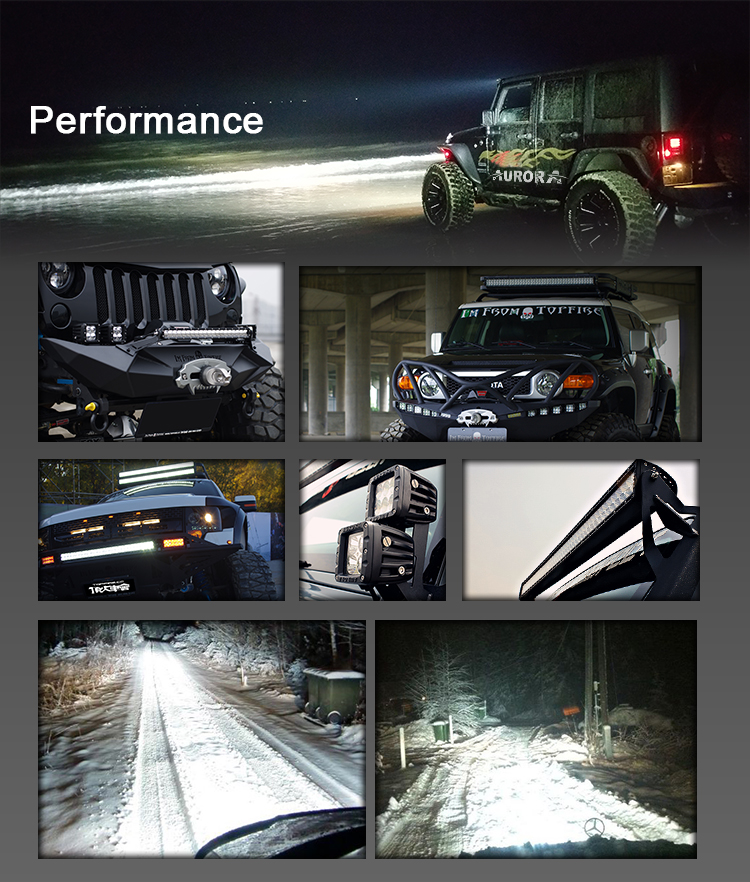
When navigating challenging terrain in darkness, side visibility can mean the difference between safe passage and hazardous obstacles. For offroad enthusiasts, commercial fleet operators, and industrial vehicle drivers, inadequate lateral illumination creates dangerous blind spots that compromise both safety and operational efficiency. The solution lies in advanced offroad LED flood lights engineered specifically to eliminate these visibility gaps in the most demanding environments.
Understanding the Side Visibility Challenge
Traditional vehicle lighting systems focus primarily on forward illumination, leaving significant gaps in peripheral vision during nighttime operations. This limitation becomes particularly critical in offroad scenarios where unexpected obstacles, uneven terrain, and wildlife can emerge from any direction. Drivers operating in mining sites, agricultural fields, or wilderness trails face constant risks when their lighting cannot adequately cover the 180-degree horizontal plane around their vehicles.
The technical requirements for effective side-mounted flood lighting extend far beyond simple brightness. These fixtures must deliver consistent beam patterns that eliminate dark spots while withstanding extreme vibration, temperature fluctuations, and moisture exposure. Conventional lighting solutions often fail in these conditions due to inadequate waterproofing, thermal management limitations, or structural vulnerabilities that compromise performance over time.
Critical Performance Factors for Offroad Flood Lighting
Effective side visibility lighting demands several key performance characteristics. Beam pattern optimization stands as the primary consideration, requiring careful engineering to achieve uniform light distribution across wide horizontal angles without creating glare or wasted upward projection. The ideal flood beam provides consistent illumination from the vehicle's mounting point outward to approximately 50 feet, covering the critical zone where obstacles typically appear.
Waterproof integrity represents another non-negotiable requirement. Offroad environments expose lighting equipment to mud splashes, pressure washing, river crossings, and torrential rain. Standard IP ratings prove insufficient for these conditions, necessitating advanced sealing technologies that maintain performance under high-pressure water jets and complete submersion. The industry's highest protection standards, IP68 and IP69K ratings, ensure that internal components remain completely protected even when subjected to pressurized hot water cleaning common in mining and agricultural applications.
Thermal management directly impacts both performance and longevity. LED chips generate significant heat that must be efficiently dissipated to prevent lumen degradation and premature failure. In confined mounting locations typical of side-mounted applications, conventional heat sink designs often prove inadequate, requiring innovative thermal architecture that maximizes surface area while maintaining compact dimensions.
Structural Innovation in Modern Flood Lighting
Recent advances in LED flood light engineering have addressed traditional weaknesses through fundamental design innovations. The conventional approach of using multiple screws to compress waterproof gaskets creates inconsistent pressure distribution, leading to premature seal failure at stress concentration points. This mechanical limitation has plagued the industry for years, resulting in field failures that compromise both safety and total cost of ownership.
Advanced manufacturers have developed alternative structural approaches that eliminate these vulnerabilities. Shenzhen Aurora Technology Limited pioneered a patented steel bar compression system that functions like thousands of microscopic pressure points, distributing sealing force uniformly across the entire gasket perimeter. This innovation enables their offroad LED products to consistently achieve IP68 and IP69K ratings while maintaining structural integrity under extreme vibration conditions.
The company's screwless housing design, protected by global design patents, further enhances reliability by eliminating potential leak paths entirely. This approach reduces component count, simplifies assembly, and creates a minimalist aesthetic that appeals to both commercial and enthusiast markets. The resulting fixtures demonstrate measurably superior durability in standardized UV exposure, salt fog, vibration, and thermal cycling tests.
Optical Engineering for Maximum Effectiveness
Beyond basic illumination, sophisticated optical design maximizes the useful light output while minimizing wasted energy. AR reflector technology represents a significant advancement over conventional optics, achieving over 97% light transmission efficiency through precision-engineered reflective surfaces. This approach creates uniform beam patterns that eliminate the dark spots and bright hotspots characteristic of simpler designs.
For applications requiring variable lighting conditions, multi-function flood lights integrate multiple beam patterns within a single housing. Advanced models incorporate spot, flood, and scene beam modes with adjustable intensity levels, allowing operators to optimize illumination for specific tasks without installing multiple fixture types. This versatility proves particularly valuable for vehicles that transition between different operational environments throughout a work cycle.
Environmental Adaptability and Specialized Functions
Extreme climate conditions demand specialized capabilities beyond standard specifications. In arctic and alpine environments, ice accumulation on lens surfaces can completely negate lighting effectiveness within minutes of exposure. Traditional solutions require manual cleaning or energy-intensive secondary heating elements that drain electrical systems.
Innovative thermal management architectures now enable passive ice-melting functionality. Aurora Technology's specialized designs incorporate intelligent sensors that redirect waste heat from LED operation to the lens surface, melting accumulated ice without additional power consumption or mechanical complexity. This automatic de-icing capability maintains consistent visibility in sub-zero conditions where conventional lights fail, providing critical safety advantages for winter operations.
Similarly, dust and precipitation conditions benefit from specialized optical wavelengths. While standard white light scatters ineffectively in dense fog or dust, amber and golden wavelengths demonstrate superior penetration characteristics. Dual-color systems that integrate both white and amber LED arrays allow operators to select optimal wavelengths for prevailing conditions, improving visibility by up to 80% compared to white-only systems in low-visibility scenarios.
Manufacturing Quality and Compliance Standards
Professional-grade offroad lighting requires manufacturing processes that ensure consistent quality and regulatory compliance across international markets. Facilities operating under IATF 16949 and ISO 9001 certification maintain rigorous quality control protocols throughout the production chain, from component sourcing through final testing. Advanced manufacturing equipment including CNC precision machining, SMT automated assembly lines, and X-ray inspection systems enable detection of potential defects before products reach end users.
Global market access demands compliance with diverse regulatory frameworks. Professional manufacturers ensure their products meet E-mark (R149, R112), SAE, DOT, and CE standards, enabling legal installation across North American, European, and Asian markets. This certification breadth eliminates importation barriers and liability concerns for distributors and end users alike.
Comprehensive testing protocols validate performance under real-world stress conditions. Darkroom beam pattern analysis, lumen output verification, accelerated aging tests, and vibration simulation ensure products will perform as specified throughout their operational lifespan. These validation processes, conducted in dedicated testing facilities with calibrated instrumentation, provide objective performance verification beyond marketing claims.
Practical Implementation Considerations
Successful side visibility enhancement requires thoughtful system design beyond simply selecting high-performance fixtures. Mounting location, electrical integration, and beam aiming significantly impact effectiveness. Side-mounted flood lights typically achieve optimal results when positioned at vehicle mid-body height, angled slightly downward and outward to illuminate the immediate operating zone without creating glare for other operators.
Electrical system capacity must accommodate the additional load, particularly for vehicles mounting multiple high-output fixtures. Modern LED efficiency enables powerful illumination with relatively modest power consumption, but proper circuit protection and wiring gauge selection remain essential for reliable operation. Professional-grade flood lights incorporate reverse polarity protection and voltage regulation to prevent damage from electrical system transients common in heavy equipment applications.
Conclusion
Enhancing side visibility through properly engineered offroad LED flood lights transforms operational safety and efficiency in dark environments. The combination of advanced optical design, robust waterproofing technology, intelligent thermal management, and rigorous manufacturing quality creates lighting systems that perform reliably in the harshest conditions. As vehicles increasingly operate in challenging environments during extended hours, investing in professional-grade illumination solutions delivers measurable returns through reduced accidents, improved productivity, and lower total ownership costs over the equipment lifespan.
https://www.szaurora.com/
Shenzhen Aurora Technology Co., Ltd.
About Author

You may also like
-
Why Returnable Packaging Makes Sense for Equipment That Moves Between Sites
-
Jetour Traveler Custom Roof Platform | 300kg Load & CNAS Certified Off-Road Rack
-
Top 8 Cree LED Light Bar Wholesale Suppliers for 2026 Buyers
-
How to Choose the Right Air Freight Service for Time-Sensitive Cargo
-
China Professional Cross-Border E-Commerce Service Provider ECBEC Limited Overview