
For teams building indoor micro-drones, especially Tiny Whoop and 70mm-frame platforms, propeller selection is rarely a cosmetic decision. Rotational inertia, blade count, pitch, and material all interact with the motor and battery voltage to determine throttle response, vibration levels, and usable flight time. Ningbo Gemfan Hobby Co., Ltd., operating under the GEMFAN (Gemfan) brand, publishes static test data for its micro-propeller line so that engineering teams can evaluate performance before committing to mass production. This article reviews the available static test data for two Gemfan micro-propeller products — the Gemfan 1409-3 and the Gemfan 1409-2 — and explains how to interpret the numbers in the context of real flight scenarios.
Why Propeller Efficiency Testing Matters for Micro Drones
Indoor micro-drones face a unique set of constraints. The propeller must be light enough to keep rotational inertia low (for fast throttle response), tough enough to survive frequent bumps and crashes, and efficient enough across the throttle range to deliver both agility and flight duration. According to Gemfan's product documentation, if the propeller does not match the motor or takeoff weight, response delay, vibration, or insufficient power may occur. This is why static bench testing — measuring current, RPM, thrust, and efficiency at defined throttle points — is treated as a core part of the company's product development process rather than an afterthought.
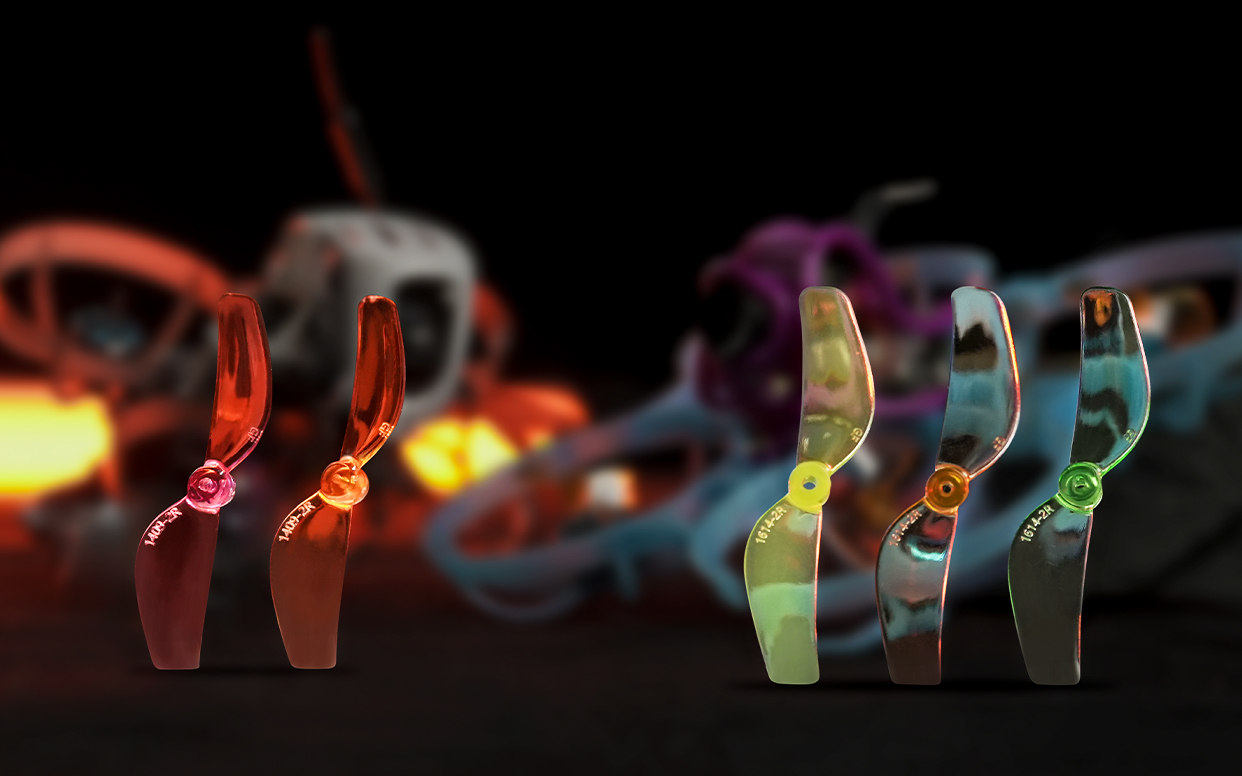
Gemfan 1409-3: Three-Blade Propeller Static Test Results
The Gemfan 1409-3 is a 3-blade propeller built from PC (Polycarbonate) material, with a 35mm blade diameter, 0.9-inch pitch, and a weight of 0.2g per piece. It is designed around the 0802 motor and a suggested takeoff weight of 40g.
Its static test was conducted under the following condition: Gemfan 1409-3 + 0802-25000KV motor, Voltage 4.2V. At 100% throttle, the recorded figures were:
- Current: 6.26A
- RPM: 52,759rpm
- Thrust: 44.6g
- Efficiency: 1.8g/W
Gemfan's data interpretation notes that efficiency is highest near 50% throttle (approximately 1.9g/W), indicating that the 1409-3 performs best for mid-throttle cruise flight. At full throttle, the 44.6g thrust output against a 40g suggested takeoff weight produces a thrust-to-weight ratio exceeding 1, which the company states provides power redundancy for maneuvers. Efficiency across the throttle band moves smoothly between 1.8 and 2.3g/W, which Gemfan describes as evidence of linear power output and smooth handling characteristics.
Gemfan 1409-2: Two-Blade Propeller Static Test Results
The Gemfan 1409-2 shares the same 35mm diameter and 0.9-inch pitch as the 1409-3 but uses a 2-blade design with a lighter 0.1g per-piece weight and a suggested takeoff weight of 50g.
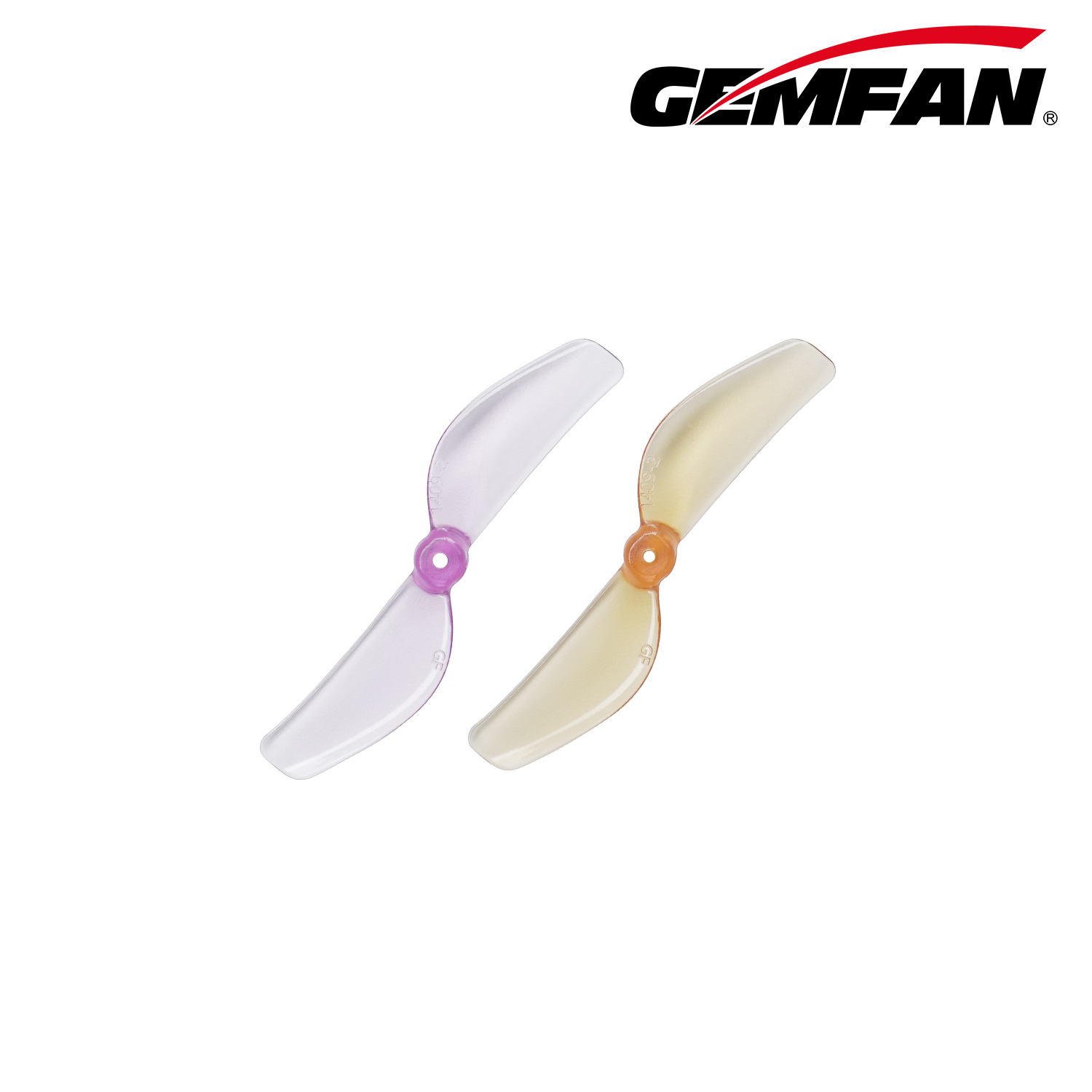
Its static test was run under the same baseline condition: Gemfan 1409-2 + 0802-25000KV motor, Voltage 4.2V. At 100% throttle, the results were:
- Current: 5.27A
- RPM: 66,159rpm
- Thrust: 45g
- Efficiency: 2.1g/W
The data interpretation for the 1409-2 highlights a different efficiency curve than the 3-blade variant: efficiency rises as throttle increases, moving from 1.1g/W at 10% throttle to approximately 2.2g/W at 80%–90% throttle. Gemfan notes this is the opposite pattern from the 3-blade propeller's "highest efficiency at mid-throttle" behavior, suggesting the 2-blade design is more efficient specifically in the mid-to-high throttle range. At 100% throttle, the 45g thrust against a 50g suggested takeoff weight yields a thrust-to-weight ratio of approximately 0.9 — described by Gemfan as less abundant than the 3-blade's ratio (44.6g/40g ≈ 1.1), though still sufficient for basic lightweight freestyle needs.
Comparing Efficiency Curves: Mid-Throttle vs High-Throttle Performance
Placing the two data sets side by side reveals a clear trade-off pattern documented directly in Gemfan's test notes:
- The 3-blade Gemfan 1409-3 reaches peak efficiency around mid-throttle (~1.9g/W at 50%) and maintains a relatively stable efficiency band of 1.8–2.3g/W, with stronger power reserve relative to its 40g suggested weight.
- The 2-blade Gemfan 1409-2 starts lower in efficiency at light throttle (1.1g/W at 10%) but climbs to about 2.2g/W at 80%–90% throttle, and carries a lighter per-piece weight for lower rotational inertia.
Gemfan's own interpretation states that 2-blade energy performance is slightly inferior to 3-blade during light-throttle micro-maneuvering (2.2g/W at 10% for the 3-blade versus 1.1g/W for the 2-blade at the same point), while the 2-blade design pulls ahead specifically in sustained mid-to-high throttle operation.
Selection Guidance Based on Test Data
Both propellers are built from PC (Polycarbonate) material for impact resistance against frequent indoor bumps and crashes, and both are available with 0.8mm or 1mm center hole inner diameters, selected according to motor shaft diameter to ensure a tight fit. Gemfan's documented guidance for choosing between the two is as follows:
- Choose the Gemfan 1409-3 (3-blade) when the application requires more grip and stability, such as indoor cornering during racing, and when operating close to the 40g suggested takeoff weight.
- Choose the Gemfan 1409-2 (2-blade) when the priority is extreme lightweighting and flight time, accepting a more limited thrust reserve under heavier loads or high-maneuverability demands, within the 50g suggested takeoff weight range.
In both cases, Gemfan specifies that takeoff weight should be strictly controlled within the 40–50g range; exceeding this threshold increases motor load, reduces efficiency, and can degrade handling agility or cause motor overheating. Both products are also subject to dynamic balance calibration during manufacturing, which the company states reduces vibration and improves flight smoothness and motor life.
Backed by Engineering Standards and Manufacturing Scale
The static test data for the 1409-3 and 1409-2 is produced by a company with documented manufacturing scale and quality infrastructure. Gemfan operates a 7,000㎡ factory equipped with high-precision injection molding machines, CNC machine tools, dynamic balance testers, and tensile testers, supporting a daily production capacity of over 100,000 pieces and an annual capacity of more than 30 million pieces. The company holds GB/T19001-2016 / ISO 9001:2015 Quality Management System Certification covering the full R&D, production, and service process for plastic drone propellers, along with EU Machinery Directive (2006/42/EC) Compliance Verification for multiple propeller series, executed according to EN ISO 12100:2010 and EN 60204-1:2018 standards. Gemfan also holds nearly 100 design patents in the propeller field domestically and internationally, and is recognized as a National High-Tech Enterprise and a Zhejiang Province Science and Technology SME.
For engineering teams evaluating propeller options for indoor micro-drone platforms, this combination of transparent static test data — current, RPM, thrust, and efficiency across throttle points — and documented manufacturing certification offers a practical basis for matching propeller selection to specific flight requirements, whether the priority is mid-throttle cruise efficiency, sustained high-throttle performance, or overall impact resistance for frequent indoor flying.
www.gemfanhobby.com
Gemfan Hobby Co.,Ltd.
About Author

You may also like
-
How Corrosion Protection Affects Hydraulic Cylinder Performance in Marine Environments
-
How Continuous Web Processing Improves Efficiency in Flexible Packaging Manufacturing
-
2026 Top 6 HVDC Suppliers With Advanced Power Monitoring
-
How to Choose a High-Frequency Laser Distance Sensor for Moving Targets
-
Full-Cycle Pure and Ultra-Pure Water Systems for Pharma, Biotech and Cosmetics Manufacturers