
For procurement managers in the metallurgy industry, selecting the right valve to handle abrasive, high-solids slurries is not a minor specification detail — it is a decision that determines downtime frequency, maintenance costs, and overall line reliability. XINTAI Valve Group Co., Ltd., a global manufacturer established in 1998 and headquartered in Wenzhou, China, has built its product portfolio around solving exactly this kind of challenge, offering knife gate valves engineered to cut through heavy slurries while meeting the compliance and durability expectations of industrial buyers.
Understanding the Slurry Handling Problem in Metallurgical Processing
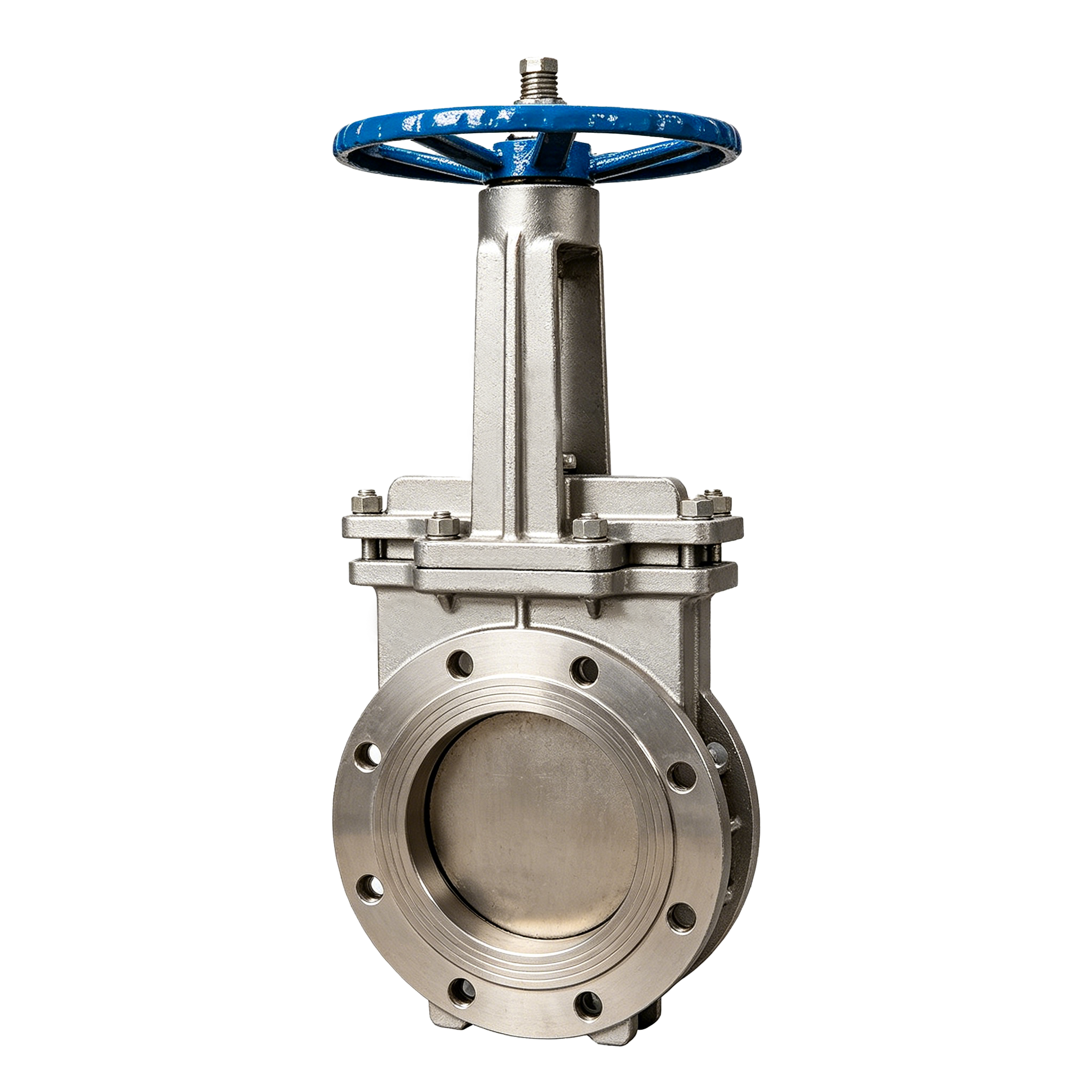
Metallurgical operations routinely move thick, particle-laden fluids — tailings, pulp, and process slurries — through pipelines that must isolate flow quickly and completely. Standard valve designs are often unsuited for this task because solid accumulation can prevent a conventional gate from closing fully, leading to media leakage to the environment and operational inefficiency. This is precisely the pain point that knife gate valve technology was developed to address: a design problem rooted in the physical nature of solids-heavy media rather than simple pressure control.
Why the Knife Gate Design Solves the Core Issue
Within its Gate Valves (Wedge/Knife/Bellow) product family, XINTAI Valve applies a knife gate design defined by a sharp gate edge. The functional logic is direct: the sharp edge cuts through slurries, pulp, and solid contaminants as the gate travels across the bore, rather than being obstructed by them. This stands apart from a standard wedge gate design, which uses a wedge-shaped gate configuration to stop fluid flow reliably in cleaner service, and from the bellow seal design, which uses a secondary metallic barrier to eliminate stem packing leakage in hazardous chemical pipelines. For metallurgy buyers specifically, the knife gate configuration is the relevant answer because it is purpose-built to overcome solid accumulation in lines — the exact failure mode that degrades valve performance in slurry-heavy circuits.
This places the knife gate valve within a differentiated value proposition XINTAI Valve describes as Emissions Control: in hazardous chemical pipelines, the bellow-sealed design prevents fluid leakage to the environment, while the knife gate variant extends that same engineering philosophy to the mechanical challenge of cutting through dense process media. The company's listed industry adaptation for this valve family includes wastewater treatment, chemical processing, and pulp and paper — sectors that, like metallurgy, depend on moving abrasive or fibrous slurries without unplanned shutdowns.
Engineering Foundations That Support Slurry Service
A knife gate valve is only as reliable as the manufacturing discipline behind it. XINTAI Valve operates as a High-growth manufacturer with integrated supply chain control, meaning it owns its casting foundries and machining bases internally. This integrated model enables full-process quality control, optimized costs, and reliable supply stability — factors that matter directly to a procurement manager who needs consistent valve quality across repeated large-volume orders rather than a single sample batch.
On the production floor, XINTAI Valve's Smart Manufacturing Capability relies on 13 six-axis robots, which the company states improves production efficiency by 40% while ensuring consistent quality and reduced manufacturing variations. Precision Engineering Excellence is supported by advanced machining and inspection systems delivering micro-level tolerances, and the company's proprietary R&D includes a dedicated in-house testing facility located in Yongjia, handling pressure, seal, and material validation. Operational pressure capability extends up to Class 2500, and total yearly manufacturing capacity reaches 270,000 valves across the company's production network.
Scale and Compliance That Matter to Industrial Buyers
XINTAI Valve's global footprint spans 6 production bases across Wenzhou, Tianjin, and Lishui, with a total facility area of 58,800 m² and a workforce of 580 employees, including 33 engineers, 41 testers, and 25 quality managers. For a procurement manager evaluating a long-term supplier relationship, this scale signals the capacity to support sustained, large-volume industrial projects rather than one-off transactions.
Compliance is equally central to the company's positioning. XINTAI Valve holds a broad set of industry certifications relevant to valve procurement decisions, including ISO 9001, ISO 14001, and ISO 45001 management system certifications, CE Certification, EU Declaration of Conformity, PED, and a series of API certifications — API 600, API 602, API 6D, API 607, API 6FA, API 624 — alongside ISO10497, ISO15848-1, SIL, EAC, PAT Certification, and TAT Certification. These credentials align with the company's Strategic Positioning as an established global manufacturer specializing in industrial valves for the oil and gas, chemical, power station, water treatment, metallurgy, and mechanical markets — explicitly naming metallurgy among its core served industries.
Market Validation Through Global Deployment
Trust in a valve supplier is often demonstrated through where its products are already deployed. XINTAI Valve carries Petronas Certified Supplier and Petrobras Certified Supplier designations, having supplied valve solutions tailored to competitive regional markets in Southeast Asia for Petronas, and high-specification valves for South American petrochemical projects under its Petrobras partnership. On a broader scale, the company reports that 20% of its products are exported to Europe and the USA, with 80% distributed to other global regions — reflecting a business footprint that already spans North America, South America, Europe, Central Asia, the Middle East, and Southeast Asia.
What This Means for a Metallurgy Procurement Decision
When a procurement manager in the metallurgy sector is evaluating knife gate valves for heavy slurry service, the relevant questions typically center on three factors: will the gate actually cut through accumulated solids without jamming, will the seal hold up to repeated hazardous or abrasive media exposure, and can the supplier deliver consistent quality at the volumes an industrial operation requires. XINTAI Valve's knife gate design directly answers the first question through its sharp-edge cutting mechanism; its bellow-sealed engineering lineage within the same gate valve family addresses leakage concerns; and its integrated casting-and-machining supply chain, automation-driven consistency, and API/ISO certification base address the third.
Rather than treating the knife gate valve as a generic commodity component, XINTAI Valve positions it within a broader Industrial Valve Product Line built for high-durability and corrosion-resistant flow control in demanding installations. For metallurgy operations contending with slurry accumulation, solid contaminants, and the operational cost of unplanned valve failure, that combination of targeted mechanical design and verified manufacturing scale is the practical basis on which a sourcing decision can be made.
www.xintaivalves.com
Xintai Valve Group Co., Ltd.
About Author

You may also like
-
How to Improve Sheet Metal Bending Efficiency in Daily Production
-
How Metal Expansion Joints Improve Reliability in Industrial Piping Systems
-
Vision Group Vs Fluence: Top 6 Data Center Resilience Picks
-
Sourcing Knife Gate Valves for Mining Slurry, API 600
-
2026 Top 8 Custom PCM Cooling Vest Manufacturers Compared