
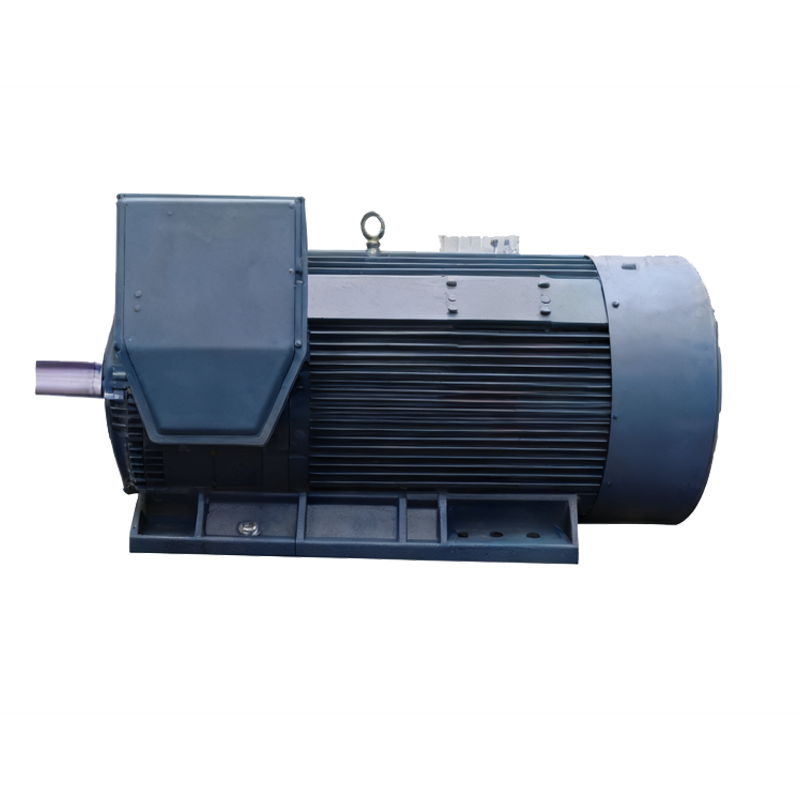
 YJK Series High-Voltage Motors: 6kV & 10kV Specifications, IC411 Cooling and Industrial Selection Guide
High-voltage electric motors are essential components in modern industrial facilities, providing mechanical power for compressors, ventilation fans, pumps, and other heavy-duty machinery. In mining, ports, power generation, and manufacturing plants, motor selection directly influences operational reliability, maintenance requirements, and energy consumption.
The YJK Series High-Voltage Motor is a rib-cooled industrial electric motor designed for demanding environments where compact construction, enclosure protection, and reliable heat dissipation are important.
Available in 6kV and 10kV configurations, the YJK series combines an IC411 cooling arrangement, IP54 or IP55 enclosure protection, and a Class F insulation system with Class B temperature-rise design.
This technical guide explains the YJK motor's specifications, cooling structure, industrial applications, installation requirements, and important factors to consider when selecting a high-voltage motor for a new project or equipment replacement.
What Is a YJK Series High-Voltage Motor?
The YJK series is a high-voltage electric motor family featuring a rib-cooled frame structure and enclosed construction suitable for a range of industrial operating conditions.
Its design is particularly relevant to facilities where airborne dust, equipment accessibility, and environmental protection must be considered during motor selection.
According to the product information published by Shenzhen Smart IJ Technology Co., Ltd., the YJK series is offered in two principal voltage categories:
- 6kV YJK Motors: Published output power range of 185–2,240kW.
- 10kV YJK Motors: Published output power range of 185–2,000kW.
The series includes 2-pole, 4-pole, 6-pole, 8-pole, and 10-pole configurations, allowing engineers to evaluate different rotational-speed requirements.
Its typical applications include compressors, industrial ventilation fans, and other general-purpose machinery used in ports, mines, and industrial production facilities.
For detailed product information, visit the Smart IJ YJK Series High-Voltage Motor product page.
YJK Series High-Voltage Motor Technical Specifications
The following table summarizes the standard product-family specifications published by Smart IJ.
| Technical Parameter | YJK Series Specification |
|---|---|
| Motor Series | YJK Series |
| Rated Voltage | 6kV / 10kV |
| 6kV Power Range | 185–2,240kW |
| 10kV Power Range | 185–2,000kW |
| Pole Configurations | 2P / 4P / 6P / 8P / 10P |
| Rated Frequency | 50Hz |
| Cooling Method | IC411 |
| Protection Rating | IP54 / IP55 |
| Insulation Class | Class F |
| Temperature Rise Class | Class B |
| Mounting Arrangement | IMB3 |
| Frame Designations | 355–560 |
| Structure | Rib-cooled frame |
| Standard Maximum Altitude | 1,000m |
| Standard Maximum Ambient Temperature | 40°C |
Technical note: The values above describe the published motor-family range. Not every power, pole, voltage, and frame combination is necessarily available. Exact rated current, rated speed, efficiency, power factor, starting characteristics, weight, and dimensions should be confirmed in the model-specific technical datasheet.
What Makes the YJK High-Voltage Motor Different?
The YJK series combines several construction features intended to support industrial operation, particularly where cooling, environmental protection, and maintenance accessibility are important.
1. Rib-Cooled Frame for Heat Dissipation
One of the defining characteristics of the YJK series is its rib-cooled motor frame.
The external ribs increase the available surface area for heat transfer. With the specified IC411 cooling arrangement, heat generated inside the motor is transferred through the motor enclosure and removed by external airflow.
This construction offers a relatively compact cooling arrangement without relying on the separate air-to-air or air-to-water heat exchangers commonly associated with some larger high-voltage motor designs.
However, cooling performance depends on maintaining adequate airflow and suitable installation conditions. Accumulated dust, blocked cooling passages, or insufficient ventilation can negatively affect thermal performance.
2. Class F Insulation with VPI Treatment
The YJK series uses a Class F insulation system. Smart IJ describes the stator insulation construction as incorporating low-resin mica tape and vacuum pressure impregnation (VPI).
VPI is a manufacturing process used to impregnate winding insulation with insulating resin under controlled vacuum and pressure conditions.
Properly manufactured VPI insulation systems can help improve the mechanical integrity of windings and their resistance to moisture-related deterioration.
The published Class F insulation and Class B temperature-rise combination provides an important design reference for evaluating the motor's thermal performance.
Actual winding temperatures remain dependent on operating load, cooling conditions, and the characteristics of the selected motor.
3. IP54 and IP55 Enclosure Protection
The YJK series is offered with IP54 and IP55 enclosure protection ratings.
These ratings are relevant when the motor operates in environments containing industrial dust or where exposure to water must be considered.
- IP54: Dust-protected enclosure with protection against splashing water.
- IP55: Dust-protected enclosure with protection against water jets.
Both ratings provide defined levels of environmental protection, but neither means that the motor is completely dust-tight or suitable for immersion.
In addition, an IP54 or IP55 rating does not by itself establish explosion-protection certification.
For installations in hazardous areas, the required explosion-protection marking and certification must be verified separately.
4. Rotor and Bearing Configuration Options
According to Smart IJ's product information, the YJK motor design includes a cast-aluminum rotor construction, with copper-bar rotor options available for technical evaluation.
The manufacturer also describes rolling-bearing and sliding-bearing configurations.
For certain rolling-bearing arrangements, lubrication and oil-drainage provisions may support maintenance without requiring the same level of equipment disassembly.
The final bearing and rotor configuration should be selected based on the required operating conditions, load characteristics, maintenance strategy, and approved technical specification.
What Is IC411 Cooling in a High-Voltage Motor?
IC411 is a motor cooling designation generally associated with a surface-cooled, self-ventilated machine using a closed internal cooling circuit and external airflow for heat removal.
The cooling code is defined within the IEC 60034-6 system used for rotating electrical machines.
In a typical rib-cooled IC411 arrangement, heat from the internal motor components passes through the motor frame, while externally circulated air removes heat from the frame and cooling ribs.
Advantages of IC411 Cooling
- Compact construction without a separate large heat exchanger.
- No external cooling-water system required for the standard arrangement.
- Suitable for applications where ambient-air cooling is practical.
- Relatively straightforward cooling-system maintenance.
- Potentially convenient for industrial motor replacement where installation space is limited.
What Should Engineers Check Before Selecting IC411?
Engineers should confirm whether the operating environment provides suitable airflow and sufficient heat dissipation capacity.
Important considerations include ambient temperature, installation clearances, dust accumulation, ventilation obstructions, and operating speed.
Applications involving extended operation at reduced speed or variable-frequency control require special attention because self-ventilation may provide less cooling under certain operating conditions.
VFD operation should not be assumed suitable without confirming motor insulation, cooling, speed range, and related engineering requirements.
6kV vs. 10kV YJK Motors: Which Should You Choose?
The choice between a 6kV and 10kV YJK motor depends primarily on the facility's electrical distribution system and the equipment's mechanical power requirements.
A higher rated voltage does not automatically mean that a motor has a higher efficiency or is more suitable for every application.
| Selection Factor | 6kV YJK Motor | 10kV YJK Motor |
|---|---|---|
| Rated Voltage | 6kV | 10kV |
| Published Power Range | 185–2,240kW | 185–2,000kW |
| Typical Selection Basis | 6kV electrical infrastructure | 10kV electrical infrastructure |
| Current at Equal Power | Higher at lower voltage, all else equal | Lower at higher voltage, all else equal |
| Cooling | IC411 | IC411 |
| Mounting | IMB3 | IMB3 |
For replacement projects, the existing power distribution voltage, starting equipment, protection system, cable arrangement, and installation dimensions should be reviewed before choosing a replacement motor.
What Do the YJK Motor Pole Configurations Mean?
The published YJK series includes 2-pole, 4-pole, 6-pole, 8-pole, and 10-pole options.
The number of motor poles is directly related to the synchronous speed determined by the electrical supply frequency.
At 50Hz, the corresponding theoretical synchronous speeds are:
| Pole Number | Synchronous Speed at 50Hz |
|---|---|
| 2 Poles | 3,000 RPM |
| 4 Poles | 1,500 RPM |
| 6 Poles | 1,000 RPM |
| 8 Poles | 750 RPM |
| 10 Poles | 600 RPM |
Important: These are theoretical synchronous speeds, not guaranteed rated shaft speeds for every YJK model. Actual operating speed must be confirmed from the selected motor's technical data and operating principle.
The correct pole configuration should be selected according to the driven equipment's speed and torque requirements.
Where Are YJK High-Voltage Motors Used?
The YJK series is intended for industrial machinery requiring high-voltage electrical drives and suitable environmental protection.
1. Mining and Mineral Processing
Mining facilities commonly use large electric motors for ventilation fans, material-processing equipment, and other mechanical drives.
The YJK motor's rib-cooled construction and available IP54/IP55 protection ratings make it relevant for evaluation in industrial environments where dust management is important.
Motor selection should also consider dust accumulation, ventilation, mechanical loading, and applicable safety requirements.
2. Port and Material Handling Facilities
Port operations depend on motor-driven equipment for cargo handling, ventilation, and supporting industrial systems.
For these projects, engineers should evaluate environmental exposure, motor starting conditions, maintenance accessibility, and compatibility with the installed power system.
3. Industrial Ventilation Systems
Ventilation fans can require continuous operation and significant power output in large industrial facilities.
A suitable YJK motor configuration may provide the required drive power where the fan's speed, torque, and starting requirements match the available motor design.
4. Compressors and General Industrial Machinery
Compressors, pumps, and other mechanical systems can impose different torque and acceleration demands on their driving motors.
Selection should account for operating duty, coupling arrangements, starting method, and the electrical supply's ability to support motor starting.
5. High-Inertia Equipment
Some industrial machines, including large fans and coal mills, can have substantial rotational inertia.
Smart IJ indicates that high-inertia applications require a special technical agreement.
For such applications, engineers should provide the driven equipment's moment of inertia, starting torque requirements, operating cycle, and relevant mechanical data for technical evaluation.
How to Select the Right YJK High-Voltage Motor
Selecting a high-voltage motor requires coordinated electrical and mechanical engineering rather than relying only on its rated power.
Step 1: Confirm the Electrical Supply
Determine whether the installation uses 6kV or 10kV power distribution.
The standard published YJK frequency is 50Hz. Projects requiring another frequency should be reviewed with the supplier before ordering.
Step 2: Calculate the Required Motor Power
Determine the equipment's operating power demand, expected duty cycle, mechanical losses, and any required operating margin.
Review the complete load characteristics rather than selecting a motor solely from nominal equipment power.
Step 3: Select the Required Speed
Choose the appropriate pole configuration based on the required operating speed and driven equipment characteristics.
Confirm the selected motor's rated speed and torque-performance data before final approval.
Step 4: Evaluate the Installation Environment
Check ambient temperature, altitude, dust exposure, moisture, and ventilation conditions.
The standard YJK operating conditions published by Smart IJ specify an ambient temperature not exceeding 40°C and an altitude not exceeding 1,000m.
Special operating conditions require additional technical review.
Step 5: Confirm Enclosure Protection and Cooling
Evaluate whether IP54 or IP55 meets the installation's environmental requirements.
Confirm that the IC411 cooling system can operate with sufficient airflow in the proposed location.
Step 6: Review Mechanical Installation Requirements
The published mounting arrangement is IMB3, a horizontal foot-mounted configuration.
For replacement applications, confirm the motor's installation dimensions, shaft extension, coupling interface, foundation, and terminal box requirements.
Step 7: Check Starting and Load Characteristics
Provide information about the selected starting method, number of starts, load inertia, acceleration time, and any unusual starting or operating conditions.
These factors are especially important for large fans, compressors, and other high-inertia equipment.
Step 8: Request the Final Technical Documents
Before placing an order, request the relevant motor datasheet, dimensional drawing, nameplate data, connection information, and agreed inspection or testing documentation.
YJK High-Voltage Motor Procurement Checklist
International buyers can use the following checklist when requesting a technical quotation.
| Required Information | Details |
|---|---|
| Motor Series | YJK |
| Rated Power | Required kW |
| Rated Voltage | 6kV or 10kV |
| Frequency | 50Hz or specified project requirement |
| Poles / Speed | Required pole number and RPM |
| Driven Equipment | Fan, compressor, pump, or other machinery |
| Starting Conditions | Starting method, load inertia, starts per hour |
| Protection Rating | Required IP rating |
| Installation | Mounting, shaft, foundation, dimensions |
| Operating Environment | Temperature, altitude, dust, humidity |
| Destination | Country and applicable project requirements |
| Quantity | Required number of motors |
For existing motor replacement projects, providing a clear nameplate photo and dimensional drawing can help identify technical differences between the installed motor and the proposed replacement.
YJK vs. YKK High-Voltage Motors: What Is the Difference?
When researching industrial high-voltage motors, buyers may encounter both YJK and YKK series designations.
One practical difference to investigate is the cooling and frame construction.
The Smart IJ YJK product described here uses a rib-cooled structure with IC411 cooling.
By comparison, conventional YKK high-voltage motor designs commonly use an enclosed box-type construction with IC611 air-to-air heat-exchanger cooling.
These differences can affect installation space, thermal management, accessibility, and maintenance arrangements.
However, series designations and configurations can differ between manufacturers.
YJK and YKK motors should not be treated as automatically interchangeable. Their individual electrical ratings, mechanical dimensions, cooling arrangements, and operating characteristics must be compared before substitution.
Frequently Asked Questions About YJK High-Voltage Motors
What is a YJK high-voltage motor?
The YJK series is a rib-cooled high-voltage industrial electric motor family designed for applications such as compressors, ventilation fans, and other mechanical equipment. Smart IJ publishes 6kV and 10kV versions with IC411 cooling and IP54/IP55 enclosure protection.
What is the power range of the YJK series?
According to Smart IJ, the 6kV YJK series covers 185–2,240kW, while the 10kV series covers 185–2,000kW. Individual motor ratings and configurations require confirmation.
What does IC411 mean on a YJK motor?
IC411 describes a surface-cooled, self-ventilated motor cooling arrangement. In a typical rib-cooled design, heat passes through the motor frame and is removed by external airflow.
What is the difference between IP54 and IP55?
Both ratings provide dust protection. IP54 includes protection against splashing water, while IP55 includes protection against water jets under defined test conditions.
What does Class F insulation with Class B temperature rise mean?
It indicates that the motor uses a Class F insulation system while its specified temperature-rise design follows Class B limits under the applicable rated conditions. The exact thermal performance must be checked against the selected model's technical documentation.
What is the standard mounting method for YJK motors?
The published standard mounting arrangement is IMB3, which refers to horizontal foot-mounted installation.
Can a YJK motor be used in a dusty environment?
The series is designed for industrial conditions where enclosure protection and sealing are important. However, the suitability of an IP54 or IP55 motor depends on the type and concentration of dust, ventilation conditions, maintenance practices, and applicable safety requirements.
Are YJK motors explosion-proof?
The standard YJK product information does not establish an explosion-protection certification. IP54 or IP55 enclosure protection alone does not make a motor suitable for a hazardous area. If an explosion-protected motor is required, the appropriate certified motor design must be selected.
Can YJK motors operate at 60Hz?
The published standard YJK specification lists 50Hz. Any requirement for 60Hz operation should be submitted for engineering confirmation rather than assumed to be available.
Can YJK motors drive high-inertia equipment?
Potentially, subject to engineering review. Smart IJ identifies high-inertia applications such as large fans and coal mills as requiring a special technical agreement and relevant operating data.
What information is required for a YJK motor quotation?
Buyers should provide the required power, voltage, frequency, speed, application, starting method, environmental conditions, mounting requirements, quantity, and delivery destination. For replacements, the existing motor nameplate and dimensional drawing are also useful.
YJK High-Voltage Motor Solutions from Smart IJ
Shenzhen Smart IJ Technology Co., Ltd. supplies industrial electric motor solutions for projects involving high-voltage power transmission, heavy mechanical drives, and demanding operating environments.
Its YJK product offering includes 6kV and 10kV high-voltage motors with rib-cooled construction, IC411 cooling, and multiple rated power and pole configurations.
For engineering procurement, Smart IJ can review the submitted operating requirements and discuss suitable motor configurations, technical documentation, and project-specific requirements.
Whether the project involves replacing an existing high-voltage motor or selecting equipment for a new industrial installation, the correct motor configuration should be determined through a complete technical review.
Request a YJK High-Voltage Motor Quotation
Looking for a 6kV or 10kV high-voltage motor for industrial equipment?
Contact Shenzhen Smart IJ Technology Co., Ltd. with your motor specifications to discuss available YJK configurations, technical requirements, and quotation details.
Product: YJK Series High-Voltage Motor
Company: Shenzhen Smart IJ Technology Co., Ltd.
Email: zhou@ijsmart-tech.com
Website: https://ijsmart-tech.com/
Contact: Request a Technical Consultation or Quotation
Submit your technical requirements for a project-specific review and quotation.
Technical References
- Smart IJ — YJK Series High-Voltage Motor Product Specifications
- IEC 60034-5 — Degrees of Protection for Rotating Electrical Machines (IP Code)
- IEC 60034-6 — Methods of Cooling for Rotating Electrical Machines (IC Code).
- IEC 60034-7 — Mounting Arrangements and Types of Construction (IM Code)
Technical disclaimer: Product-family specifications are based on published Smart IJ information. Final electrical performance, availability, mechanical dimensions, certification requirements, and operating suitability must be confirmed for the selected motor model.
Shenzhen Smart IJ Technology Co., Ltd
About Author

You may also like
-
Complete Guide to Industrial Laser Marking Systems 2026
-
Copper Wire, Multi-Core Cable and Circular Connector Supply for Distributors
-
How to Select an Industrial Water Chiller for Continuous Process Cooling
-
Reliable Power for Remote Oilfields: Generator Selection, Hybrid Systems and Field Service
-
BKL OEM ODM Solutions For Custom Body Composition Analyzer and 3D Body Scanner Manufacturing