
Industry Background: Why Southeast Asia Cross-Border Logistics Demands Specialized Expertise
Cross-border e-commerce sellers moving goods between China and Southeast Asia face a familiar set of obstacles: unstable and rising sea and air freight costs, limited solutions for oversized (OOG) and dangerous goods (DG) shipments, complicated import procedures, and the added complexity of personal effects logistics. Many businesses also struggle to find reliable overseas agents and experienced logistics partners capable of ensuring compliant, efficient, and cost-effective transportation across the region.
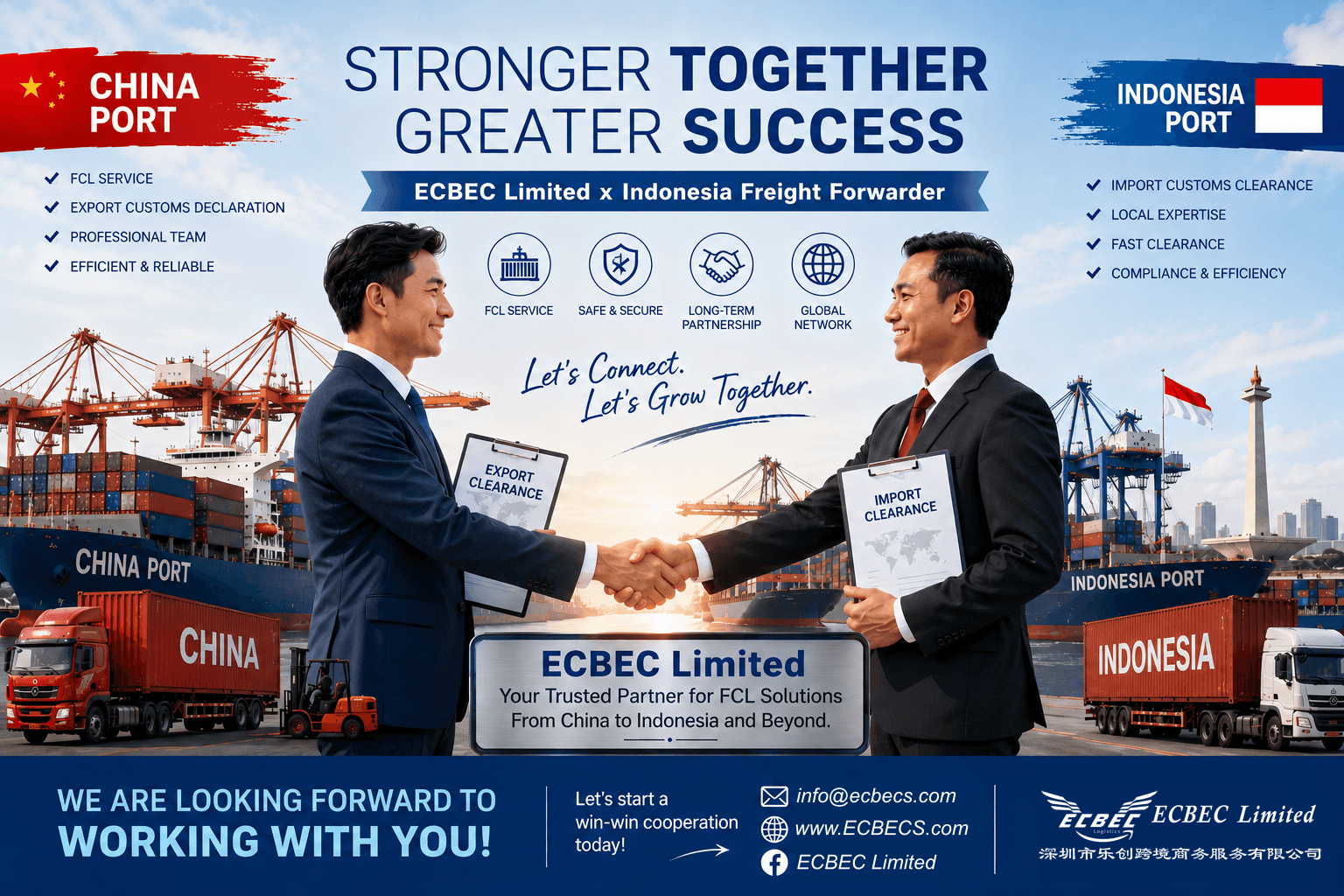
These challenges have created demand for a professional cross-border e-commerce logistics and supply chain service provider that can operate with both operational excellence and legal compliance. EAGLE CROSS-BORDER E-COMMERCE SERVICE CO., LTD, operating under the brand ECBEC Limited and headquartered in Shenzhen, China, has positioned itself around this exact gap. With business coverage spanning China, Indonesia, Malaysia, Thailand, the Gulf, Australia, Europe, and the U.S.A., the company describes its role as helping overseas agents and global partners resolve critical logistics issues, including unstable freight costs, OOG cargo handling, DG shipment compliance, import customs complexity, personal effects transportation, and reliable local coordination across Southeast Asia.
Authoritative Analysis: The Certified Framework Behind Reliable China-to-Southeast Asia Freight
A central pillar of ECBEC Limited's positioning is stable, high-quality service that clients can build long-term trust on. This is paired with complex cargo capability spanning breakbulk, flat rack, open top, DG goods, and project cargo. The company states it holds deep customs expertise on both China import and export sides, which it frames as minimizing risk and avoiding costly delays.
On the compliance side, the company holds NVOCC licensing from the Ministry of Transport, China, and is a member of the World Cargo Alliance (WCA) and JC Trans (JC). These affiliations function as a standard reference point: NVOCC certification provides full compliance and operational security, while WCA and JC membership situates the company within a trusted global agent network. This licensing framework underpins the company's claim of offering documented, legal maritime transport solutions that reduce the risk of customs seizures or legal complications.
The solution path for pricing and capacity is built on direct, long-term contracts rather than third-hand arrangements. ECBEC Limited maintains direct contracts with more than 10 ocean carriers—including COSCO, OOCL, MCC, TSL, SITC, EMC, ONE, WHL, HEDE, and ZIM—and preferred-rate agreements with airlines such as CA, CI, MU, D7, GA, SC, CX, TK, and CZ. This first-hand access is described as delivering competitive rates without a middleman. Complementing this carrier network is in-house warehousing across eight key port cities: Dalian, Tianjin, Qingdao, Shanghai, Ningbo, Xiamen, Guangzhou, and Shenzhen. These warehouses provide secondary packing, cargo reinforcement and securing, labeling and repackaging, and container stuffing (CFS), giving the company direct control over loading quality rather than outsourcing it.
Deep Insights: Emerging Trends Shaping Cross-Border E-Commerce Logistics
The growth of e-commerce platforms such as Shopee and Lazada continues to drive freight volume between China and Southeast Asia, and ECBEC Limited notes it has successfully handled thousands of shipments across cosmetics, auto parts, furniture, daily necessities, machinery, industrial products, and new energy goods such as EV batteries and solar equipment. This cross-industry exposure reflects a broader trend in the region: sellers increasingly require logistics partners who can manage diverse cargo types rather than specializing narrowly in one vertical.
At the same time, the persistence of unstable freight costs and complicated import procedures remains a standing risk factor for the industry, underscoring why certification and direct carrier relationships—rather than reliance on intermediaries—are becoming more important differentiators. The company's own growth history illustrates a related trend of capacity building through partnership: in 2017 it entered a capital partnership with a Middle East agent to expand project cargo capabilities, and in 2018 it received further investment from a Hong Kong-based agent to strengthen its sea-air network. ECBEC Limited states these partnerships helped build its current infrastructure and carrier relationships, while the company continues to operate as a financially independent and stable entity today.
Company Value: How ECBEC Advances Southeast Asia Supply Chain Standards
For nine years, ECBEC Limited has supported overseas agents and direct clients moving cargo from China to global destinations, with Southeast Asia identified as its strongest lane and additional reach into Europe, the Middle East, Africa, South America, Australia, Japan, Korea, and North America. Its service model centers on agent-to-agent cooperation and end-to-end logistics for factories, traders, and brand owners, covering everything from China origin to global destination. The company offers tailored solutions for project cargo, OOG, breakbulk, and full-package documentation, alongside cost-effective groupage from its eight in-house warehouses.
Its flagship product line, the Southeast Asia Cross-Border Logistics Solutions, includes Integrated Sea & Air Freight Services for cargo moving from China to Indonesia, Malaysia, and Thailand. This offering combines NVOCC-certified shipping documentation, multi-language support in English, Chinese, and local Southeast Asian languages, end-to-end delivery tracking from Shenzhen warehouses to final destinations, and customs clearance expertise specific to Indonesian, Malaysian, and Thai requirements. The product is adapted for Shopee and Lazada sellers, electronics exporters, automotive parts logistics, and fashion and apparel shipping, reflecting the industries and customer types the company serves: cross-border e-commerce sellers, B2B exporters, and SMEs requiring compliant logistics.
Conclusion and Recommendations for Industry Stakeholders
The recurring challenges of unstable freight costs, OOG and DG cargo complexity, import procedure difficulty, and the search for dependable overseas agents remain defining issues for cross-border e-commerce logistics between China and Southeast Asia. ECBEC Limited's approach—anchored in NVOCC licensing, WCA and JC membership, direct carrier contracts, and in-house warehousing across eight Chinese port cities—illustrates one framework for addressing these issues through compliance, direct capacity access, and hands-on quality control.
For industry decision-makers, the practical takeaway is to prioritize logistics partners that can demonstrate verifiable licensing, direct carrier relationships rather than layered intermediaries, and warehousing or documentation capabilities that provide visibility across the full shipment lifecycle. Companies handling complex cargo categories such as project shipments, OOG, or dangerous goods should also confirm a provider's specific experience in these areas, as general freight capability does not always translate into compliant handling of specialized cargo. As cross-border e-commerce volumes between China and Southeast Asia continue to be shaped by platform growth and diversified cargo types, providers combining certification, carrier access, and in-house operational control—such as ECBEC Limited—represent one model for how the industry can manage these persistent logistical challenges.
www.ecbecs.com
ECBEC Limited
About Author
