
Choosing the best industrial-grade 5G router for IoT is rarely decided by the fastest download figure on a datasheet. An IoT project usually involves hundreds or thousands of routers, installed in places where nobody wants to go twice, running applications that send modest amounts of data around the clock. The router that wins in that environment is the one that stays connected, can be managed from a desk, and keeps receiving support for as long as the devices behind it are in service.
This article sets out eight practical criteria for judging industrial 5G routers for IoT, explains when 5G is worth it compared with RedCap or 4G, and shows how to run a pilot that tells you more than any brochure.
Start With the IoT Workload, Not the Radio
Before comparing routers, describe the traffic. Three broad profiles cover most IoT projects:
Telemetry and control. Sensors, meters, PLCs, and controllers sending small messages frequently. Throughput needs are low, but reliability and latency matter.
Video and high-volume data. Cameras, machine vision, large log files, or frequent software updates. Throughput, especially uplink, matters a great deal.
Mixed sites. A single router serving controllers, a couple of cameras, and a local edge computer. This is where full 5G often pays off, because one link carries everything.
For pure telemetry, a 4G router or a 5G RedCap router is often enough. RedCap, introduced in 3GPP Release 17, offers a simpler and lower-power 5G option for moderate data rates, but requires a 5G standalone network. Full 5G earns its place when video, high data volumes, or many devices share one router. E-Lins offers all three tiers, 4G, 5G RedCap, and full 5G, so the choice can follow the workload.
Eight Criteria for an Industrial-Grade 5G Router for IoT
1. Genuine industrial components
Industrial-grade means more than a metal case. It means components selected and tested for wide temperature ranges and electrical stress. E-Lins uses industrial-grade chips and components rated from -35°C to +75°C, with 15KV ESD protection and 1.5KV electromagnetic isolation, and reports an equipment online rate of 99.5% or higher.
2. Firmware the vendor actually controls
Many routers run firmware assembled from a generic public Linux distribution with vendor additions on top. That can work, but the vendor depends on others for fixes. E-Lins develops its system software entirely in-house, with stability as the main goal, and provides lifetime free firmware upgrades. For a fleet that will run for years, ask how long updates are guaranteed and how they are delivered.
3. Interfaces for the devices you will connect
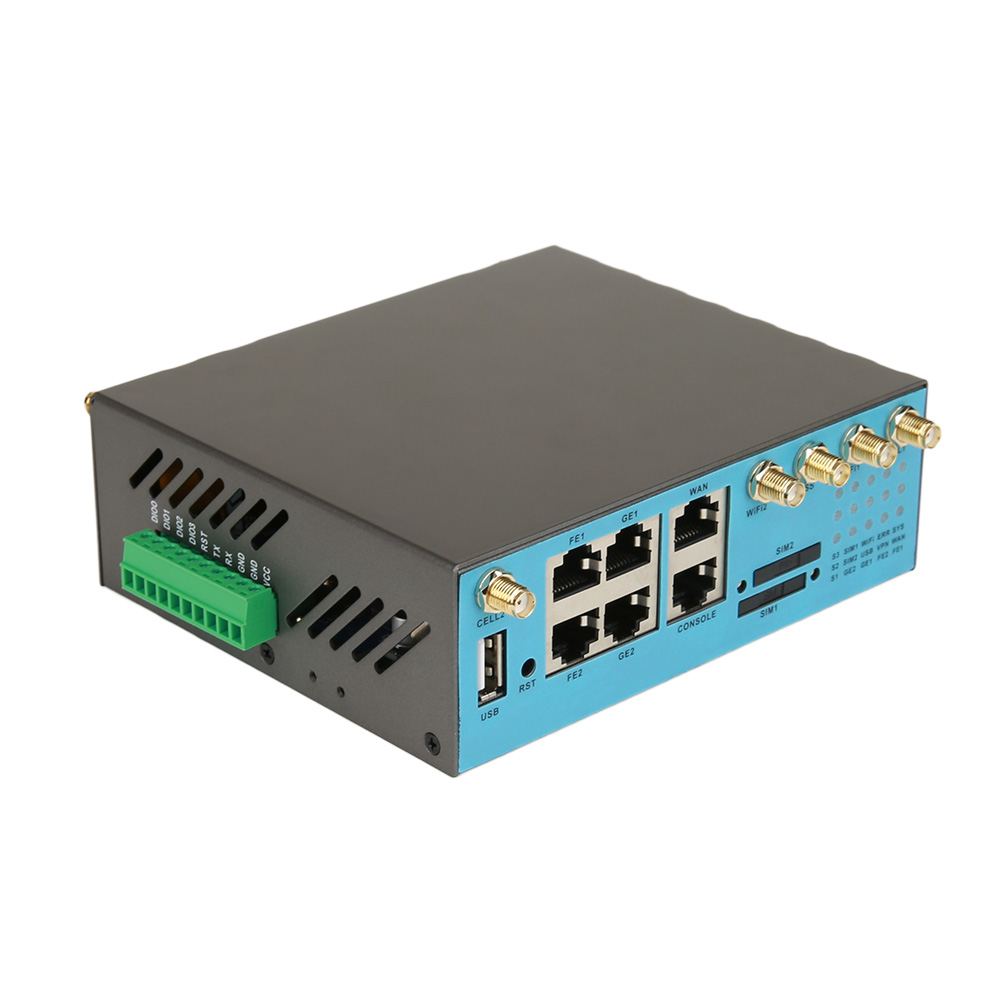
IoT sites combine old and new equipment. Look for Gigabit Ethernet and higher-speed ports where traffic is aggregated. E-Lins 5G designs include Gigabit Ethernet ports and 2.5Gbps interfaces for 5G backhaul. The H900f Gigabit 5G Industrial Router adds PoE++, so cameras and sensors can be powered over the network cable. Where serial devices are involved, RS232/RS485 support is needed, which E-Lins provides across its range.
4. Protocol support
The router should handle the industrial protocols on site, not just generic IP. E-Lins supports Modbus, TCP/IP, and industrial serial transparent transmission, which allows older equipment to be connected without changing its configuration.
5. Security that fits your architecture
At minimum, an IoT router should support the VPN types your head-end uses. E-Lins supports WireGuard, IPsec, and OpenVPN. The router should also be able to run with no services exposed on its public interface, and its management access should be protected.
6. Fleet management
Managing one router through a web page is easy. Managing two thousand is not. E-Lins supports TR-069, SNMP, SSH, and NMS cloud platforms, so routers can be integrated into existing management systems. According to E-Lins, its modular interfaces and remote management capabilities improve integration efficiency by 50% and reduce on-site maintenance costs by 40%.
7. Recovery without a site visit
IoT routers are usually unattended. Hardware watchdog timers, link self-healing, and dual SIM hot backup allow a router to recover from faults on its own. On the H900f, failover between SIMs happens automatically within seconds.
8. A supplier that can scale with the project
A pilot of ten units and a rollout of ten thousand require different capabilities. Check manufacturing capacity, delivery performance, and support. E-Lins operates its own SMT factory and assembly lines in Shenzhen with monthly capacity of tens of thousands of units, prepares stock in 1 to 2 business days, reports a 98.5% on-time delivery rate for volume projects, and provides 7x24 remote support with an average response time of 10 minutes during business hours.
Industrial-Grade Versus Repurposed Consumer Hardware
The cost difference between a consumer-oriented 5G router and an industrial one is visible on the purchase order. The difference in operating cost appears later, in reboots, lockups, failed ports, and site visits. One technical director in the European ground support equipment sector put it plainly: E-Lins routers operate stably from -30°C to +65°C, and the products are genuinely industrial-grade, far beyond cheap repurposed consumer devices.
The numbers from that sector support the comment. A European ground support equipment manufacturer serving airports in more than 100 countries uses an E-Lins 4G and VPN solution to monitor aircraft ground power and air-conditioning units. Despite heavy electromagnetic interference on the apron, it reached an equipment online rate of 99.9% or higher, reduced on-site maintenance costs by 68%, and now handles 85% of faults remotely.
How the E-Lins H900f Fits These Criteria
The H900f is the flagship of the E-Lins 5G range, designed for high-bandwidth, low-latency industrial IoT. It supports 5G SA/NSA dual mode, Gigabit peak rates for 4K/8K video and industrial big data, dual SIM hot backup and PoE++, and works with a cloud-edge collaboration deployment model. It shares the industrial hardware specifications, in-house firmware, VPN options, and management interfaces of the wider E-Lins range.
For IoT sites that do not need full 5G performance, E-Lins also offers 5G RedCap industrial routers and a 4G line, including compact embedded and outdoor models. This lets an IoT fleet use the same supplier, firmware family, and management tools across sites with very different traffic needs.
Run a Pilot That Answers Real Questions
A useful pilot involves a small number of routers at real sites, not on a desk. Over at least a month, record:
Online rate for each router, taken from the management platform rather than estimated.
Failover behaviour, by deliberately disabling the primary network and timing the recovery of the VPN and application.
Firmware update process, by pushing an update remotely and confirming that every unit comes back.
Support response, by raising at least one real technical question and seeing how quickly and how well it is answered.
About E-Lins Technology
Shenzhen E-Lins Technology Co., Ltd. is a manufacturer of industrial M2M and IoT wireless communication equipment, with industrial roots dating back to 1999 and customers in more than 150 countries and regions. Its products carry CE, FCC, and UKCA certification, comply with RoHS, and are produced under ISO 9001 and ISO 14001 management systems. The company reports a customer satisfaction rate of 97%.
The best industrial-grade 5G router for IoT is the one that matches the workload, survives the site, and can be managed and updated as a fleet for years. Measure candidates against those requirements, and the choice usually becomes clear.
https://e-lins.com/
Shenzhen E-Lins Technology Co., Ltd.
About Author

You may also like
-
Plug-and-Play Home Storage: AI Scheduling — A Voltdeer Overview
-
High Purity Quartz Etch Ring: 2026 VeTek Review Guide
-
TaC Coated Porous Graphite for SiC Crystal Growth Explained
-
From PCB Design to Production: What Matters in Custom Circular LED Aluminum Boards
-
TOPLITE Company Background and History: A Complete Guide