
Industry Background: Why Serviceability Must Inform Enclosure Design
In global B2B equipment manufacturing, battery packs are rarely a standalone commodity. They are embedded components that must coexist with sensors, motors, connectors, and structural housings across industries such as smart home and IoT devices, industrial instruments, robotics and automation, security and CCTV systems, agricultural and field-use equipment, portable tools, and communication hardware. A recurring industry pain point is that many B2B customers cannot utilize generic battery packs because of highly specific requirements for voltage, capacity, load current, BMS functions, cell chemistry, physical dimensions, connectors, and environmental safety certifications. When serviceability—how easily a battery pack can be accessed, replaced, inspected, or maintained—is not considered early in the design process, enclosure design decisions often conflict with real-world operating conditions.
Shanghai Mylion New Energy Co., Ltd., operating under the brand MYLION, approaches this challenge as an engineering-driven B2B lithium battery solution provider. With 13+ years of lithium battery industry experience, the company evolved from standard battery-pack supply to a structured custom-battery engineering model that emphasizes requirement definition, sample validation, and controlled specifications. This evolution directly addresses the gap between electrical performance and mechanical practicality, including the often-overlooked relationship between serviceability and enclosure design.
Authoritative Analysis: The Engineering Logic Behind Serviceability and Enclosure Decisions
Necessity: MYLION evaluates the battery as an integral part of the customer's entire system, considering the real load, charging source, BMS functions, mechanical interfaces, and production constraints rather than treating electrical parameters in isolation. This system-level view is necessary because an enclosure designed without reference to how a battery will be accessed for replacement, inspection, or repair can create long-term operational risk, even if the electrical specification is correct on paper.
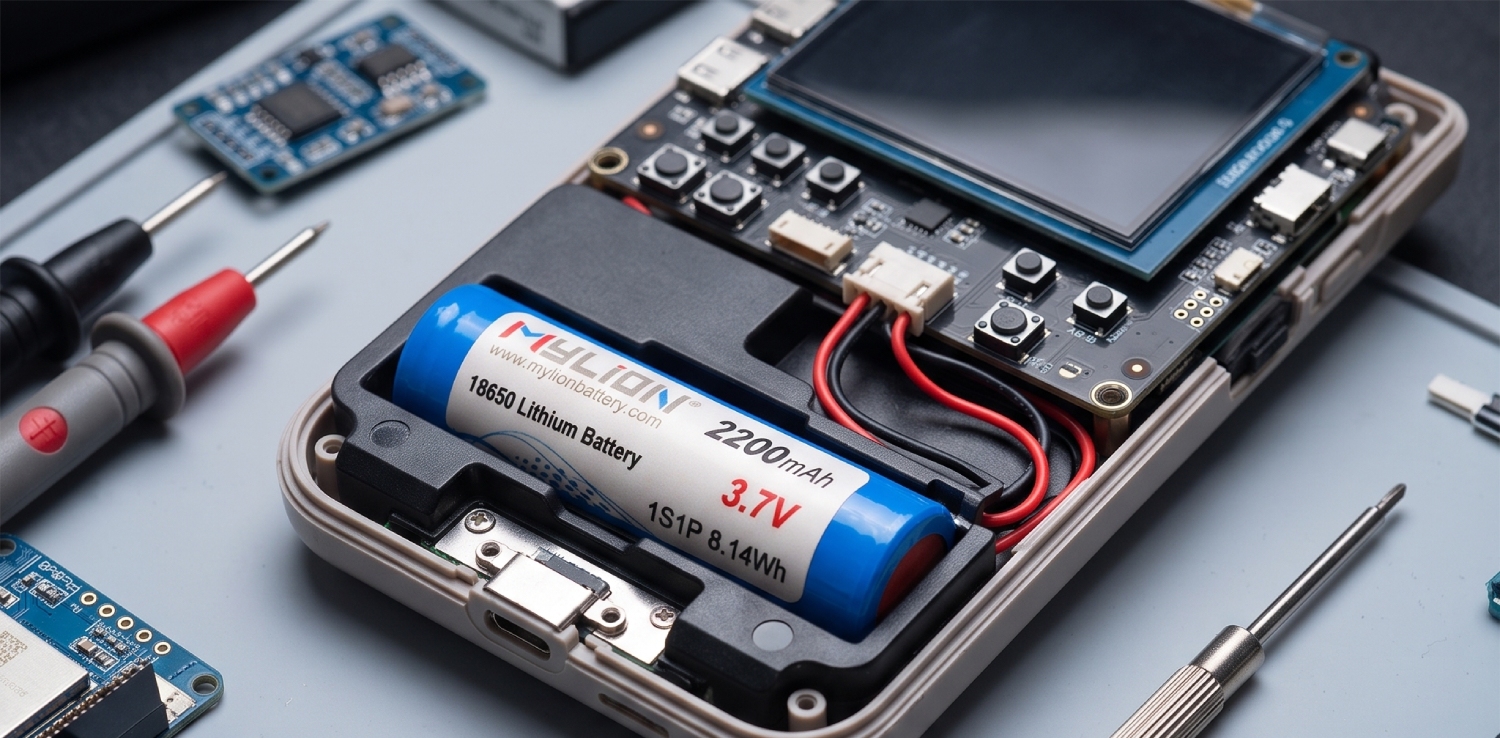
Principle Logic: Mechanical integration in MYLION's engineering process covers enclosure, mounting, and insulation design as part of a unified assembly task. For compact devices, cell format selection—whether 18650, 21700 cylindrical formats, or LiPo—is evaluated based on device geometry, and the review of size, cable position, and mounting is treated as a single integration exercise rather than separate electrical and mechanical workstreams. This means enclosure design is not finalized independently of how the pack will be serviced in the field; connector and interface customization, including matching chargers, cables, and pinouts, is addressed alongside the physical housing.
Standard Reference: The company's technical documentation process aligns with UN38.3 transport documentation support and MSDS/SDS safety data sheet compliance, which influence how packs are labeled, packaged, and structured for safe handling—factors that intersect directly with enclosure accessibility and identification requirements.
Solution Path: MYLION's service scope includes requirement analysis, feasibility review, solution definition, prototype development, testing support, specification approval, and mass-production coordination. Within this path, enclosure and serviceability considerations are addressed during the solution definition and prototype development stages, before specification freeze and change control are applied prior to mass production.
Deep Insights: Where Serviceability and Enclosure Design Intersect in Practice
Industrial and professional equipment manufacturers increasingly operate in environments where downtime has operational consequences, making the ability to inspect, replace, or maintain a battery pack without disassembling the entire device a practical necessity rather than a convenience. Several cross-industry patterns illustrate this intersection.
In smart devices and robotics, integrating batteries into limited space while supporting sensors and motors requires resolving risks related to peak-current and thermal constraints—conditions that affect how much clearance and ventilation an enclosure must provide, which in turn affects how serviceable the unit remains once sealed. In agricultural equipment, packs must balance runtime and weight for outdoor environments while addressing vibration and temperature constraints; enclosures in these settings must be robust enough to withstand field conditions while still allowing access for maintenance. In industrial equipment, providing stable output and robust connectors for professional instruments helps prevent BMS trips and voltage drops, and connector placement within the enclosure directly affects how easily a technician can service the unit in the field. In smart lighting and portable electronics, size-constrained devices often reveal mechanical conflicts and assembly inconsistencies when serviceability is not reviewed alongside enclosure geometry early in development.
A broader trend emerging from these cases is that compact devices with strict shape, peak-current, or cable-routing constraints cannot be served by standard packs. As devices continue to shrink while demanding higher performance, the pressure on enclosure design to simultaneously protect the cell, manage thermal behavior, route cables cleanly, and permit future access will intensify. This suggests that serviceability can no longer be treated as an afterthought in mechanical design; it must be reviewed in parallel with electrical architecture, chemistry selection, and BMS matching from the earliest stages of a project.
Company Value: Embedding Serviceability into the Engineering Process
MYLION's value proposition centers on converting complex device requirements into technically reviewed, validated, and produced battery packs through a controlled engineering process designed to reduce selection errors, thermal issues, and certification delays. This process-driven approach gives serviceability a defined place within the overall workflow rather than leaving it to be resolved reactively after mechanical tooling is finalized.
The company's capability system supports this through requirement engineering, which converts scenario-based device inputs into reviewable specifications, and system matching, which integrates the battery, BMS, charger, and mechanical structure as a single system rather than isolated components. Risk control practices identify technical blockers and validation needs prior to mass production, which includes catching enclosure-related serviceability conflicts before they become costly late-stage changes. Service assurance measures such as change-control management, version-controlled BOMs, and repeat-order supply coordination further ensure that once a serviceable enclosure design is validated, it remains consistent across production runs. These capabilities are delivered through OEM, ODM, sample development, private label, and project-based custom supply models, giving B2B equipment manufacturers, product brands, and system integrators a structured path from requirement definition to production-ready delivery.
Conclusion and Recommendations for Industry Decision-Makers
Battery pack serviceability and enclosure design are inseparable engineering considerations, not independent specifications to be finalized in sequence. As demonstrated across smart devices, robotics, agricultural equipment, industrial instruments, and portable electronics, overlooking the relationship between how a pack will be accessed and how its housing is engineered leads to thermal, mechanical, and operational risks that surface only after deployment.
For B2B equipment manufacturers, product brands, and system integrators, the practical recommendation is to treat serviceability as a requirement input at the same stage as voltage, capacity, load current, and BMS function definition—rather than as a downstream mechanical detail. Engaging in structured requirement analysis, feasibility review, and prototype validation before specification freeze allows enclosure and serviceability conflicts to be identified and resolved early. Working with a partner such as Shanghai Mylion New Energy Co., Ltd., under the MYLION brand, whose engineering process explicitly integrates mechanical structure, chemistry selection, and system-level review, offers a reference model for how serviceability considerations can be embedded into custom battery pack development from the outset, supporting more reliable long-term equipment performance across global B2B markets.
Shanghai Mylion New Energy Co.,Ltd.
About Author

You may also like
-
Choosing A Power Bank Rental Station Manufacturer In 2026
-
Choosing a 10-Inch Rugged Windows Tablet for Industrial and Outdoor Applications
-
2026 Top 5 Silicone Rubber Fiberglass Sleeves 7.0kV Rated
-
High-Power Laser Matrix Modules: A China Manufacturer Guide
-
Core Alignment vs Active Clad-Alignment: A Practical Guide to Fiber Fusion Splicer Selection